
有核红细胞作为一种新的生物标志物在儿童脓毒症严重程度的诊断和预测中的应用。
Nucleated red blood cells as a novel biomarker in the diagnosis and prediction of sepsis severity in children.
机构信息
Department of Emergency, Children's Hospital of Chongqing Medical University, Chongqing, China.
Ministry of Education Key Laboratory of Child Development and Disorders, Chongqing, China.
出版信息
Front Cell Infect Microbiol. 2023 Nov 1;13:1264607. doi: 10.3389/fcimb.2023.1264607. eCollection 2023.
INTRODUCTION
Sepsis is a vitally serious disease leading to high mortality. Nucleated red blood cells (NRBCs) are present in some noninfectious diseases, but the relationship between NRBCs and sepsis in children remains unknown. The purpose of this study was to compare the clinical characteristics and outcomes of sepsis with positive NRBCs and negative NRBCs in children, and to further explore whether the count of NRBCs has a relationship with the severity of sepsis.
METHODS
We enrolled children with sepsis who were admitted to the Children's Hospital of Chongqing Medical University between January 2020 and December 2022. The children's clinical data, laboratory data and outcomes were recorded and analyzed.
RESULTS
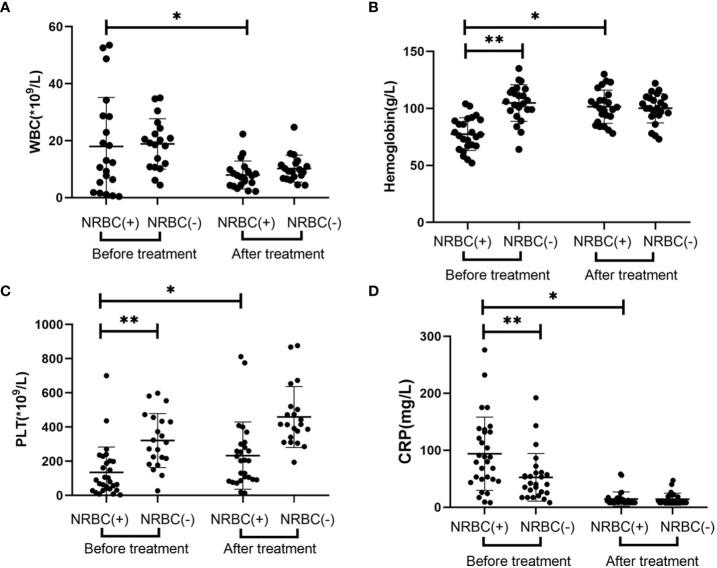
One hundred and fifteen children met the inclusion criteria in our study. Compared to negative NRBCs patients, the C-reactive protein, alanine transaminase, urea nitrogen values, mortality rate and length of hospitalization were found to be significantly increased, while platelet counts, and hemoglobin were significantly decreased in sepsis patients with positive NRBC ( < 0.05). Receiver operating characteristic (ROC) curves analysis showed that the optimal cutoff value of the NRBC count in the diagnosis of severe sepsis was 3, with a sensitivity of 87.5% and specificity of 94.9%. The area under the ROC curve was 0.877 (95% CI: 0.798-0.957).
DISCUSSION
These findings demonstrated that NRBC count has the potential to be a biomarker for the diagnosis of sepsis in children, especially an NRBC count greater than 3, which may predict the severity and poor prognosis in children suffering from sepsis.
简介
败血症是一种严重的疾病,死亡率很高。有核红细胞(NRBCs)存在于一些非传染性疾病中,但 NRBCs 与儿童败血症之间的关系尚不清楚。本研究旨在比较 NRBCs 阳性和 NRBCs 阴性败血症患儿的临床特征和结局,并进一步探讨 NRBCs 计数与败血症严重程度的关系。
方法
我们纳入了 2020 年 1 月至 2022 年 12 月期间在重庆医科大学儿童医院就诊的败血症患儿。记录并分析了患儿的临床资料、实验室数据和结局。
结果
本研究共纳入 115 例符合条件的患儿。与 NRBCs 阴性患儿相比,NRBCs 阳性患儿的 C 反应蛋白、丙氨酸转氨酶、尿素氮值、死亡率和住院时间明显增加,血小板计数和血红蛋白明显降低(<0.05)。受试者工作特征(ROC)曲线分析显示,NRBC 计数诊断严重败血症的最佳截断值为 3,其灵敏度为 87.5%,特异性为 94.9%。ROC 曲线下面积为 0.877(95%CI:0.798-0.957)。
讨论
这些发现表明,NRBC 计数有可能成为儿童败血症的诊断生物标志物,尤其是 NRBC 计数大于 3,可能预示着儿童败血症的严重程度和不良预后。



 Zotero 插件