
I/ Ib 期、开放性、多中心、剂量递增研究,评估抗 TGF-β 单克隆抗体 NIS793 联合 Spartalizumab 在晚期肿瘤成人患者中的疗效。
Phase I/Ib, open-label, multicenter, dose-escalation study of the anti-TGF-β monoclonal antibody, NIS793, in combination with spartalizumab in adult patients with advanced tumors.
机构信息
Sarah Cannon Research Institute, Nashville, Tennessee, USA.
Department of Biomedical Sciences, Humanitas University, Pieve Emanuele, Italy.
出版信息
J Immunother Cancer. 2023 Nov 29;11(11):e007353. doi: 10.1136/jitc-2023-007353.
BACKGROUND
NIS793 is a human IgG2 monoclonal antibody that binds to transforming growth factor beta (TGF-β). This first-in-human study investigated NIS793 plus spartalizumab treatment in patients with advanced solid tumors.
METHODS
Patients received NIS793 (0.3-1 mg/kg every 3 weeks (Q3W)) monotherapy; following evaluation of two dose levels, dose escalation continued with NIS793 plus spartalizumab (NIS793 0.3-30 mg/kg Q3W and spartalizumab 300 mg Q3W or NIS793 20-30 mg/kg every 2 weeks [Q2W] and spartalizumab 400 mg every 4 weeks (Q4W)). In dose expansion, patients with non-small cell lung cancer (NSCLC) resistant to prior anti-programmed death ligand 1 or patients with microsatellite stable colorectal cancer (MSS-CRC) were treated at the recommended dose for expansion (RDE).
RESULTS
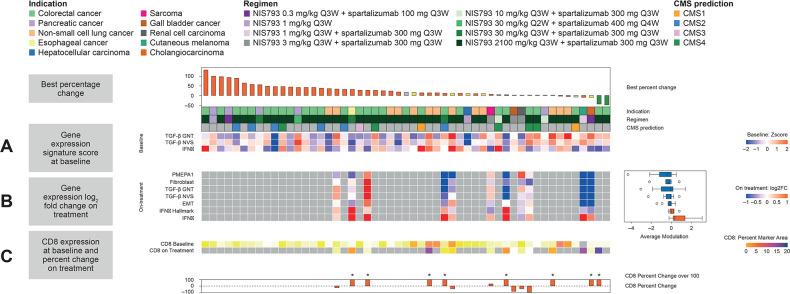
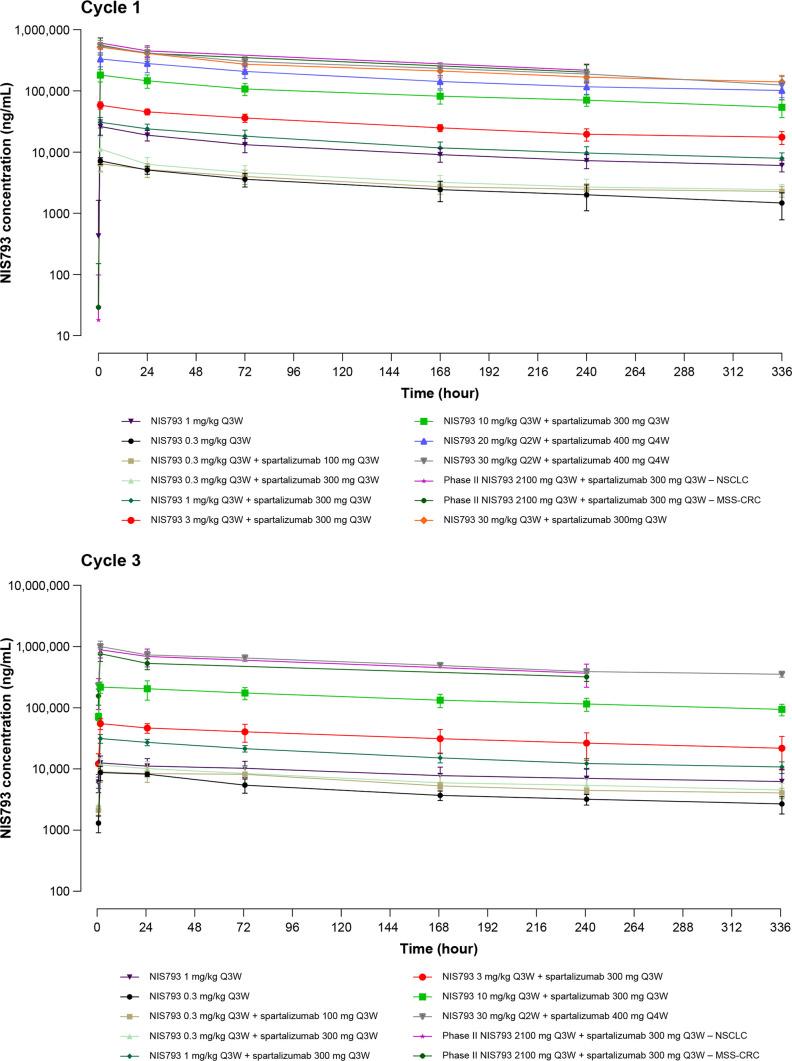
Sixty patients were treated in dose escalation, 11 with NIS793 monotherapy and 49 with NIS793 plus spartalizumab, and 60 patients were treated in dose expansion (MSS-CRC: n=40; NSCLC: n=20). No dose-limiting toxicities were observed. The RDE was established as NIS793 30 mg/kg (2100 mg) and spartalizumab 300 mg Q3W. Overall 54 (49.5%) patients experienced ≥1 treatment-related adverse event, most commonly rash (n=16; 13.3%), pruritus (n=10; 8.3%), and fatigue (n=9; 7.5%). Three partial responses were reported: one in renal cell carcinoma (NIS793 30 mg/kg Q2W plus spartalizumab 400 mg Q4W), and two in the MSS-CRC expansion cohort. Biomarker data showed evidence of target engagement through increased TGF-β/NIS793 complexes and depleted active TGF-β in peripheral blood. Gene expression analyses in tumor biopsies demonstrated decreased TGF-β target genes and signatures and increased immune signatures.
CONCLUSIONS
In patients with advanced solid tumors, proof of mechanism of NIS793 is supported by evidence of target engagement and TGF-β pathway inhibition.
TRIAL REGISTRATION NUMBER
NCT02947165.
背景
NIS793 是一种与人 IgG2 单克隆抗体结合的转化生长因子-β(TGF-β)。这项首次人体研究调查了 NIS793 联合斯帕塔卢单抗在晚期实体瘤患者中的治疗效果。
方法
患者接受 NIS793(0.3-1mg/kg,每 3 周[Q3W])单药治疗;在评估了两个剂量水平后,继续以 NIS793 加斯帕塔卢单抗(NIS793 0.3-30mg/kg,Q3W 和斯帕塔卢单抗 300mg,Q3W 或 NIS793 20-30mg/kg,每 2 周[Q2W]和斯帕塔卢单抗 400mg,每 4 周[Q4W])进行剂量递增。在剂量扩展中,对先前抗程序性死亡配体 1 耐药的非小细胞肺癌(NSCLC)患者或微卫星稳定结直肠癌(MSS-CRC)患者以扩展推荐剂量(RDE)进行治疗。
结果
在剂量递增中治疗了 60 例患者,11 例接受 NIS793 单药治疗,49 例接受 NIS793 加斯帕塔卢单抗治疗,在剂量扩展中治疗了 60 例患者(MSS-CRC:n=40;NSCLC:n=20)。未观察到剂量限制毒性。RDE 确定为 NIS793 30mg/kg(2100mg)和斯帕塔卢单抗 300mg,Q3W。共有 54 例(49.5%)患者发生≥1 例与治疗相关的不良事件,最常见的是皮疹(n=16;13.3%)、瘙痒(n=10;8.3%)和疲劳(n=9;7.5%)。报告了 3 例部分缓解:1 例为肾细胞癌(NIS793 30mg/kg,Q2W 加斯帕塔卢单抗 400mg,Q4W),2 例为 MSS-CRC 扩展队列。生物标志物数据表明通过增加 TGF-β/NIS793 复合物和耗尽外周血中的活性 TGF-β,证明了靶标结合。肿瘤活检的基因表达分析表明 TGF-β 靶基因和特征减少,免疫特征增加。
结论
在晚期实体瘤患者中,NIS793 的机制证明得到了靶标结合和 TGF-β 途径抑制的证据支持。
试验注册
NCT02947165。


 Zotero 插件