
将废弃聚对苯二甲酸乙二酯微生物转化为己二酸
Microbial Upcycling of Waste PET to Adipic Acid.
作者信息
Valenzuela-Ortega Marcos, Suitor Jack T, White Mirren F M, Hinchcliffe Trevor, Wallace Stephen
机构信息
Institute of Quantitative Biology, Biochemistry and Biotechnology, School of Biological Sciences, University of Edinburgh, Alexander Crum Brown Road, King's Buildings, Edinburgh, EH9 3FF, U.K.
Impact Solutions Ltd., Impact Technology Centre, Fraser Road, Kirkton Campus, Livingston, EH54 7BU, U.K.
出版信息
ACS Cent Sci. 2023 Nov 1;9(11):2057-2063. doi: 10.1021/acscentsci.3c00414. eCollection 2023 Nov 22.
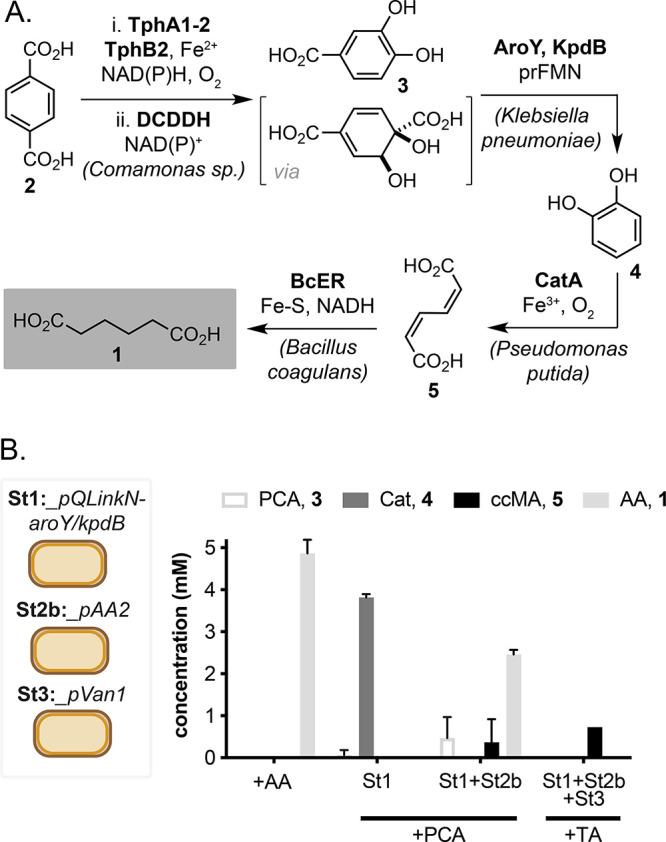
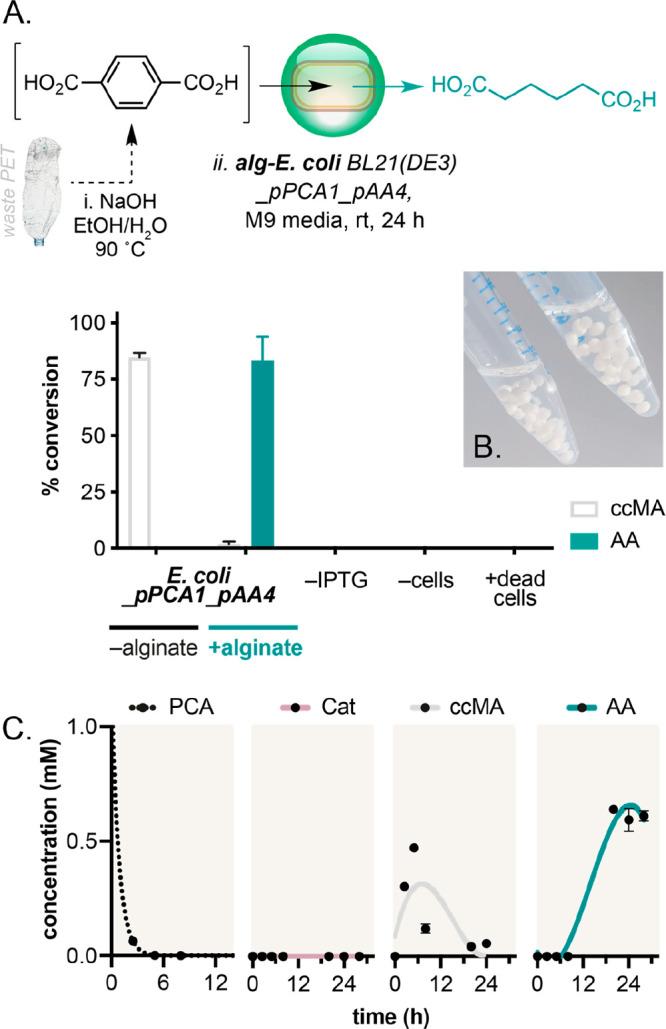
Microorganisms can be genetically engineered to transform abundant waste feedstocks into value-added small molecules that would otherwise be manufactured from diminishing fossil resources. Herein, we report the first one-pot bio-upcycling of PET plastic waste into the prolific platform petrochemical and nylon precursor adipic acid in the bacterium . Optimizing heterologous gene expression and enzyme activity enabled increased flux through the pathway, and immobilization of whole cells in alginate hydrogels increased the stability of the rate-limiting enoate reductase BcER. The pathway enzymes were also interfaced with hydrogen gas generated by engineered DD-2 in combination with a biocompatible Pd catalyst to enable adipic acid synthesis from metabolic ,-muconic acid. Together, these optimizations resulted in a one-pot conversion to adipic acid from terephthalic acid, including terephthalate samples isolated from industrial PET waste and a post-consumer plastic bottle.
微生物可以通过基因工程进行改造,将丰富的废弃原料转化为增值小分子,否则这些小分子将由日益减少的化石资源制造。在此,我们报告了首次在细菌中将聚对苯二甲酸乙二酯(PET)塑料废物一锅法生物升级循环转化为多产的平台石化产品和尼龙前体己二酸。优化异源基因表达和酶活性可增加通过该途径的通量,并且将全细胞固定在藻酸盐水凝胶中可提高限速烯醇还原酶BcER的稳定性。该途径的酶还与工程化的DD-2产生的氢气以及生物相容性钯催化剂相结合,以实现由代谢产生的衣康酸合成己二酸。这些优化共同实现了从对苯二甲酸一锅法转化为己二酸,包括从工业PET废物和消费后塑料瓶中分离出的对苯二甲酸酯样品。




 Zotero 插件