
生物制剂和Janus激酶抑制剂用于特应性皮炎患者的短期疗效和安全性:一项系统评价和荟萃分析
Short-term efficacy and safety of biologics and Janus kinase inhibitors for patients with atopic dermatitis: A systematic review and meta-analysis.
作者信息
Chen Qianyu, Cui Lian, Hu Yifan, Chen Zeyu, Gao Yunlu, Shi Yuling
机构信息
Department of Dermatology, Shanghai Skin Disease Hospital, Tongji University School of Medicine, 200443, Shanghai, China.
Institute of Psoriasis, Tongji University School of Medicine, Shanghai, China.
出版信息
Heliyon. 2023 Nov 8;9(11):e22014. doi: 10.1016/j.heliyon.2023.e22014. eCollection 2023 Nov.
BACKGROUND
In recent years, biologics targeting key cytokines and Janus kinase (JAK) inhibitors have demonstrated favorable efficacy and safety outcomes for atopic dermatitis (AD) therapy. To evaluate the short-term efficacy and safety of AD therapy involving biologics, JAK inhibitors, and their combination with topical corticosteroids (TCS) for patients with AD, we conducted this systematic review and meta-analysis. Using eligible randomized clinical trials (RCTs) of 12 or 16 weeks of treatment with systemic medications and 4 weeks of topical treatment for AD.
METHODS
PubMed, Web of Science, ScienceDirect, and the Cochrane Library were searched from inception up to October 25, 2023. English-language randomized clinical trials (RCTs) of 12 or 16 weeks of treatment with systemic medications and 4 weeks of topical treatment for AD were included. Titles, abstracts, and articles were screened in duplicate. Of 7261 citations, 37 studies were included. The data were analyzed using Review Manager 5.4 and the outcomes were measured by the Eczema Area and Severity Index (EASI), Investigator Global Assessment (IGA), the pruritus Numerical Rating Scale (NRS), as well as instances of adverse events (AE), and serious AE (SAE), which were presented as risk ratio (RR) with a 95 % confidence interval (CI). The efficacy of the biological therapies was analyzed with the percentage of patients who have achieved EASI 75, EASI 90, IGA 0/1 and pruritus NRS4, while the safety of treatments was evaluated in terms of the number of patients who had ≥1 AE and who had at least one SAE.
RESULTS
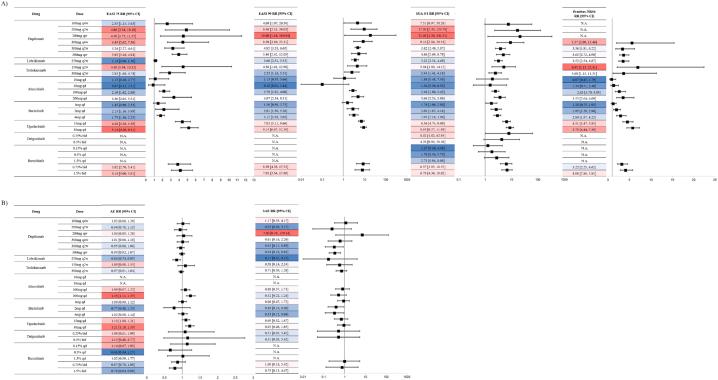
A total of 37 studies with 43 cohorts that examined 9 medications and placebo and involved 18172 participants were included. Compared with the placebo, all biologics and JAK inhibitors were associated with a higher response rate in efficacy outcomes, while systematic administration was presented by dupilumab 200 mg subcutaneously every 2 weeks with superior improvement in EASI 90 (RR 9.50, 95 % CI 2.31-39.03) and IGA0/1 (RR 17.00, 95 % CI 2.33-123.78), upadacitinib 30 mg once daily in EASI 75 (RR 5.14, 95 % CI 4.20-6.31) and Pruritus NRS4 (RR 5.73, 95 % CI 4.44-7.39), and external use was presented by ruxolitinib 1.5 % twice daily orally in EASI 75 (RR 4.14, 95 % CI 3.06-5.61) and Pruritus NRS4 (RR 4.08, 95 % CI 2.86-5.81), and most of doses led to a better safety profile. Most doses of baricitinib, dupilumab, tralokinumab, and upadacitinib in combination with TCS demonstrated good efficacy as compared with the control groups (placebo + TCS). However, patients receiving baricitinib at a dosage of 2 mg daily (RR 1.23, 95 % CI 1.02-1.49) and 4 mg daily (RR 1.39, 95 % CI 1.22-1.58) in combination with TCS, exhibited a higher incidence of one or more SAE as compared with those taking placebo + TCS.
CONCLUSION
Our research has revealed that ruxolitinib and dupilumab are effective and safe treatments for mild to moderate AD and moderate to severe AD, respectively. Additionally, the combination of dupilumab and TCS demonstrates greater efficacy and safety compared to baricitinib, tralokinumab, and upadacitinib with TCS as a background treatment for moderate to severe AD. We suggest that the use of topical JAK inhibitors could be a potential alternative to TCS when used in combination with systemic medications, as a novel approach to treat AD. Insufficient different data sources caused by partial interventions were only mentioned in a few articles and low event rates in safety analyses may lead to the results being biased. Further studies directly comparing existing and novel treatments are needed and will be included in forthcoming updates of this review. Our findings could form a useful foundation for developing a new generation of treatment guidelines for AD.
背景
近年来,靶向关键细胞因子的生物制剂和Janus激酶(JAK)抑制剂在特应性皮炎(AD)治疗中显示出良好的疗效和安全性。为了评估生物制剂、JAK抑制剂及其与外用糖皮质激素(TCS)联合治疗AD患者的短期疗效和安全性,我们进行了这项系统评价和荟萃分析。纳入了符合条件的关于AD全身用药治疗12周或16周以及局部治疗4周的随机临床试验(RCT)。
方法
检索了PubMed、Web of Science、ScienceDirect和Cochrane图书馆,检索时间从建库至2023年10月25日。纳入了关于AD全身用药治疗12周或16周以及局部治疗4周的英文随机临床试验(RCT)。对标题、摘要和文章进行了重复筛选。在7261条引用中,纳入了37项研究。使用Review Manager 5.4进行数据分析,结局指标采用湿疹面积和严重程度指数(EASI)、研究者整体评估(IGA)、瘙痒数字评定量表(NRS)以及不良事件(AE)和严重不良事件(SAE)的发生情况,以风险比(RR)及95%置信区间(CI)表示。分析生物治疗的疗效时采用达到EASI 75、EASI 90、IGA 0/1和瘙痒NRS4的患者百分比,而治疗安全性则根据发生≥1次AE和至少1次SAE的患者数量进行评估。
结果
共纳入37项研究,涉及43个队列,研究了9种药物和安慰剂,共18172名参与者。与安慰剂相比,所有生物制剂和JAK抑制剂在疗效结局方面的反应率更高,其中系统性给药方面,每2周皮下注射200mg度普利尤单抗在EASI 90(RR 9.50,95%CI 2.31 - 39.03)和IGA0/1(RR 17.00,95%CI 2.33 - 123.78)方面改善更优,每日一次口服30mg乌帕替尼在EASI 75(RR 5.14,95%CI 4.20 - 6.31)和瘙痒NRS4(RR 5.73,95%CI 4.44 - 7.39)方面表现更佳,外用方面,每日两次口服1.5%芦可替尼在EASI 75(RR 4.14,95%CI 3.06 - 5.61)和瘙痒NRS4(RR 4.08,95%CI 2.86 - 5.81)方面效果较好,且大多数剂量的安全性更好。与对照组(安慰剂 + TCS)相比,大多数剂量的巴瑞替尼、度普利尤单抗、曲罗芦单抗和乌帕替尼与TCS联合使用显示出良好的疗效。然而,每日服用2mg(RR 1.23,95%CI 1.02 - 1.49)和4mg(RR 1.39,95%CI 1.22 - 1.58)巴瑞替尼联合TCS的患者,与服用安慰剂 + TCS的患者相比,发生一种或多种SAE的发生率更高。
结论
我们的研究表明,芦可替尼和度普利尤单抗分别是治疗轻度至中度AD和中度至重度AD的有效且安全的疗法。此外,与以TCS为背景治疗的中度至重度AD患者使用巴瑞替尼、曲罗芦单抗和乌帕替尼相比,度普利尤单抗与TCS联合使用显示出更高的疗效和安全性。我们建议,局部使用JAK抑制剂与全身用药联合使用时,可能是TCS的一种潜在替代方法,作为治疗AD的一种新方法。部分干预导致的不同数据源不足仅在少数文章中提及,且安全性分析中的低事件发生率可能导致结果存在偏差。需要进一步开展直接比较现有治疗和新治疗的研究,并将纳入本综述的后续更新中。我们的研究结果可为制定新一代AD治疗指南提供有用的基础。


 Zotero 插件