
追踪 2023 年流感季及以后黎巴嫩的 SARS-CoV-2 变异株。
Tracking SARS-CoV-2 variants during the 2023 flu season and beyond in Lebanon.
机构信息
Department of Natural Sciences, School of Arts and Sciences, Lebanese American University, Lebanon.
School of Medicine, Lebanese American University, Lebanon.
出版信息
Virus Res. 2024 Jan 2;339:199289. doi: 10.1016/j.virusres.2023.199289. Epub 2023 Dec 2.
BACKGROUND
Early SARS-CoV-2 variant detection relies on testing and genomic surveillance. The Omicron variant (B.1.1.529) has quickly become the dominant type among the previous circulating variants worldwide. Several subvariants have emerged exhibiting greater infectivity and immune evasion. In this study we aimed at studying the prevalence of the Omicron subvariants during the flu season and beyond in Lebanon through genomic screening and at determining the overall standing and trajectory of the pandemic in the country.
METHODS
A total of 155 SARS-CoV-2 RNA samples were sequenced, using Nanopore sequencing technology.
RESULTS
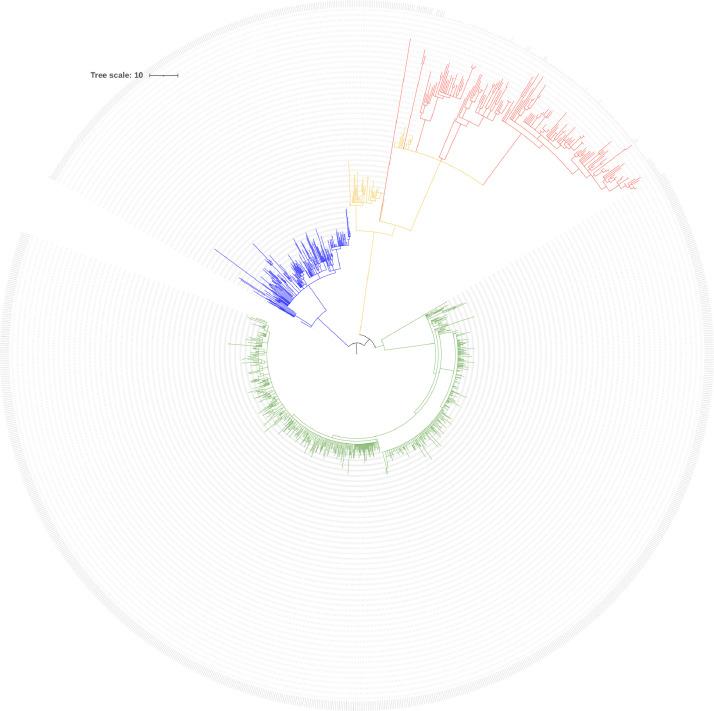
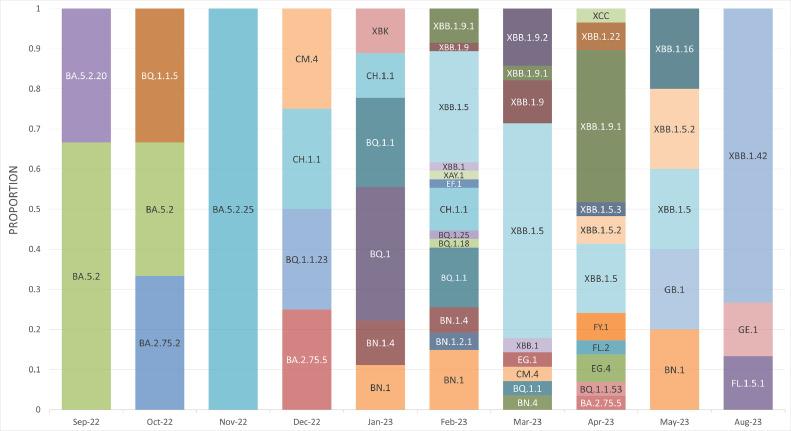
Nanopore sequencing of 155 genomes revealed their distribution over 39 Omicron variants. XBB.1.5 (23.29 %) was the most common, followed by XBB.1.9.1 (10.96 %) and XBB.1.42 (7.5 %). The first batch collected between September and November 2022, included the BA.2.75.2, BA.5.2, BA.5.2.20, BA.5.2.25 and BQ.1.1.5 lineages. Between December 2022 and January 2023, those lineages were replaced by BA.2.75.5, BN.1, BN.1.4, BQ.1, BQ.1.1, BQ.1.1.23, CH.1.1, CM.4 and XBK. Starting February 2023, we observed a gradual emergence and dominance of the recombinant XBB and its sub-lineages (XBB.1, XBB.1.5, XBB.1.5.2, XBB.1.5.3, XBB.1.9, XBB.1.9.1, XBB.1.9.2, XBB.1.16, XBB.1.22 and XBB.1.42).
CONCLUSIONS
The timely detection and characterization of SARS-CoV-2 variants is important to reduce transmission through established disease control measures and to avoid introductions into animal populations that could lead to serious public health implications.
背景
早期 SARS-CoV-2 变体检测依赖于检测和基因组监测。奥密克戎变体(B.1.1.529)已迅速成为全球以前流行变体中的主要类型。已经出现了几种亚变体,表现出更高的传染性和免疫逃避性。在这项研究中,我们旨在通过基因组筛查研究奥密克戎亚变体在黎巴嫩流感季节及以后的流行情况,并确定该国大流行的总体状况和轨迹。
方法
使用纳米孔测序技术对总共 155 个 SARS-CoV-2 RNA 样本进行测序。
结果
对 155 个基因组的纳米孔测序显示,它们分布在 39 种奥密克戎变体中。XBB.1.5(23.29%)最为常见,其次是 XBB.1.9.1(10.96%)和 XBB.1.42(7.5%)。2022 年 9 月至 11 月采集的第一批样本包括 BA.2.75.2、BA.5.2、BA.5.2.20、BA.5.2.25 和 BQ.1.1.5 谱系。2022 年 12 月至 2023 年 1 月,这些谱系被 BA.2.75.5、BN.1、BN.1.4、BQ.1、BQ.1.1、BQ.1.1.23、CH.1.1、CM.4 和 XBK 取代。从 2023 年 2 月开始,我们观察到重组 XBB 及其亚谱系(XBB.1、XBB.1.5、XBB.1.5.2、XBB.1.5.3、XBB.1.9、XBB.1.9.1、XBB.1.9.2、XBB.1.16、XBB.1.22 和 XBB.1.42)的逐渐出现和主导地位。
结论
及时检测和描述 SARS-CoV-2 变体对于通过既定的疾病控制措施减少传播以及避免引入可能对公共卫生造成严重影响的动物种群非常重要。

 Zotero 插件