
用于 BCG 无应答的高危非肌肉浸润性膀胱癌的新型免疫治疗选择。
Novel immunotherapeutic options for BCG-unresponsive high-risk non-muscle-invasive bladder cancer.
机构信息
Faculty of Medicine, Al Andalus University for Medical Sciences, Tartus, Syrian Arab Republic.
Cancer Research Center, Tishreen University, Lattakia, Syrian Arab Republic.
出版信息
Cancer Med. 2023 Dec;12(24):21944-21968. doi: 10.1002/cam4.6768. Epub 2023 Dec 1.
BACKGROUND
High-risk non-muscle-invasive bladder cancer (HR-NMIBC) presents a challenge to many physicians due to its ability to resist Bacillus Calmette-Guérin (BCG) intravesical therapy and the substantial rate of progression into muscle-invasive bladder cancer (MIBC). Patients who are BCG-unresponsive have worse prognosis and thus require further management including radical cystectomy (RC), which significantly impacts quality of life. Moreover, the ongoing worldwide shortage of BCG warrants the need for policies that prioritize drug use and utilize alternative treatment strategies. Hence, there is a significant unmet need for bladder preserving therapy in this subset of patients.
METHODS
To address this issue, we searched the relevant literature in PUBMED for articles published from 2019 through May of 2023 using appropriate keywords. All clinical trials of patients with HR-NMIBC treated with immune-related agents were retrieved from clinicaltrials.gov.
FINDINGS AND FUTURE PERSPECTIVES
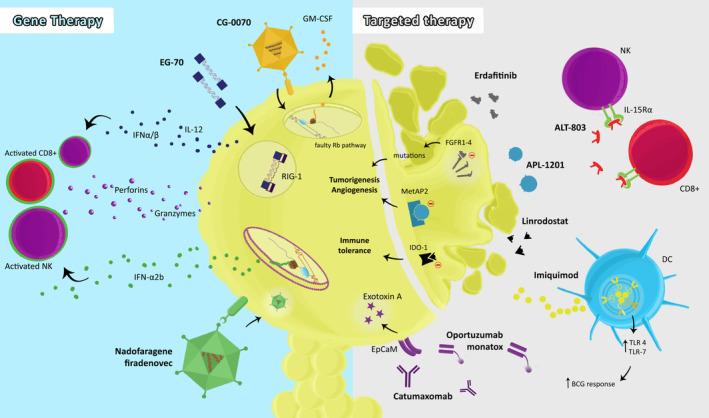
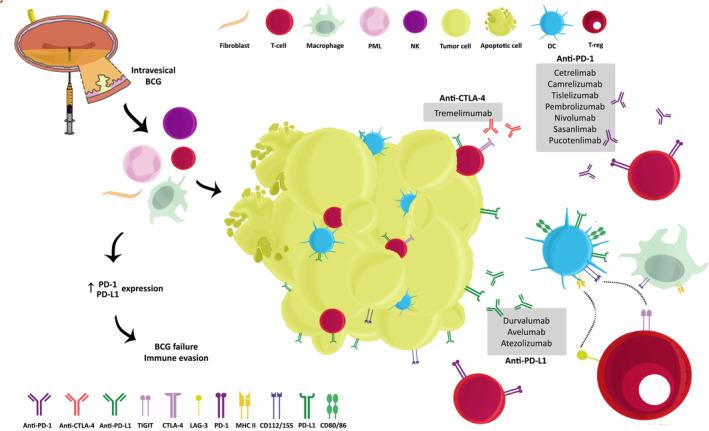
Exploratory treatments for BCG-Unresponsive HR-NMIBC included immune checkpoint inhibitors (ICI), oncolytic viral therapy, cytokine agonists, and other immunomodulators targeting TLR, EpCaM, FGFR, MetAP2, and IDO1. Some combination therapies have been found to work synergistically and are preferred therapeutically over monotherapy. Three drugs-pembrolizumab, valrubicin, and most recently, nadofaragene firadenovec-vncg-have been FDA approved for the treatment of BCG-unresponsive NMIBC in patients who are ineligible for or decline RC. However, all explored treatment options tend to postpone RC rather than provide long-term disease control. Additional combination strategies need to be studied to enhance the effects of immunotherapy. Despite the challenges faced in finding effective therapies, many potential treatments are currently under investigation. Addressing the landscape of biomarkers, mechanisms of progression, BCG resistance, and trial design challenges in HR-NMIBC is essential for the discovery of new targets and the development of effective treatments.
背景
高危非肌肉浸润性膀胱癌(HR-NMIBC)因其对卡介苗(BCG)膀胱内治疗的抵抗力以及向肌肉浸润性膀胱癌(MIBC)进展的高比率,给许多医生带来了挑战。对 BCG 无反应的患者预后更差,因此需要进一步治疗,包括根治性膀胱切除术(RC),这显著影响生活质量。此外,全球范围内卡介苗持续短缺,需要制定优先使用药物和利用替代治疗策略的政策。因此,这部分患者对保留膀胱的治疗存在显著的未满足需求。
方法
为了解决这个问题,我们在 PUBMED 中使用适当的关键词搜索了 2019 年至 2023 年 5 月发表的相关文献,并从 clinicaltrials.gov 检索了所有用免疫相关药物治疗 HR-NMIBC 患者的临床试验。
结果和未来展望
针对 BCG 无反应的 HR-NMIBC 的探索性治疗包括免疫检查点抑制剂(ICI)、溶瘤病毒治疗、细胞因子激动剂和其他针对 TLR、EpCaM、FGFR、MetAP2 和 IDO1 的免疫调节剂。一些联合疗法已被发现具有协同作用,在治疗上优于单药治疗。三种药物——帕博利珠单抗、伐昔洛韦和最近的那多伐珠单抗——已被 FDA 批准用于治疗不适合或拒绝 RC 的 BCG 无反应性 NMIBC 患者。然而,所有探索的治疗方法往往只是推迟了 RC,而不能提供长期疾病控制。需要进一步研究联合策略以增强免疫治疗的效果。尽管在寻找有效疗法方面面临挑战,但目前仍有许多潜在的治疗方法正在研究中。解决 HR-NMIBC 中的生物标志物、进展机制、BCG 耐药性和试验设计挑战的问题,对于发现新的靶点和开发有效的治疗方法至关重要。
 Zotero 插件