
老年人纵向睡眠模式与认知障碍。
Longitudinal Sleep Patterns and Cognitive Impairment in Older Adults.
机构信息
VISN 20 Northwest Mental Illness Research, Education and Clinical Center (MIRECC), VA Puget Sound Health Care System, Seattle, Washington.
Department of Psychiatry and Behavioral Sciences, University of Washington School of Medicine, Seattle.
出版信息
JAMA Netw Open. 2023 Dec 1;6(12):e2346006. doi: 10.1001/jamanetworkopen.2023.46006.
IMPORTANCE
Sleep disturbances and clinical sleep disorders are associated with all-cause dementia and neurodegenerative conditions, but it remains unclear how longitudinal changes in sleep impact the incidence of cognitive impairment.
OBJECTIVE
To evaluate the association of longitudinal sleep patterns with age-related changes in cognitive function in healthy older adults.
DESIGN, SETTING, AND PARTICIPANTS: This cross-sectional study is a retrospective longitudinal analyses of the Seattle Longitudinal Study (SLS), which evaluated self-reported sleep duration (1993-2012) and cognitive performance (1997-2020) in older adults. Participants within the SLS were enrolled as part of a community-based cohort from the Group Health Cooperative of Puget Sound and Health Maintenance Organization of Washington between 1956 and 2020. Data analysis was performed from September 2020 to May 2023.
MAIN OUTCOMES AND MEASURES
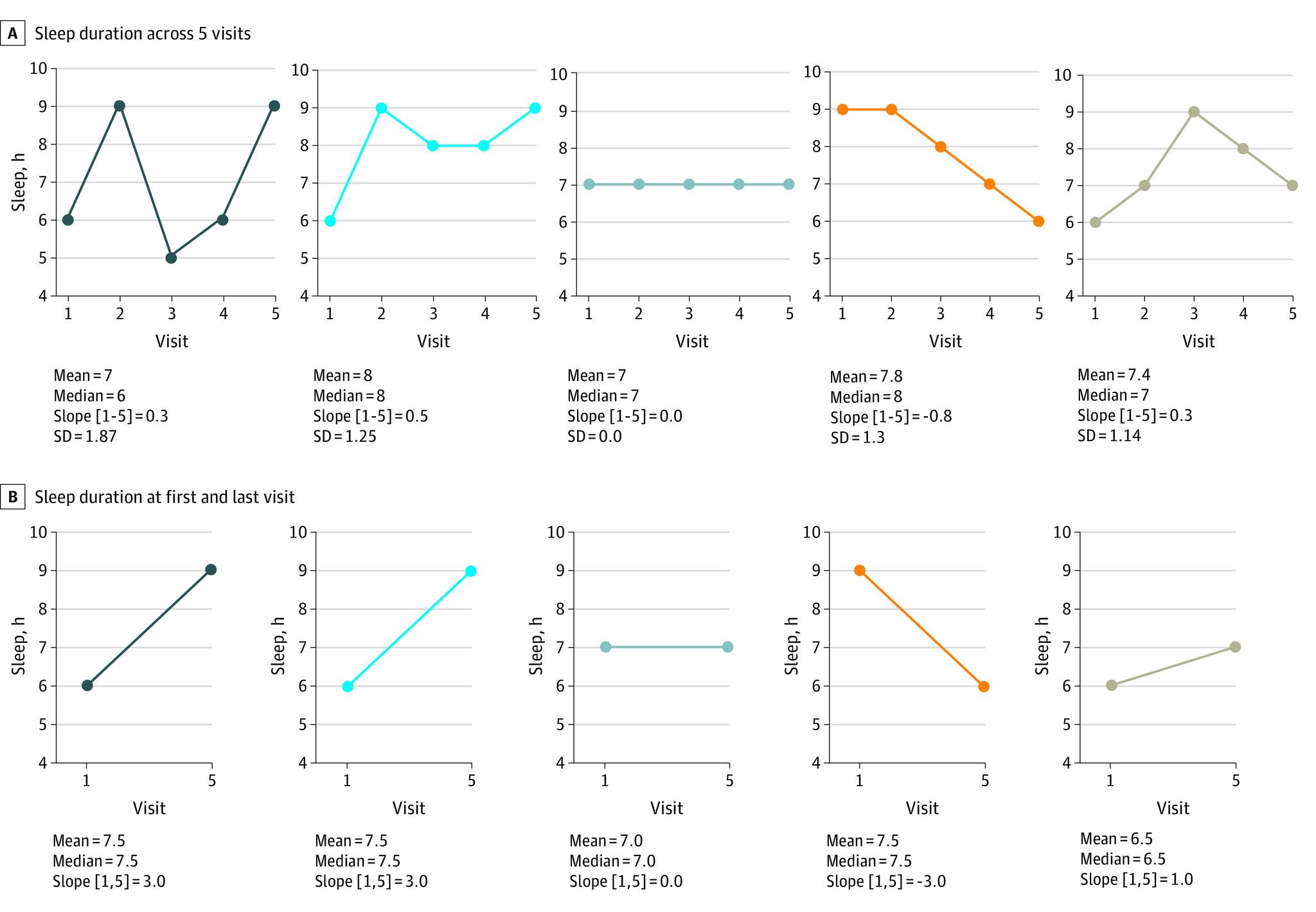
The main outcome for this study was cognitive impairment, as defined by subthreshold performance on both the Mini-Mental State Examination and the Mattis Dementia Rating Scale. Sleep duration was defined by self-report of median nightly sleep duration over the last week and was assessed longitudinally over multiple time points. Median sleep duration, sleep phenotype (short sleep, median ≤7 hours; medium sleep, median = 7 hour; long sleep, median ≥7 hours), change in sleep duration (slope), and variability in sleep duration (SD of median sleep duration, or sleep variability) were evaluated.
RESULTS
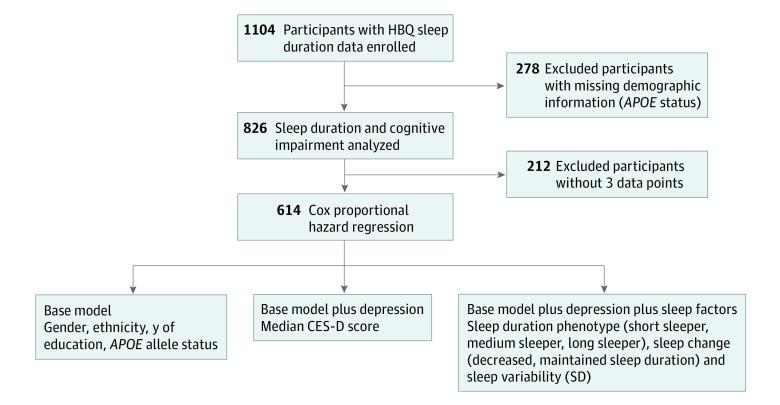
Of the participants enrolled in SLS, only 1104 participants who were administered both the Health Behavior Questionnaire and the neuropsychologic battery were included for analysis in this study. A total of 826 individuals (mean [SD] age, 76.3 [11.8] years; 468 women [56.7%]; 217 apolipoprotein E ε4 allele carriers [26.3%]) had complete demographic information and were included in the study. Analysis using a Cox proportional hazard regression model (concordance, 0.76) showed that status as a short sleeper (hazard ratio, 3.67; 95% CI, 1.59-8.50) and higher sleep variability (hazard ratio, 3.06; 95% CI, 1.14-5.49) were significantly associated with the incidence of cognitive impairment.
CONCLUSIONS AND RELEVANCE
In this community-based longitudinal study of the association between sleep patterns and cognitive performance, the short sleep phenotype was significantly associated with impaired cognitive performance. Furthermore, high sleep variability in longitudinal sleep duration was significantly associated with the incidence of cognitive impairment, highlighting the possibility that instability in sleep duration over long periods of time may impact cognitive decline in older adults.
重要性
睡眠障碍和临床睡眠障碍与全因痴呆和神经退行性疾病有关,但目前尚不清楚睡眠的纵向变化如何影响认知障碍的发生。
目的
评估健康老年人中纵向睡眠模式与年龄相关的认知功能变化之间的关系。
设计、地点和参与者:这是一项横断面研究,是西雅图纵向研究(SLS)的回顾性纵向分析,该研究评估了老年人的自我报告睡眠时间(1993-2012 年)和认知表现(1997-2020 年)。SLS 中的参与者是作为 1956 年至 2020 年间社区为基础的 Puget Sound 集团健康合作组织和华盛顿健康维护组织队列的一部分招募的。数据分析于 2020 年 9 月至 2023 年 5 月进行。
主要结果和措施
本研究的主要结果是认知障碍,定义为简易精神状态检查和 Mattis 痴呆评定量表的亚阈值表现。睡眠时间通过过去一周每晚的中位数睡眠时间自我报告,并在多个时间点进行纵向评估。评估了中位数睡眠时间、睡眠表型(短睡眠,中位数≤7 小时;中睡眠,中位数=7 小时;长睡眠,中位数≥7 小时)、睡眠时间变化(斜率)和睡眠时间变异性(中位数睡眠时间的标准差,或睡眠变异性)。
结果
在参加 SLS 的参与者中,只有接受了健康行为问卷和神经心理测试的 1104 名参与者被纳入本研究进行分析。共有 826 人(平均[标准差]年龄,76.3[11.8]岁;468 名女性[56.7%];217 名载脂蛋白 E ε4 等位基因携带者[26.3%])有完整的人口统计学信息并被纳入研究。使用 Cox 比例风险回归模型(一致性,0.76)分析显示,作为短睡眠者(风险比,3.67;95%CI,1.59-8.50)和更高的睡眠变异性(风险比,3.06;95%CI,1.14-5.49)与认知障碍的发生显著相关。
结论和相关性
在这项基于社区的纵向研究中,研究了睡眠模式与认知表现之间的关系,短睡眠表型与认知表现受损显著相关。此外,纵向睡眠时间的高睡眠变异性与认知障碍的发生显著相关,这突出表明,长时间内睡眠持续时间的不稳定性可能会影响老年人的认知能力下降。

 Zotero 插件