
CD20 表达缺失是复发/难治性 B 细胞淋巴瘤对 mosunetuzumab 产生耐药的机制。
Loss of CD20 expression as a mechanism of resistance to mosunetuzumab in relapsed/refractory B-cell lymphomas.
机构信息
Lymphoma Program, Abramson Cancer Center, University of Pennsylvania, Philadelphia, PA.
Genentech, Inc., South San Francisco, CA.
出版信息
Blood. 2024 Feb 29;143(9):822-832. doi: 10.1182/blood.2023022348.
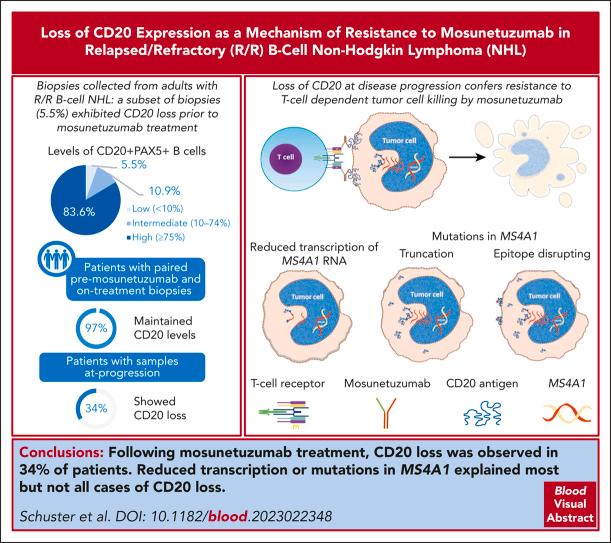
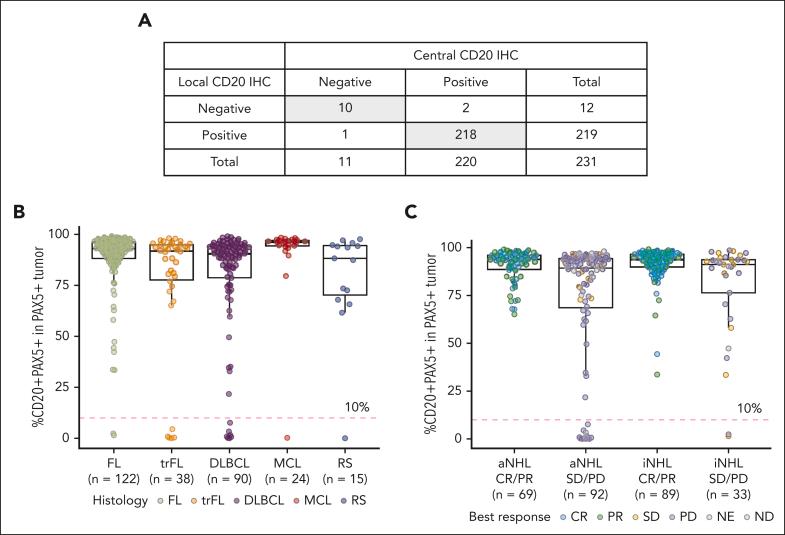
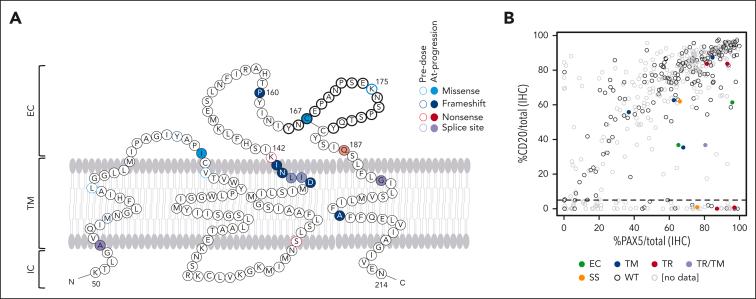
CD20 is an established therapeutic target in B-cell malignancies. The CD20 × CD3 bispecific antibody mosunetuzumab has significant efficacy in B-cell non-Hodgkin lymphomas (NHLs). Because target antigen loss is a recognized mechanism of resistance, we evaluated CD20 expression relative to clinical response in patients with relapsed and/or refractory NHL in the phase 1/2 GO29781 trial investigating mosunetuzumab monotherapy. CD20 was studied using immunohistochemistry (IHC), RNA sequencing, and whole-exome sequencing performed centrally in biopsy specimens collected before treatment at predose, during treatment, or upon progression. Before treatment, most patients exhibited a high proportion of tumor cells expressing CD20; however, in 16 of 293 patients (5.5%) the proportion was <10%. Analyses of paired biopsy specimens from patients on treatment revealed that CD20 levels were maintained in 29 of 30 patients (97%) vs at progression, where CD20 loss was observed in 11 of 32 patients (34%). Reduced transcription or acquisition of truncating mutations explained most but not all cases of CD20 loss. In vitro modeling confirmed the effects of CD20 variants identified in clinical samples on reduction of CD20 expression and missense mutations in the extracellular domain that could block mosunetuzumab binding. This study expands the knowledge about the occurrence of target antigen loss after anti-CD20 therapeutics to include CD20-targeting bispecific antibodies and elucidates mechanisms of reduced CD20 expression at disease progression that may be generalizable to other anti-CD20 targeting agents. These results also confirm the utility of readily available IHC staining for CD20 as a tool to inform clinical decisions. This trial was registered at www.ClinicalTrials.gov as #NCT02500407.
CD20 是 B 细胞恶性肿瘤的既定治疗靶点。CD20×CD3 双特异性抗体 mosunetuzumab 在 B 细胞非霍奇金淋巴瘤 (NHL) 中具有显著疗效。由于靶抗原丢失是公认的耐药机制,我们评估了在研究 mosunetuzumab 单药治疗的复发和/或难治性 NHL 患者中,相对于临床反应的 CD20 表达。在治疗前、治疗期间或进展时,使用中央进行的免疫组织化学 (IHC)、RNA 测序和全外显子组测序,在活检标本中研究 CD20。在治疗前,大多数患者的肿瘤细胞高比例表达 CD20;然而,在 293 名患者中的 16 名(5.5%)比例<10%。对接受治疗的患者配对活检标本的分析表明,在 30 名患者中的 29 名(97%)与进展时相比,CD20 水平保持不变,在 32 名患者中的 11 名(34%)中观察到 CD20 丢失。大多数但不是所有 CD20 丢失病例都可以用转录减少或获得截断突变来解释。体外模型证实了在临床样本中鉴定的 CD20 变体对减少 CD20 表达和可能阻断 mosunetuzumab 结合的细胞外结构域中的错义突变的影响。这项研究扩展了关于抗 CD20 治疗后靶抗原丢失的发生的知识,包括 CD20 靶向双特异性抗体,并阐明了疾病进展时 CD20 表达减少的机制,这些机制可能推广到其他抗 CD20 靶向药物。这些结果还证实了易于获得的 CD20 IHC 染色作为告知临床决策的工具的实用性。该试验在 www.ClinicalTrials.gov 上注册为 #NCT02500407。



 Zotero 插件