
南非儿童在 COVID-19 大流行前后的鼻咽细菌定植:一项观察性研究。
Bacterial nasopharyngeal colonisation in children in South Africa before and during the COVID-19 pandemic: an observational study.
机构信息
South Africa Medical Research Council Vaccines and Infectious Diseases Analytics Research Unit, University of the Witwatersrand, Faculty of Health Science, Johannesburg, South Africa; Department of Science-National Research Foundation, Vaccine Preventable Diseases, University of the Witwatersrand, Faculty of Health Science, Johannesburg, South Africa.
South Africa Medical Research Council Vaccines and Infectious Diseases Analytics Research Unit, University of the Witwatersrand, Faculty of Health Science, Johannesburg, South Africa; Department of Science-National Research Foundation, Vaccine Preventable Diseases, University of the Witwatersrand, Faculty of Health Science, Johannesburg, South Africa; Centre of Excellence in Respiratory Pathogens, Hospices Civils de Lyon, and Centre International de Recherche en Infectiologie, Inserm, U1111, Université Claude Bernard Lyon 1, CNRS, UMR5308, Lyon, France.
出版信息
Lancet Microbe. 2024 Jan;5(1):e34-e42. doi: 10.1016/S2666-5247(23)00260-4. Epub 2023 Dec 1.
BACKGROUND
Deployment of non-pharmaceutical interventions such as face masking and physical distancing during the COVID-19 pandemic could have altered the transmission dynamics and carriage of respiratory organisms. We evaluated colonisation with Streptococcus pneumoniae and other upper respiratory tract bacterial colonisers before and during the COVID-19 pandemic.
METHODS
We did two cross-sectional surveys in Soweto, South Africa from July 3 to Dec 13, 2018 (pre-COVID-19 period) and from Aug 4, 2021, to March 31, 2022 (COVID-19 period) in healthy children (aged ≤60 months) who had recorded HIV status and had not received antibiotics in the 21 days before enrolment. At enrolment, we collected nasopharyngeal swab samples from child participants. Following nucleic acid extraction, nanofluidic quantitative PCR was used to screen all samples for 92 S pneumoniae serotypes and 14 other bacteria. The primary objective was to compare the prevalence and density of pneumococcal nasopharyngeal colonisation, overall and stratified by 13-valent pneumococcal conjugate vaccine (PCV13) serotypes and non-vaccine serotypes. Secondary study objectives included a comparison of serotype-specific pneumococcal colonisation and density, as well as colonisation by the 14 other bacteria in the COVID-19 versus pre-COVID-19 period. We used an adjusted multiple logistic and linear regression model to compare the colonisation prevalence and density between study periods.
FINDINGS
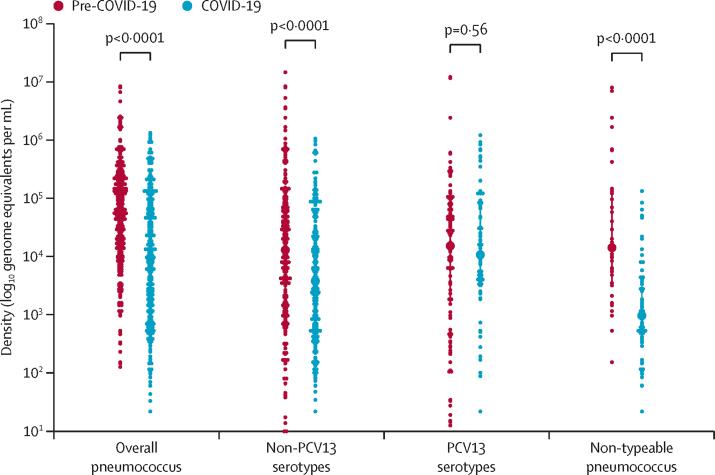
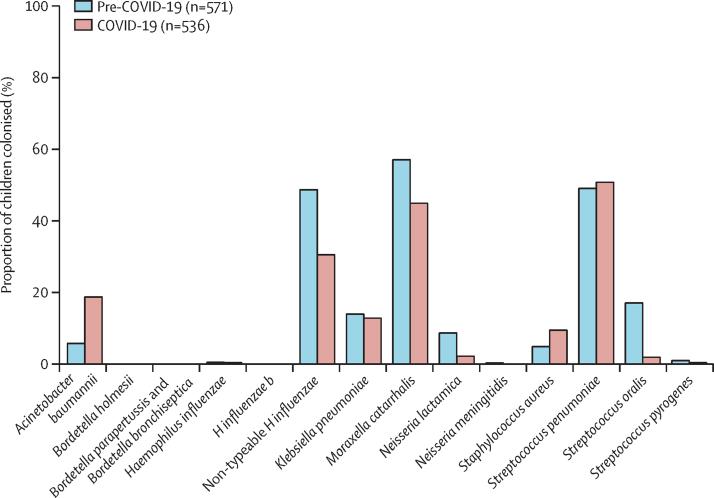
We analysed nasopharyngeal swabs from 1107 children (n=571 in the pre-COVID-19 period; n=536 in the COVID-19 period). We observed no change in overall pneumococcal colonisation between periods (274 [51%] of 536 in the COVID-19 period vs 282 [49%] of 571 in the pre-COVID-19 period; adjusted odds ratio [aOR] 1·03 [95% CI 0·95-1·12]). The prevalence of PCV13 serotypes was lower in the COVID-19 than in the pre-COVID-19 period (72 [13%] vs 106 [19%]; 0·87 [0·78-0·97]), whereas the prevalence of non-typeable S pneumoniae was higher (34 [6%] vs 63 [12%]; 1·30 [1·12-1·50]). The mean log density for overall pneumococcal colonisation was lower in the COVID-19 period than in the pre-COVID-19 period (3·96 [95% CI 3·85-4·07] vs 4·72 [4·63-4·80] log genome equivalents per mL; p<0·0001). A lower density of non-vaccine serotypes (3·63 [3·51-3·74] vs 4·08 [3·95-4·22] log genome equivalents per mL; p<0·0001) and non-typeable S pneumoniae (3·11 [2·94-3·29] vs 4·41 [4·06-4·75] log genome equivalents per mL; p<0·00001) was also observed in the COVID-19 period. There was no difference in the density of PCV13 serotypes between the periods. The prevalence of colonisation during the COVID-19 versus pre-COVID-19 period was lower for non-typeable Haemophilus influenzae (280 [49%] vs 165 [31%]; aOR 0·77 [95% CI 0·71-0·84]), Moraxella catarrhalis (328 [57%] vs 242 [45%]; 0·85 [0·79-0·92]), and Neisseria lactamica (51 [9%] vs 13 [2%]; 0·64 [0·52-0·78]), but higher for Acinetobacter baumannii (34 [6%] vs 102 [19%]; 1·55 [1·35-1·77]) and Staphylococcus aureus (29 [5%] vs 52 [10%]; 1·28 [1·10-1·50]).
INTERPRETATION
There were variable effects on the colonisation prevalence and density of bacterial organisms during the COVID-19 compared with the pre-COVID-19 period. The lower prevalence of PCV13 serotype together with other respiratory organisms including non-typeable H influenzae and M catarrhalis could have in part contributed to a decrease in all-cause lower respiratory tract infections observed in South Africa during the initial stage of the COVID-19 pandemic. The pathophysiological mechanism for the increase in A baumannii and S aureus colonisation warrants further investigation, as does the clinical relevance of these findings.
FUNDING
The Bill & Melinda Gates Foundation.
背景
在 COVID-19 大流行期间,部署非药物干预措施,如佩戴口罩和保持身体距离,可能改变了呼吸道病原体的传播动态和携带情况。我们评估了 COVID-19 大流行前后肺炎链球菌和其他上呼吸道细菌定植者的定植情况。
方法
我们在南非索韦托进行了两项横断面研究,时间分别为 2018 年 7 月 3 日至 12 月 13 日(COVID-19 前时期)和 2021 年 8 月 4 日至 2022 年 3 月 31 日(COVID-19 时期),纳入的健康儿童(年龄≤60 个月)记录了 HIV 状态,且在入组前 21 天内未接受过抗生素治疗。入组时,我们从儿童参与者中采集鼻咽拭子样本。核酸提取后,采用纳米流定量 PCR 筛选所有样本中的 92 种肺炎链球菌血清型和 14 种其他细菌。主要目标是比较 COVID-19 与 COVID-19 前时期的肺炎链球菌鼻咽定植的流行率和密度,以及 13 价肺炎球菌结合疫苗(PCV13)血清型和非疫苗血清型的差异。次要研究目标包括比较 COVID-19 与 COVID-19 前时期的肺炎链球菌定植和密度,以及其他 14 种细菌的定植情况。我们使用调整后的多变量逻辑和线性回归模型来比较两个研究期间的定植流行率和密度。
结果
我们分析了 1107 名儿童的鼻咽拭子(COVID-19 时期 536 名,COVID-19 前时期 571 名)。我们观察到两个时期的总体肺炎链球菌定植率没有变化(COVID-19 时期 536 名中的 274 名[51%],COVID-19 前时期 571 名中的 282 名[49%];调整后的优势比[aOR]1.03[95%CI 0.95-1.12])。COVID-19 时期的 PCV13 血清型流行率低于 COVID-19 前时期(72 名[13%]比 106 名[19%];0.87[0.78-0.97]),而非型别肺炎链球菌的流行率更高(34 名[6%]比 63 名[12%];1.30[1.12-1.50])。COVID-19 时期的肺炎链球菌总体定植密度低于 COVID-19 前时期(3.96[95%CI 3.85-4.07]比 4.72[4.63-4.80]对数基因组当量/mL;p<0.0001)。非疫苗血清型(3.63[3.51-3.74]比 4.08[3.95-4.22]对数基因组当量/mL;p<0.0001)和非型别肺炎链球菌(3.11[2.94-3.29]比 4.41[4.06-4.75]对数基因组当量/mL;p<0.00001)的密度也较低。COVID-19 时期的 PCV13 血清型密度没有差异。与 COVID-19 前时期相比,COVID-19 时期非型别流感嗜血杆菌(280 名[49%]比 165 名[31%];aOR 0.77[95%CI 0.71-0.84])、卡他莫拉菌(328 名[57%]比 242 名[45%];0.85[0.79-0.92])和奈瑟菌(51 名[9%]比 13 名[2%];0.64[0.52-0.78])的定植率较低,但鲍曼不动杆菌(34 名[6%]比 102 名[19%];1.55[1.35-1.77])和金黄色葡萄球菌(29 名[5%]比 52 名[10%];1.28[1.10-1.50])的定植率较高。
结论
与 COVID-19 前时期相比,COVID-19 期间细菌定植的流行率和密度存在不同的变化。PCV13 血清型以及其他呼吸道病原体,包括非型别流感嗜血杆菌和卡他莫拉菌的流行率降低,可能在一定程度上导致南非 COVID-19 大流行初期下呼吸道感染的减少。A 鲍曼不动杆菌和金黄色葡萄球菌定植增加的病理生理学机制需要进一步研究,同样需要研究这些发现的临床意义。
资金
比尔及梅琳达·盖茨基金会。


 Zotero 插件