
2022/2023 年季节在一家德国大型初级保健中心住院治疗流感、SARS-CoV-2 或呼吸道合胞病毒感染的患者的特征和结局。
Characteristics and outcomes of patients hospitalized for infection with influenza, SARS-CoV-2 or respiratory syncytial virus in the season 2022/2023 in a large German primary care centre.
机构信息
Department of Internal Medicine III, Division of Pneumology and Respiratory Medicine, RoMed Hospital Rosenheim, Ellmaierstraße 23, 83022, Rosenheim, Germany.
Institute and Outpatient Clinic for Occupational, Social and Environmental Medicine, Member of the German Center for Lung Research (DZL), LMU Hospital, Comprehensive Pneumology Center Munich (CPC-M), Ziemssenstraße 1, 80336, Munich, Germany.
出版信息
Eur J Med Res. 2023 Dec 6;28(1):568. doi: 10.1186/s40001-023-01482-z.
BACKGROUND
In 2022/2023, Influenza A and Respiratory Syncytial Virus (RSV) reappeared in hospitalized patients, which was in parallel to ongoing SARS-CoV-2 infections. The aim of our study was to compare the characteristics and outcomes of these infections during the same time.
METHODS
We included patients of all ages with a positive polymerase chain reaction (PCR) test for Influenza A/B, RSV, or SARS-CoV-2 virus hospitalized in the neurological, internal or paediatric units of the RoMed Hospital Rosenheim, Germany, between October 1st 2022 and February 28th 2023.
RESULTS
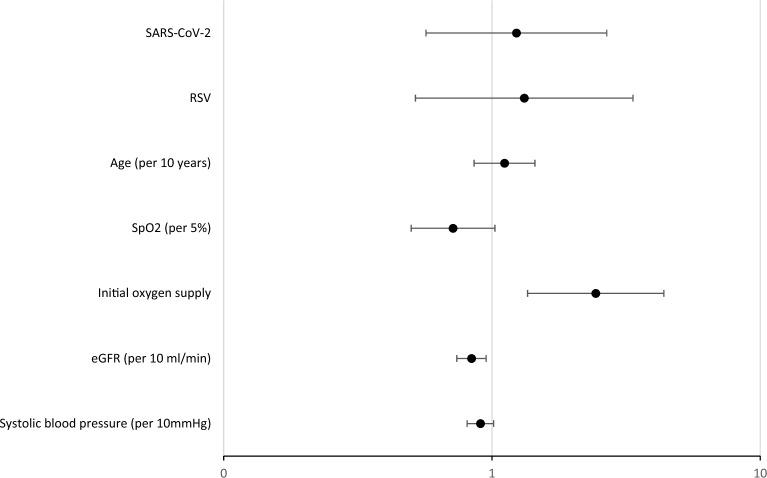
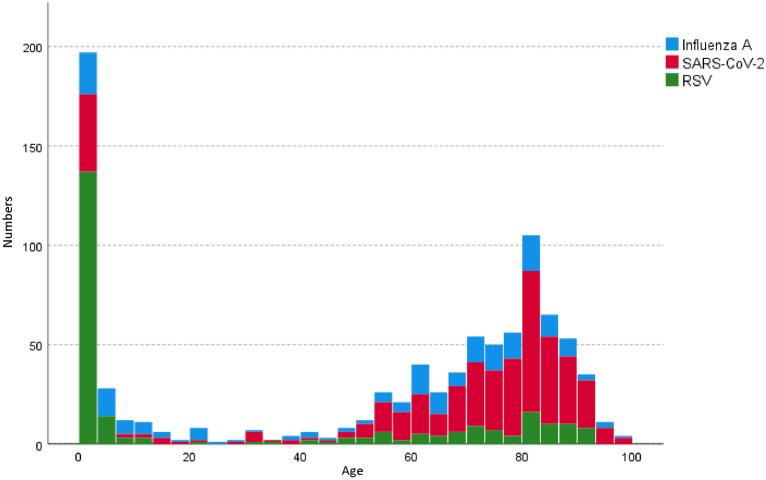
A total of 906 patients were included (45.6% female; median age 68.0 years; 21.9% Influenza A, 48.2% SARS-CoV-2, 28.3% RSV). Influenza B (0.2%) and co-infections (1.5%) played a minor role. In patients aged ≥ 18 years (n = 637, 71%), Influenza A, SARS-CoV-2 and RSV groups differed in age (median 72, 79, 76 years, respectively; p < 0.001). Comorbidities, particularly asthma and COPD, were most prevalent for RSV. 103 patients were admitted to the intensive care unit (ICU) (16.3% Influenza A, 15.3% SARS-CoV-2, 19.2% RSV; p = 0.649), 56 died (6.8% Influenza A, 9% SARS-CoV-2, 11.1% RSV; p = 0.496). RSV showed the highest frequencies of low-flow oxygen supplementation for admission and stay. Differences in the length of stay were minor (median 7 days). Conversely, in patients aged < 18 years (n = 261, 28,8%), 19.5%, 17.6% and 60.2% were in the Influenza A, SARS-CoV-2 and RSV groups, respectively; 0.4% showed Influenza B and 2.3% co-infections. 17 patients were admitted to ICU (3.9% Influenza A, 9.6% RSV, 0% SARS-CoV-2); none died. RSV showed the highest frequencies of high- and low-flow oxygen supplementation, SARS-CoV-2 the lowest.
CONCLUSION
When comparing infections with Influenza, SARS-CoV-2 and RSV in the winter 2022/2023 in hospitalized adult patients, rates of ICU admission and mortality were similar. RSV showed the highest frequencies of obstructive airway diseases, and of oxygen supplementation. The latter was also true in children/adolescents, in whom RSV dominated. Thus, in the situation of declining importance of SARS-CoV-2, RSV showed a disease burden that was relatively higher than that from Influenza and SARS-CoV-2 across ages, and this might be relevant for the seasons coming.
背景
2022/2023 年,甲型流感病毒和呼吸道合胞病毒(RSV)再次出现在住院患者中,与持续的 SARS-CoV-2 感染同时发生。我们研究的目的是比较同一时期这些感染的特征和结果。
方法
我们纳入了 2022 年 10 月 1 日至 2023 年 2 月 28 日期间在德国罗森海姆罗曼德医院神经科、内科或儿科病房因甲型流感 A/B、RSV 或 SARS-CoV-2 病毒阳性聚合酶链反应(PCR)检测而住院的所有年龄段患者。
结果
共纳入 906 例患者(45.6%为女性;中位年龄 68.0 岁;21.9%为甲型流感,48.2%为 SARS-CoV-2,28.3%为 RSV)。乙型流感(0.2%)和合并感染(1.5%)的比例较小。在年龄≥18 岁的患者(n=637,71%)中,甲型流感、SARS-CoV-2 和 RSV 组在年龄方面存在差异(中位数分别为 72、79 和 76 岁,p<0.001)。合并症,特别是哮喘和 COPD,在 RSV 中最为常见。103 例患者入住重症监护病房(ICU)(甲型流感 16.3%,SARS-CoV-2 15.3%,RSV 19.2%;p=0.649),56 例死亡(甲型流感 6.8%,SARS-CoV-2 9%,RSV 11.1%;p=0.496)。RSV 入院和住院时低流量氧补充的频率最高。住院时间的差异较小(中位数 7 天)。相反,在年龄<18 岁的患者(n=261,28.8%)中,甲型流感、SARS-CoV-2 和 RSV 组分别为 19.5%、17.6%和 60.2%;0.4%为乙型流感,2.3%为合并感染。17 例患者入住 ICU(甲型流感 3.9%,RSV 9.6%,SARS-CoV-2 0%);无死亡病例。RSV 高流量和低流量氧补充的频率最高,SARS-CoV-2 最低。
结论
在比较 2022/2023 年冬季住院成年患者流感、SARS-CoV-2 和 RSV 感染时,入住 ICU 率和死亡率相似。RSV 表现出最高的气道阻塞性疾病和氧补充频率,儿童/青少年也是如此,而 RSV 则占主导地位。因此,在 SARS-CoV-2 重要性下降的情况下,RSV 显示出的疾病负担在各年龄段均高于流感和 SARS-CoV-2,这可能与未来的季节有关。
 Zotero 插件