
探讨炎症细胞因子与强直性脊柱炎之间的因果关系:一项双向孟德尔随机化研究。
Exploring causal correlations between inflammatory cytokines and ankylosing spondylitis: a bidirectional mendelian-randomization study.
机构信息
Department of Orthopedics, Jinling Hospital, Affiliated Hospital of Medical School, Nanjing University, Nanjing, China.
出版信息
Front Immunol. 2023 Nov 20;14:1285106. doi: 10.3389/fimmu.2023.1285106. eCollection 2023.
BACKGROUND
The impact of inflammatory factors on the development of Ankylosing Spondylitis (AS) is widely recognized, but the exact causal relationship remains unclear.
METHODS
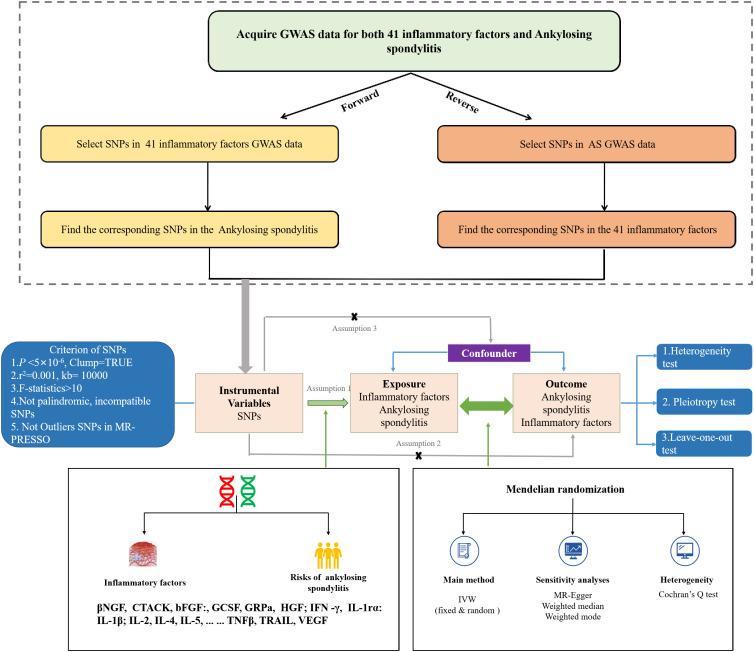
The bidirectional mendelian-randomization study utilized genetic data from a genome-wide association study (GWAS) of 186 AS cases and 456,162 controls of European ancestry. Inflammatory cytokines were obtained from a GWAS summary of 8,293 healthy participants. Causal associations were primarily investigated using the inverse variance-weighted method, supplemented by MR Egger, weighted median and weighted mode analyses. Heterogeneity in the results was assessed using the Cochrane Q test. Horizontal pleiotropy was evaluated through the MR-Egger intercept test and the MR pleiotropy residual sum and outliers (MR-PRESSO) test. Sensitivity analysis was conducted through leave-one-out analysis.
RESULTS
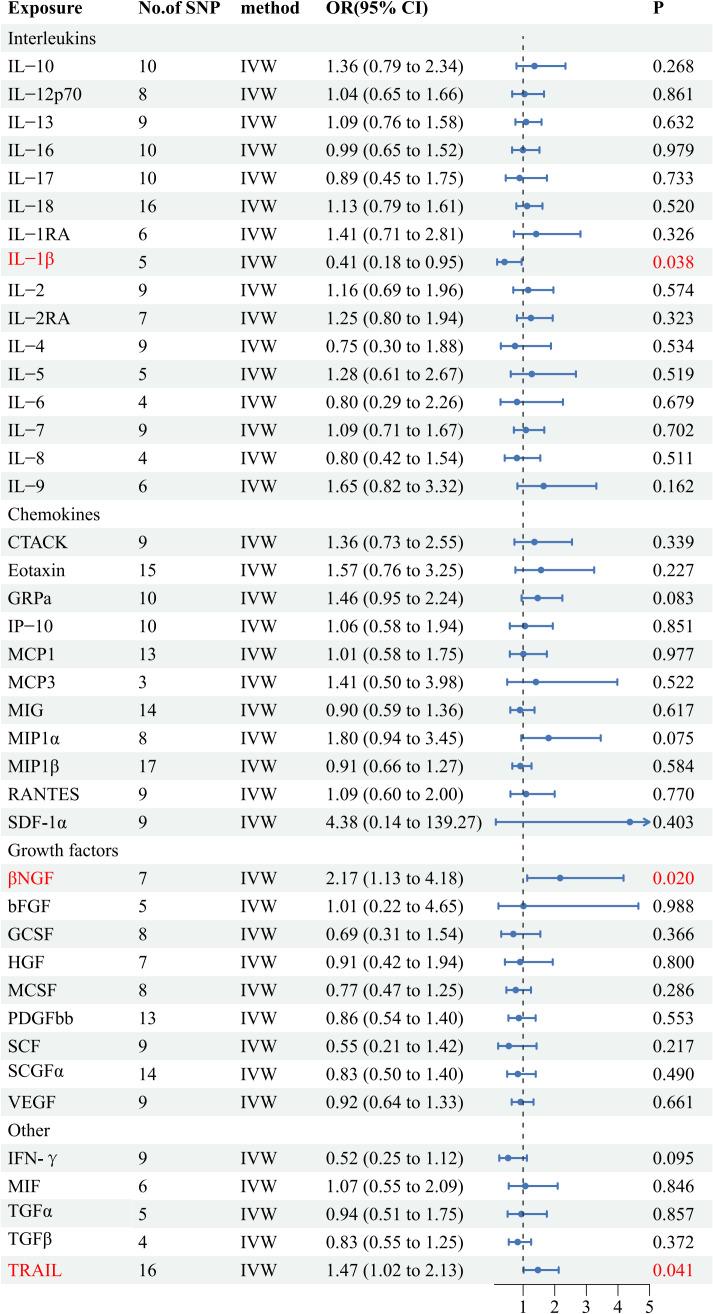
The results suggest a genetically predicted potential association between beta-nerve growth factor (βNGF), Interleukin-1-beta (IL-1β), and TNF-related apoptosis inducing ligand (TRAIL) with the risk of AS (OR: 2.17, 95% CI: 1.13-4.16; OR: 0.41, 95% CI: 0.18-0.95,; OR: 1.47, 95% CI: 1.02-2.13).Additionally, Interleukin-12p70 (IL-12p70), Interleukin-17 (IL-17), Interleukin-6 (IL-6), Interleukin-4 (IL-4), Stromal-cell-derived factor 1 alpha (SDF-1α), Macrophage inflammatory protein 1β (MIP1β), Monocyte chemoattractant protein-3 (MCP-3), Platelet-derived growth factor bb (PDGFbb), Granulocyte-colony stimulating factor (GCSF), Fibroblast growth factor basic (bFGF), TNF-related apoptosis inducing ligand (TRAIL), and Interferon-gamma (IFN -γ) are suggested as consequences of AS in genetically prediction.No evidence of horizontal pleiotropy or heterogeneity between the genetic variants was found (P>0.05), and a leave-one-out test confirmed the stability and robustness of this association.
CONCLUSION
These findings suggest that βNGF, IL-1β, and TRAIL may play a crucial role in the pathogenesis of AS. Additionally, AS may impact the expression of cytokines such as IL-12p70, IL-17, IL-6, IL-4, SDF-1α, MIP1β, MCP-3, PDGFbb,GCSF, bFGF,TRAIL,and IFN-γ. Further investigations are warranted to determine whether these biomarkers can be utilized for the prevention or treatment of AS.
背景
炎症因子对强直性脊柱炎(AS)发展的影响已得到广泛认可,但确切的因果关系仍不清楚。
方法
这项双向孟德尔随机化研究利用了欧洲血统的 186 例 AS 病例和 456162 名对照的全基因组关联研究(GWAS)的遗传数据。炎症细胞因子来自于 8293 名健康参与者的 GWAS 汇总数据。主要使用逆方差加权法、MR Egger、加权中位数和加权模式分析来研究因果关系。使用 Cochrane Q 检验评估结果的异质性。通过 MR-Egger 截距检验和 MR 多效性残差总和和异常值(MR-PRESSO)检验评估水平多效性。通过逐一删除分析进行敏感性分析。
结果
结果表明,β 神经生长因子(βNGF)、白细胞介素 1-β(IL-1β)和肿瘤坏死因子相关凋亡诱导配体(TRAIL)与 AS 风险之间存在遗传预测的潜在关联(OR:2.17,95%CI:1.13-4.16;OR:0.41,95%CI:0.18-0.95;OR:1.47,95%CI:1.02-2.13)。此外,白细胞介素 12p70(IL-12p70)、白细胞介素 17(IL-17)、白细胞介素 6(IL-6)、白细胞介素 4(IL-4)、基质细胞衍生因子 1α(SDF-1α)、巨噬细胞炎性蛋白 1β(MIP1β)、单核细胞趋化蛋白-3(MCP-3)、血小板衍生生长因子 bb(PDGFbb)、粒细胞集落刺激因子(GCSF)、碱性成纤维细胞生长因子(bFGF)、肿瘤坏死因子相关凋亡诱导配体(TRAIL)和干扰素 γ(IFN -γ)被认为是 AS 在遗传预测中的后果。没有发现遗传变异之间存在水平多效性或异质性的证据(P>0.05),逐一删除测试证实了这种关联的稳定性和稳健性。
结论
这些发现表明,βNGF、IL-1β 和 TRAIL 可能在 AS 的发病机制中起关键作用。此外,AS 可能会影响细胞因子的表达,如 IL-12p70、IL-17、IL-6、IL-4、SDF-1α、MIP1β、MCP-3、PDGFbb、GCSF、bFGF、TRAIL 和 IFN-γ。需要进一步的研究来确定这些生物标志物是否可用于 AS 的预防或治疗。



 Zotero 插件