
健康的高活动水平年轻和年长成年人心率复杂性和变异性指标的日间可靠性。
Inter-day reliability of heart rate complexity and variability metrics in healthy highly active younger and older adults.
作者信息
Fennell Christopher R J, Mauger Alexis R, Hopker James G
机构信息
School of Sport and Exercise Sciences, University of Kent, Chipperfield Building, Canterbury, Kent, CT2 7PE, UK.
出版信息
Eur J Appl Physiol. 2024 May;124(5):1409-1424. doi: 10.1007/s00421-023-05373-3. Epub 2023 Dec 6.
PURPOSE
To investigate the inter-day reliability of time-domain, frequency-domain, and nonlinear HRV metrics in healthy highly active younger and older adults. The study also assessed the effect of age on the HRV metrics.
METHODS
Forty-four older adults (34 M, 10F; 59 ± 5 years; = 40.9 ± 7.6 ml kg min) and twenty-two younger adults (16 M, 6F; 22 ± 4 years; = 47.2 ± 12.8 ml kg min) attended the laboratory. Visit one assessed aerobic fitness through an exercise test. In visits two and three, participants completed a 30-min supine RR interval measurement to derive the HRV metrics.
RESULTS
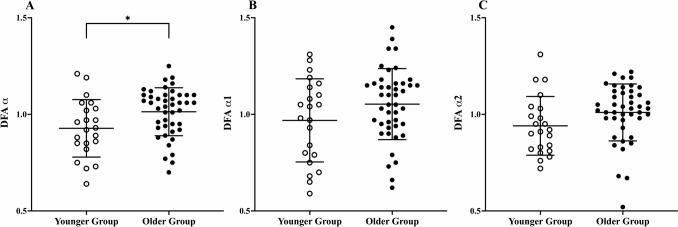
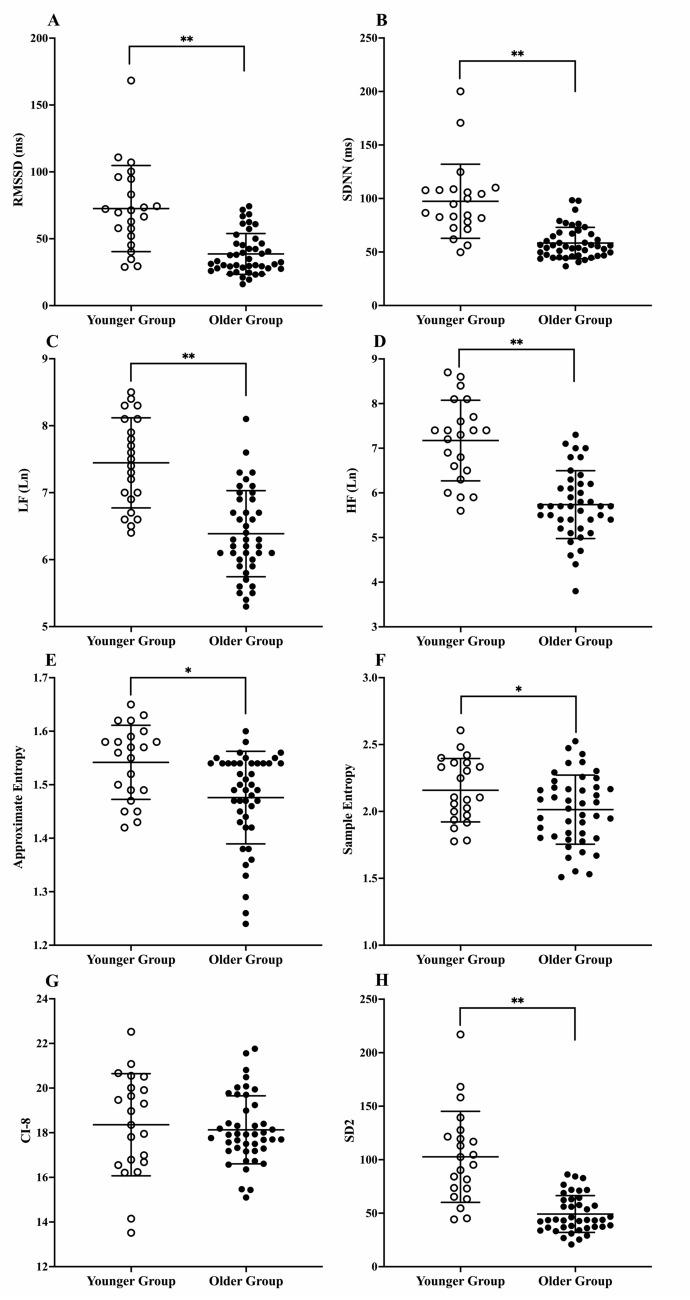
The younger group (YG) and older group (OG) demonstrated poor to good day-to-day relative and absolute reliability for all HRV metrics (OG, ICCs = 0.33 to 0.69 and between day CVs = 3.8 to 29.2%; YG, ICCs = 0.37 to 0.93 and between day CVs = 3.5 to 36.5%). There was a significant reduction in ApEn (P < 0.001), SampEn (P = 0.031), RMSSD (P < 0.001), SDNN (P < 0.001), LF power (P < 0.001) and HF power (P < 0.001), HRV metrics with ageing. There was no significant effect of age the complexity metrics DFA α1 (P = 0.107), α2 (P = 0.147) and CI-8 (P = 0.493).
CONCLUSION
HRV metrics are reproducible between days in both healthy highly active younger and older adults. There is a decline in linear and nonlinear HRV metrics with age, albeit there being no age-related change in the nonlinear metrics, DFA α1, α2 and CI-8.
目的
研究时域、频域和非线性心率变异性(HRV)指标在健康且高度活跃的年轻和年老人群中的日间可靠性。本研究还评估了年龄对HRV指标的影响。
方法
44名老年人(34名男性,10名女性;年龄59±5岁;体重指数=40.9±7.6 kg/m²)和22名年轻人(16名男性,6名女性;年龄22±4岁;体重指数=47.2±12.8 kg/m²)参与了该实验。第一次访视通过运动测试评估有氧适能。在第二次和第三次访视中,参与者完成了30分钟的仰卧位RR间期测量以得出HRV指标。
结果
年轻组(YG)和老年组(OG)在所有HRV指标上均表现出从较差到良好的日间相对和绝对可靠性(老年组,组内相关系数(ICCs)=0.33至0.69,日间变异系数(CVs)=3.8%至29.2%;年轻组,ICCs=0.37至0.93,日间CVs=3.5%至36.5%)。随着年龄增长,近似熵(ApEn)(P<0.001)、样本熵(SampEn)(P=0.031)、相邻RR间期差值的均方根(RMSSD)(P<0.001)、窦性心搏RR间期标准差(SDNN)(P<0.001)、低频功率(P<0.001)和高频功率(P<0.001)这些HRV指标显著降低。年龄对复杂度指标去趋势波动分析(DFA)的α1(P=0.107)、α2(P=0.147)和CI-8(P=0.493)没有显著影响。
结论
在健康且高度活跃的年轻和年老人群中,HRV指标在不同日间具有可重复性。随着年龄增长,线性和非线性HRV指标均有所下降,尽管非线性指标DFA的α1、α2和CI-8没有与年龄相关的变化。
 Zotero 插件