
HCC 与糖尿病和肝硬化国家队列的纵向血糖控制有关。
HCC is associated with diabetes and longitudinal blood glucose control in a national cohort with cirrhosis.
机构信息
Department of Internal Medicine, Section of Digestive Diseases, Yale School of Medicine, New Haven, Connecticut, USA.
VA Connecticut Healthcare System, Department of Internal Medicine West Haven, Connecticut, USA.
出版信息
Hepatol Commun. 2023 Dec 7;7(12). doi: 10.1097/HC9.0000000000000344. eCollection 2023 Dec 1.
BACKGROUND
Diabetes is associated with HCC; however, the impact of longitudinal blood glucose (BG) control on HCC risk in cirrhosis is not well known. We investigated this knowledge gap in a cohort of United States Veterans with cirrhosis from 2015 to 2021.
METHODS
We used repeated hemoglobin A1c measurements to categorize follow-up time according to BG control (defined as hemoglobin A1c < 7%) state over time: uncontrolled, nonsustained control (≤2 y), or sustained control (>2 y). We performed a sensitivity analysis using hemoglobin A1c < 8% to define BG control. We used Fine and Gray Cox proportional hazards regression with death and transplant as competing events to compare rates of incident HCC.
RESULTS
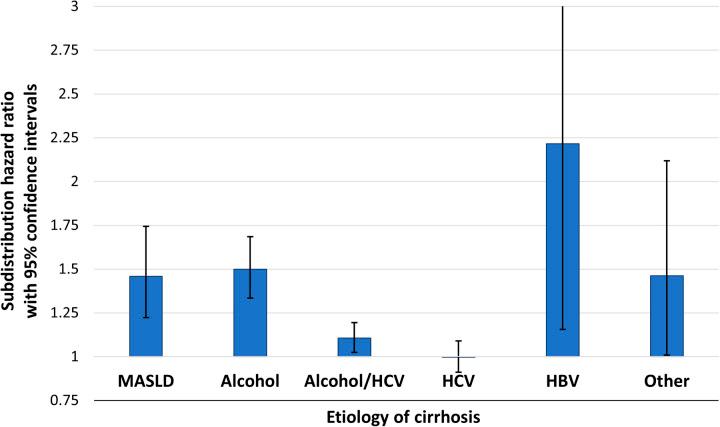
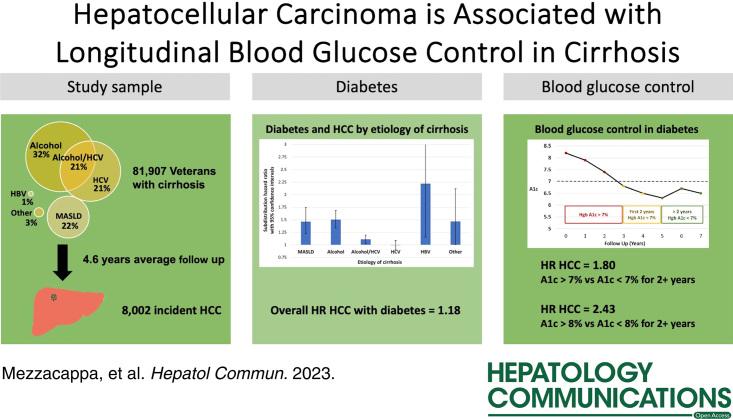
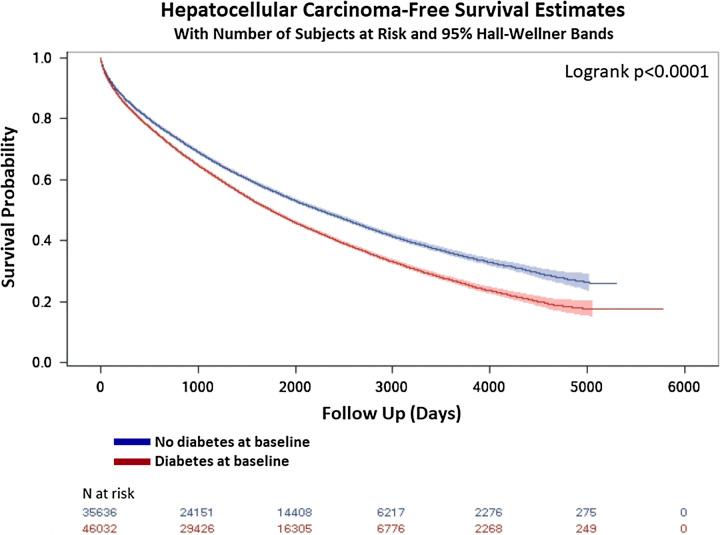
Our study included 81,907 individuals, 56.2% of whom had diabetes at baseline. There were 8,002 incident HCCs. The rate of HCC was 18% higher in diabetes (95% CI: 13% - 24%), and the relative increase in the rate of HCC varied by etiology of cirrhosis from nonsignificant (HCV) to an increase of 120% (HBV). Uncontrolled and nonsustained BG control was associated with 1.80 (95% CI: 1.70-1.91) and 2.34 (95% CI: 2.21-2.48) times the rate of HCC compared to sustained BG control, respectively. Using Hgb A1c < 8% to define BG control, HCC rates in uncontrolled and nonsustained BG control were 2.43 (2.28-2.58) and 2.23 (2.11-2.36) times that observed in sustained BG control.
CONCLUSIONS
Associations between diabetes and HCC in cirrhosis vary according to the longitudinal BG control state. Inadequate BG control is consistently associated with a higher risk of HCC, and long-term BG control should be considered in comprehensive cirrhosis care.
背景
糖尿病与 HCC 相关;然而,在肝硬化患者中,血糖(BG)的纵向控制对 HCC 风险的影响尚不清楚。我们在 2015 年至 2021 年期间对美国肝硬化退伍军人队列进行了研究,以填补这一知识空白。
方法
我们使用重复的糖化血红蛋白(HbA1c)测量结果,根据 BG 控制状态(定义为 HbA1c<7%)将随访时间分类:控制不佳、非持续控制(≤2 年)或持续控制(>2 年)。我们使用 HbA1c<8%来定义 BG 控制,进行了敏感性分析。我们使用 Fine 和 Gray Cox 比例风险回归,以死亡和移植为竞争事件,比较 HCC 的发生率。
结果
我们的研究纳入了 81907 名患者,其中 56.2%的患者在基线时患有糖尿病。有 8002 例 HCC 新发病例。糖尿病患者的 HCC 发生率高 18%(95%CI:13%-24%),HCC 发生率的相对增加幅度因肝硬化的病因而异,从无显著性差异(HCV)到增加 120%(HBV)。与持续 BG 控制相比,控制不佳和非持续 BG 控制与 HCC 发生率分别增加 1.80(95%CI:1.70-1.91)和 2.34(95%CI:2.21-2.48)。使用 HbA1c<8%来定义 BG 控制时,控制不佳和非持续 BG 控制的 HCC 发生率分别为持续 BG 控制的 2.43(2.28-2.58)和 2.23(2.11-2.36)倍。
结论
肝硬化中糖尿病与 HCC 的相关性因纵向 BG 控制状态而异。血糖控制不佳始终与 HCC 风险增加相关,在肝硬化综合治疗中应考虑长期血糖控制。
 Zotero 插件