
深入黑暗血清蛋白质组:重症 COVID-19 患者 IgG1 和 IgA1 抗体库的个性化特征
Into the Dark Serum Proteome: Personalized Features of IgG1 and IgA1 Repertoires in Severe COVID-19 Patients.
作者信息
Bondt Albert, Hoek Max, Dingess Kelly, Tamara Sem, de Graaf Bastiaan, Peng Weiwei, den Boer Maurits A, Damen Mirjam, Zwart Ceri, Barendregt Arjan, van Rijswijck Danique M H, Schulte Douwe, Grobben Marloes, Tejjani Khadija, van Rijswijk Jacqueline, Völlmy Franziska, Snijder Joost, Fortini Francesca, Papi Alberto, Volta Carlo Alberto, Campo Gianluca, Contoli Marco, van Gils Marit J, Spadaro Savino, Rizzo Paola, Heck Albert J R
机构信息
Biomolecular Mass Spectrometry and Proteomics, Bijvoet Center for Biomolecular Research and Utrecht Institute for Pharmaceutical Sciences, University of Utrecht, Utrecht, The Netherlands; Netherlands Proteomics Center, Utrecht, The Netherlands.
Department of Medical Microbiology and Infection Prevention, Amsterdam Institute for Infection and Immunity, Amsterdam UMC, University of Amsterdam, Amsterdam, The Netherlands.
出版信息
Mol Cell Proteomics. 2024 Jan;23(1):100690. doi: 10.1016/j.mcpro.2023.100690. Epub 2023 Dec 6.
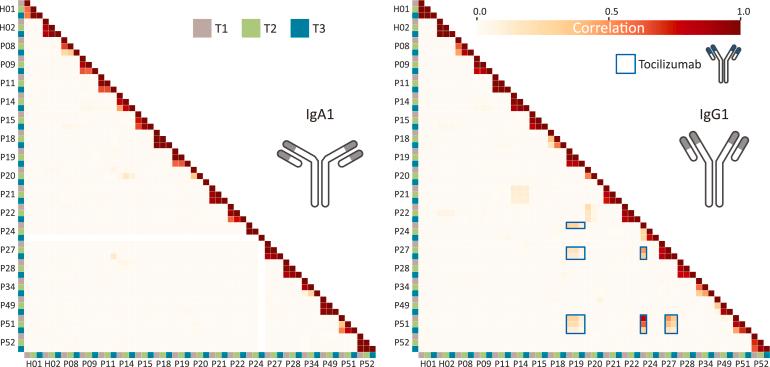
Serum proteomics has matured and is now able to monitor hundreds of proteins quantitatively in large cohorts of patients. However, the fine characteristics of some of the most dominant proteins in serum, the immunoglobulins, are in these studies often ignored, due to their vast, and highly personalized, diversity in sequences. Here, we focus exclusively on these personalized features in the serum proteome and distinctively chose to study individual samples from a low diversity population: elderly donors infected by severe acute respiratory syndrome corona virus 2 (SARS-CoV-2). By using mass spectrometry-based methods, immunoglobulin IgG1 and IgA1 clonal repertoires were monitored quantitatively and longitudinally in more than 50 individual serum samples obtained from 17 Corona virus disease 2019 patients admitted to intensive care units. These clonal profiles were used to examine how each patient reacted to a severe SARS-CoV-2 infection. All 17 donors revealed unique polyclonal repertoires and substantial changes over time, with several new clones appearing following the infection, in a few cases leading to a few, very high, abundant clones dominating their repertoire. Several of these clones were de novo sequenced through combinations of top-down, middle-down, and bottom-up proteomics approaches. This revealed sequence features in line with sequences deposited in the SARS-CoV-specific antibody database. In other patients, the serological Ig profiles revealed the treatment with tocilizumab, that subsequently dominated their serological IgG1 repertoire. Tocilizumab clearance could be monitored, and a half-life of approximately 6 days was established. Overall, our longitudinal monitoring of IgG1 and IgA1 repertoires of individual donors reveals that antibody responses are highly personalized traits of each patient, affected by the disease and the chosen clinical treatment. The impact of these observations argues for a more personalized and longitudinal approach in patients' diagnostics, both in serum proteomics as well as in monitoring immune responses.
血清蛋白质组学已经成熟,现在能够在大量患者队列中对数百种蛋白质进行定量监测。然而,血清中一些最主要的蛋白质,即免疫球蛋白,其精细特征在这些研究中常常被忽视,这是因为它们在序列上具有巨大且高度个性化的多样性。在这里,我们专门关注血清蛋白质组中的这些个性化特征,并特意选择研究来自低多样性人群的个体样本:感染严重急性呼吸综合征冠状病毒2(SARS-CoV-2)的老年捐赠者。通过使用基于质谱的方法,对从17名入住重症监护病房的2019冠状病毒病患者获得的50多个个体血清样本中的免疫球蛋白IgG1和IgA1克隆库进行了定量和纵向监测。这些克隆图谱被用于研究每位患者对严重SARS-CoV-2感染的反应。所有17名捐赠者都显示出独特的多克隆库,并且随时间有显著变化,感染后出现了几个新克隆,在少数情况下导致少数几个非常高丰度的克隆主导其库。其中几个克隆通过自上而下、中而下和自下而上的蛋白质组学方法组合进行了从头测序。这揭示了与SARS-CoV特异性抗体数据库中所存序列一致的序列特征。在其他患者中,血清学Ig谱显示了托珠单抗治疗的情况,随后托珠单抗主导了他们的血清学IgG1库。可以监测托珠单抗的清除情况,并确定其半衰期约为6天。总体而言,我们对个体捐赠者的IgG1和IgA1库的纵向监测表明,抗体反应是每位患者高度个性化的特征,受疾病和所选临床治疗的影响。这些观察结果的影响表明,在患者诊断中,无论是血清蛋白质组学还是监测免疫反应,都需要采用更个性化和纵向的方法。




 Zotero 插件