
烹饪剂量的草药和香料对预防和治疗代谢综合征的健康益处的临床证据的范围综述。
A Scoping Review of the Clinical Evidence for the Health Benefits of Culinary Doses of Herbs and Spices for the Prevention and Treatment of Metabolic Syndrome.
机构信息
Pukka Herbs Ltd., 10 York Road, London SE1 7ND, UK.
Department of Nutritional Sciences, School of Life Course and Population Sciences, Faculty of Life Sciences and Medicine, Kings College London, London SE1 9NH, UK.
出版信息
Nutrients. 2023 Nov 22;15(23):4867. doi: 10.3390/nu15234867.
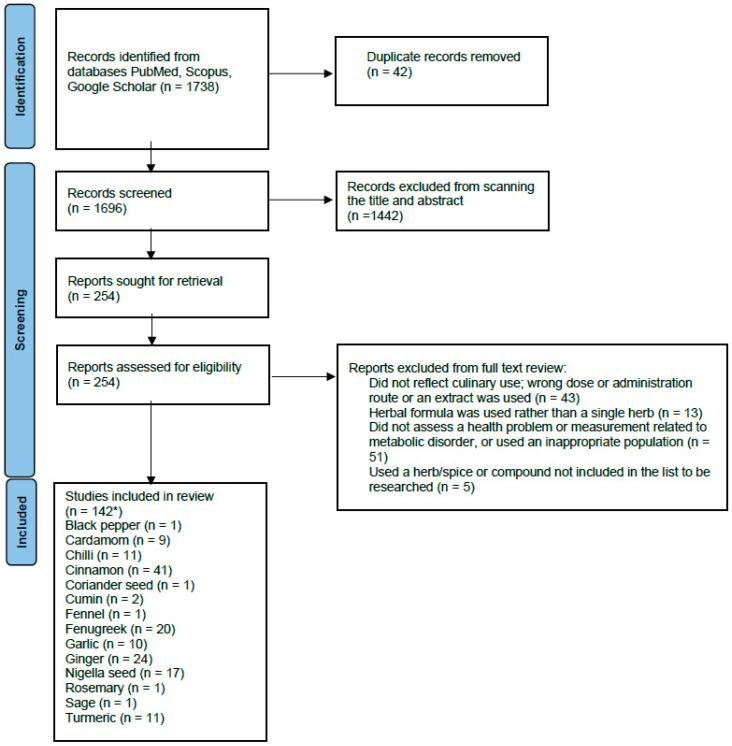
Metabolic syndrome (MetS) is a growing global health problem. Evidence suggests that diets rich in phytochemical-containing herbs and spices can contribute to reducing the risk of chronic diseases. This review assesses the scope of evidence supporting the use of herbs and spices in the diet for the prevention or treatment of MetS and its associated health conditions. A search of the PubMed, Scopus and Google Scholar databases was carried out to assess the available clinical evidence for culinary doses of commonly used herbs and spices. Trials that were measuring health factors related to metabolic disorders in healthy individuals, or the health of individuals with MetS or associated diseases, were included. Out of a total of 1738 papers identified, there were 142 relevant studies on black pepper, chilli, cardamom, cinnamon, coriander, cumin, fennel, fenugreek, garlic, ginger, nigella seed, rosemary, sage and turmeric. No relevant research was found for cloves, mint, oregano, parsley or thyme. Cinnamon, fenugreek and ginger were the herbs/spices with the most published trials on them and that showed promise for glycaemic control. Cardamom appears to have potential to reduce inflammatory markers, and cinnamon, ginger and turmeric to reduce blood lipids. Patients with type 2 diabetes were the population most likely to be included in studies, but the preventative benefits of herbs/spices in healthy populations were also investigated, particularly for chilli, ginger and cinnamon. There is evidence for the beneficial effect of culinary doses of many common herbs/spices in the prevention and treatment of MetS and associated disorders.
代谢综合征(MetS)是一个日益严重的全球健康问题。有证据表明,富含植物化学物质的草药和香料的饮食可以降低患慢性病的风险。本综述评估了支持在饮食中使用草药和香料预防或治疗 MetS 及其相关健康状况的证据范围。对 PubMed、Scopus 和 Google Scholar 数据库进行了检索,以评估常用草药和香料的烹饪剂量的现有临床证据。试验测量了与代谢紊乱相关的健康因素,涉及健康个体或患有 MetS 或相关疾病的个体的健康。在总共确定的 1738 篇论文中,有 142 篇关于黑胡椒、辣椒、小豆蔻、肉桂、香菜、孜然、茴香、胡芦巴、大蒜、生姜、黑孜然籽、迷迭香、鼠尾草和姜黄的相关研究。在丁香、薄荷、牛至、欧芹或百里香方面没有发现相关研究。肉桂、胡芦巴和生姜是研究最多且对血糖控制有希望的草药/香料。小豆蔻似乎具有降低炎症标志物的潜力,肉桂、生姜和 turmeric 具有降低血脂的潜力。2 型糖尿病患者是最有可能被纳入研究的人群,但也调查了草药/香料在健康人群中的预防益处,特别是辣椒、生姜和肉桂。有证据表明,许多常见草药/香料的烹饪剂量对 MetS 及相关疾病的预防和治疗具有有益作用。

 Zotero 插件