
普罗菲特研究方案:旨在保护瑞典年轻女性和青少年癌症患者生育能力的化疗中促性腺激素释放激素激动剂(GnRHa)研究——一项 III 期随机双盲安慰剂对照研究
ProFertil study protocol for the investigation of gonadotropin-releasing hormone agonists (GnRHa) during chemotherapy aiming at fertility protection of young women and teenagers with cancer in Sweden-a phase III randomised double-blinded placebo-controlled study.
机构信息
Department of Oncology-Pathology, Karolinska Institute, Stockholm, Sweden
Department of Reproductive Medicine, Karolinska University Hospital, Stockholm, Sweden.
出版信息
BMJ Open. 2023 Dec 9;13(12):e078023. doi: 10.1136/bmjopen-2023-078023.
BACKGROUND
Gonadotropin-releasing hormone agonists (GnRHa) cotreatment used to transiently suppress ovarian function during chemotherapy to prevent ovarian damage and preserve female fertility is used globally but efficacy is debated. Most clinical studies investigating a beneficial effect of GnRHa cotreatment on ovarian function have been small, retrospective and uncontrolled. Unblinded randomised studies on women with breast cancer have suggested a beneficial effect, but results are mixed with lack of evidence of improvement in markers of ovarian reserve. Unblinded randomised studies of women with lymphoma have not shown any benefit regarding fertility markers after long-term follow-up and no placebo-controlled study has been conducted so far. The aim of this study is to investigate if administration of GnRHa during cancer treatment can preserve fertility in young female cancer patients in a double-blind, placebo-controlled clinical trial.
METHODS AND ANALYSIS
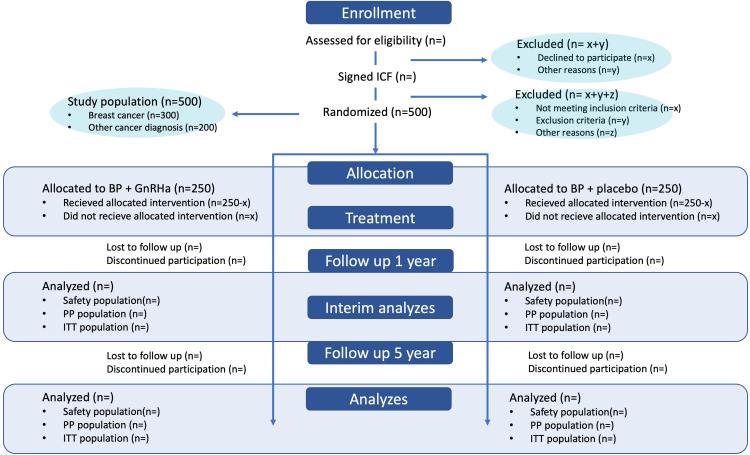
A prospective, randomised, double-blinded, placebo-controlled, phase III study including 300 subjects with breast cancer. In addition, 200 subjects with lymphoma, acute leukemias and sarcomas will be recruited. Women aged 14-42 will be randomised 1:1 to treatment with GnRHa (triptorelin) or placebo for the duration of their gonadotoxic chemotherapy. Follow-up until 5 years from end of treatment (EoT). The primary endpoint will be change in anti-Müllerian hormone (AMH) recovery at follow-up 12 months after EoT, relative to AMH levels at EoT, comparing the GnRHa group and the placebo group in women with breast cancer.
ETHICS AND DISSEMINATION
This study is designed in accordance with the principles of Good Clinical Practice (ICH-GCP E6 (R2)), local regulations (ie, European Directive 2001/20/EC) and the ethical principles of the Declaration of Helsinki. Within 6 months of study completion, the results will be analysed and the study results shall be reported in the EudraCT database.
STUDY REGISTRATION
The National Institutional review board in Sweden dnr:2021-03379, approval date 12 October 2021 (approved amendments 12 June 2022, dnr:2022-02924-02 and 13 December 2022, dnr:2022-05565-02). The Swedish Medical Product Agency 19 January 2022, Dnr:5.1-2021-98927 (approved amendment 4 February 2022). Manufacturing authorisation for authorised medicinal products approved 6 December 2021, Dnr:6.2.1-2020-079580. Stockholm Medical Biobank approved 22 June 2022, RBC dnr:202 253.
TRIAL REGISTRATION NUMBER
NCT05328258; EudraCT number:2020-004780-71.
背景
促性腺激素释放激素激动剂(GnRHa)在化疗期间被用来暂时抑制卵巢功能,以防止卵巢损伤和保留女性生育能力,这种方法在全球范围内使用,但疗效存在争议。大多数研究 GnRHa 联合治疗对卵巢功能有益效果的临床研究规模较小、回顾性和非对照。对乳腺癌女性进行的非盲随机研究表明存在有益效果,但结果不一,缺乏卵巢储备标志物改善的证据。对淋巴瘤女性进行的非盲随机研究在长期随访后并未显示生育标志物有任何改善,并且迄今为止尚未进行安慰剂对照研究。本研究旨在通过一项双盲、安慰剂对照的 III 期临床试验,调查在癌症治疗期间使用 GnRHa 是否可以在年轻女性癌症患者中保留生育能力。
方法和分析
一项包括 300 例乳腺癌患者的前瞻性、随机、双盲、安慰剂对照、III 期研究。此外,将招募 200 例淋巴瘤、急性白血病和肉瘤患者。年龄在 14-42 岁之间的女性将按照 1:1 的比例随机分配至接受 GnRHa(曲普瑞林)或安慰剂治疗,持续时间为其性腺毒性化疗。随访至治疗结束后 5 年(EoT)。主要终点将是在 EoT 后 12 个月随访时与 EoT 时的 AMH 水平相比,AMH 恢复的变化,比较乳腺癌女性中 GnRHa 组和安慰剂组的情况。
伦理和传播
本研究按照良好临床实践(ICH-GCP E6(R2))、当地法规(即欧洲指令 2001/20/EC)和《赫尔辛基宣言》的伦理原则进行设计。在研究完成后 6 个月内,将对结果进行分析,并在 EudraCT 数据库中报告研究结果。
研究注册
瑞典国家机构审查委员会编号:2021-03379,批准日期 2021 年 10 月 12 日(批准修正案日期 2022 年 6 月 12 日,编号:2022-02924-02 和 2022 年 12 月 13 日,编号:2022-05565-02)。瑞典药品管理局 2022 年 1 月 19 日,编号:5.1-2021-98927(批准修正案日期 2022 年 2 月 4 日)。批准用于授权药品的制造授权 2021 年 12 月 6 日,编号:6.2.1-2020-079580。斯德哥尔摩医疗生物库于 2022 年 6 月 22 日批准,编号:RBC dnr:202 253。
试验注册编号
NCT05328258;EudraCT 编号:2020-004780-71。

 Zotero 插件