
基于省级数据的中国医疗卫生资源配置测量的时空分析:2010-2021 年。
Spatial and temporal analysis of China's healthcare resource allocation measurements based on provincial data: 2010-2021.
机构信息
Business School, University of Shanghai for Science and Technology, Shanghai, China.
School of Management, Shanghai University of Engineering Science, Shanghai, China.
出版信息
Front Public Health. 2023 Nov 21;11:1269886. doi: 10.3389/fpubh.2023.1269886. eCollection 2023.
BACKGROUND
With the development of society, industrialization, urbanization, aging, lifestyle and social transformation, environmental degradation, global warming and other factors have had a great impact on the health of the population, and there is an urgent need to take a series of practical actions to promote the improvement of national health. Among them, healthcare resource allocation plays a key role in advancing the level of national health, treatment of chronic diseases, and leisure and healthcare.
METHODS
This article collected panel data on healthcare resource allocation in all provinces of China from 2010 to 2021, and comprehensively applied Analytic Hierarchy Process, comprehensive scoring method, regional difference analysis and spatial autocorrelation analysis to reveal regional differences, spatial-temporal patterns and development characteristics of healthcare resource allocation in China.
RESULTS
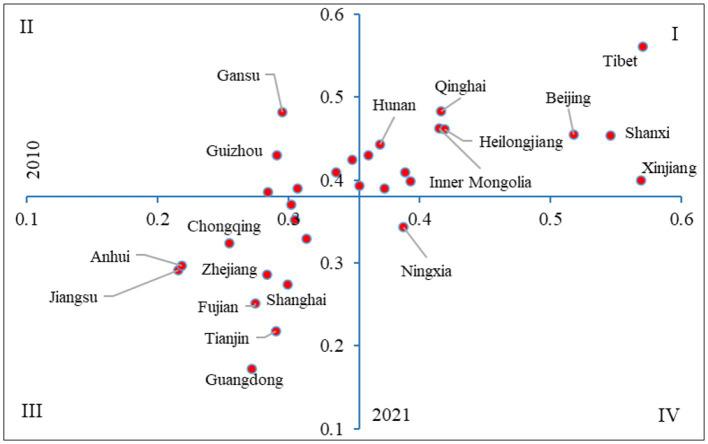
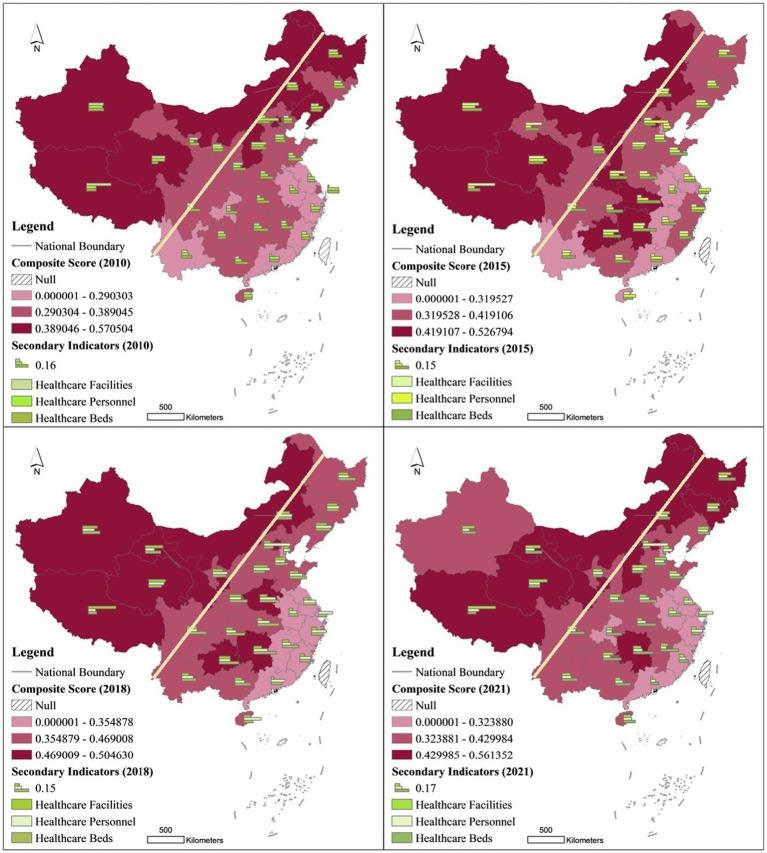
In terms of regional differences, intra-regional differences in healthcare resource allocation tend to narrow and inter-regional differences tend to widen. In terms of spatial pattern, the western provinces on the left side of the Hu Huanyong line generally have higher scores, while the central and eastern provinces on the right side of the Hu Huanyong line have lower scores, and healthcare resource allocation in the provinces on the left side of the Hu Huanyong line, such as Tibet, Xinjiang, Qinghai, Ningxia, Gansu, Inner Mongolia, Sichuan, have the spatial characteristics of HH clusters in terms of geographic location, while the southeast coastal provinces, such as Zhejiang, Fujian, Guangdong, Hainan, have the spatial characteristics of LL clusters in terms of geographic location. From the quadrant analysis, the 2010-2021 healthcare resource allocation in the first quadrant concentrates most of the provinces in the western and northeastern regions, while the third quadrant concentrates most of the provinces in the eastern region.
CONCLUSION
The allocation of healthcare resources in China's four major zones has undergone a process of change from "unbalanced quantity to relatively balanced quantity," but high-quality healthcare resources are highly concentrated in the eastern part of the country, and the problem of contradiction between people and doctors is prominent. It is recommended that Internet plus healthcare technology be used to reshape the regional allocation of high-quality healthcare resources.
背景
随着社会的发展、工业化、城市化、人口老龄化、生活方式和社会转型、环境恶化、全球变暖等因素的影响,对人群健康产生了巨大影响,需要采取一系列切实行动,促进国家卫生水平的提高。其中,医疗保健资源配置在提高国家卫生水平、慢性病治疗、休闲保健等方面发挥着关键作用。
方法
本文收集了 2010 年至 2021 年中国各省份医疗保健资源配置的面板数据,综合运用层次分析法、综合评分法、区域差异分析和空间自相关分析,揭示了中国医疗保健资源配置的区域差异、时空格局和发展特征。
结果
从区域差异来看,医疗保健资源配置的区内差异趋于缩小,区际差异趋于扩大。从空间格局来看,胡焕庸线左侧的西部省份得分普遍较高,而胡焕庸线右侧的中东部省份得分较低,胡焕庸线左侧的西藏、新疆、青海、宁夏、甘肃、内蒙古、四川等省份,从地理位置上看,医疗保健资源配置具有 HH 集聚的空间特征,而浙江、福建、广东、海南等东南沿海省份,从地理位置上看,具有 LL 集聚的空间特征。从象限分析来看,2010-2021 年第一象限的医疗资源配置集中了大部分西部和东北地区的省份,而第三象限则集中了大部分东部地区的省份。
结论
中国四大区域的医疗资源配置经历了从“数量不平衡到相对数量平衡”的变化过程,但高质量的医疗资源高度集中在东部地区,医患矛盾突出。建议利用互联网+医疗技术重塑优质医疗资源的区域配置。



 Zotero 插件