
难以捉摸的脑周血管成纤维细胞:在血管稳定性和内环境稳态中的潜在作用。
The elusive brain perivascular fibroblast: a potential role in vascular stability and homeostasis.
作者信息
Sosa Maria J, Shih Andy Y, Bonney Stephanie K
机构信息
Center for Developmental Biology and Regenerative Medicine, Seattle Children's Research Institute, Seattle, WA, United States.
Department of Pediatrics, University of Washington, Seattle, WA, United States.
出版信息
Front Cardiovasc Med. 2023 Nov 24;10:1283434. doi: 10.3389/fcvm.2023.1283434. eCollection 2023.
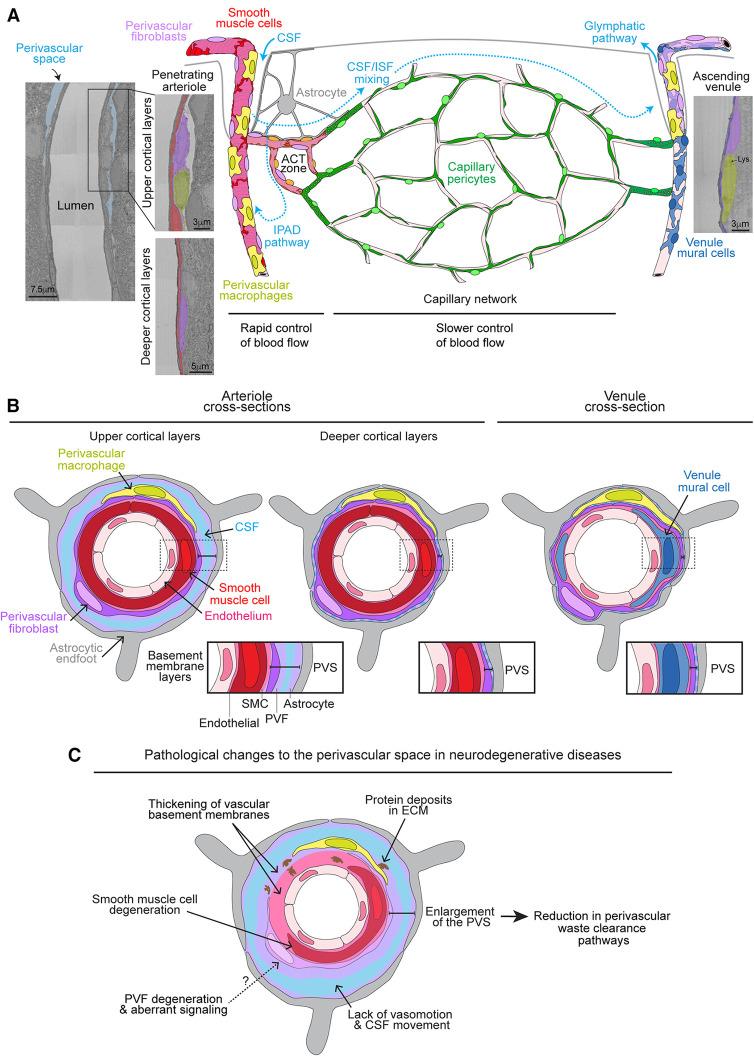
In the brain, perivascular fibroblasts (PVFs) reside within the perivascular spaces (PVSs) of arterioles and large venules, however their physiological and pathophysiological roles remain largely unknown. PVFs express numerous extracellular matrix proteins that are found in the basement membrane and PVS surrounding large diameter vessels. PVFs are sandwiched between the mural cell layer and astrocytic endfeet, where they are poised to interact with mural cells, perivascular macrophages, and astrocytes. We draw connections between the more well-studied PVF pro-fibrotic response in ischemic injury and the less understood thickening of the vascular wall and enlargement of the PVS described in dementia and neurodegenerative diseases. We postulate that PVFs may be responsible for stability and homeostasis of the brain vasculature, and may also contribute to changes within the PVS during disease.
在大脑中,血管周围成纤维细胞(PVF)存在于小动脉和大静脉的血管周围间隙(PVS)中,然而它们的生理和病理生理作用在很大程度上仍不清楚。PVF表达大量存在于基底膜和围绕大直径血管的PVS中的细胞外基质蛋白。PVF夹在壁细胞层和星形胶质细胞终足之间,在那里它们随时准备与壁细胞、血管周围巨噬细胞和星形胶质细胞相互作用。我们在缺血性损伤中研究较多的PVF促纤维化反应与痴呆和神经退行性疾病中了解较少的血管壁增厚和PVS扩大之间建立了联系。我们推测PVF可能负责脑血管系统的稳定性和内环境稳态,并且在疾病过程中也可能导致PVS内的变化。
 Zotero 插件