
视网膜类器官:高通量药物发现的新一代平台。
Retinal Organoids: A Next-Generation Platform for High-Throughput Drug Discovery.
机构信息
Key Laboratory of Yunnan Province, Yunnan Eye Institute, Affiliated Hospital of Yunnan University, Yunnan University, Kunming, Yunnan, China.
Department of Pathology and Pathophysiology, Faculty of Basic Medicine School, Kunming Medical University, 1168 Yuhua Street, Chunrong West Road, Chenggong District, Kunming, Yunnan, 650500, China.
出版信息
Stem Cell Rev Rep. 2024 Feb;20(2):495-508. doi: 10.1007/s12015-023-10661-8. Epub 2023 Dec 11.
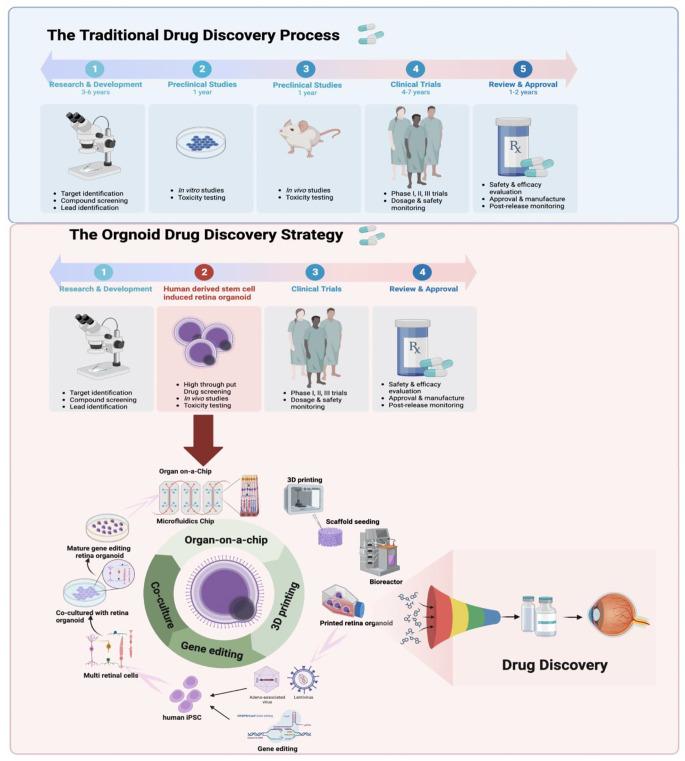
Retinal diseases are leading causes of blindness globally. Developing new drugs is of great significance for preventing vision loss. Current drug discovery relies mainly on two-dimensional in vitro models and animal models, but translation to human efficacy and safety is biased. In recent years, the emergence of retinal organoid technology platforms, utilizing three-dimensional microenvironments to better mimic retinal structure and function, has provided new platforms for exploring pathogenic mechanisms and drug screening. This review summarizes the latest advances in retinal organoid technology, emphasizing its application advantages in high-throughput drug screening, efficacy and toxicity evaluation, and translational medicine research. The review also prospects the combination of emerging technologies such as organ-on-a-chip, 3D bioprinting, single cell sequencing, gene editing with retinal organoid technology, which is expected to further optimize retinal organoid models and advance the diagnosis and treatment of retinal diseases.
视网膜疾病是全球范围内导致失明的主要原因。开发新药对于预防视力丧失具有重要意义。目前的药物发现主要依赖于二维体外模型和动物模型,但向人体疗效和安全性的转化存在偏差。近年来,视网膜类器官技术平台的出现,利用三维微环境更好地模拟视网膜结构和功能,为探索发病机制和药物筛选提供了新的平台。本综述总结了视网膜类器官技术的最新进展,强调了其在高通量药物筛选、疗效和毒性评估以及转化医学研究中的应用优势。该综述还展望了与视网膜类器官技术相结合的新兴技术,如器官芯片、3D 生物打印、单细胞测序、基因编辑等,这有望进一步优化视网膜类器官模型,推进视网膜疾病的诊断和治疗。
 Zotero 插件