
治理行为:一种将公共和私营部门统一起来以获得更好健康结果的建议方法。
The governance behaviours: a proposed approach for the alignment of the public and private sectors for better health outcomes.
机构信息
Special Programme on Primary Health Care, World Health Organization, Geneve, Switzerland
Special Programme on Primary Health Care, World Health Organization, Geneve, Switzerland.
出版信息
BMJ Glob Health. 2023 Dec 5;8(Suppl 5):e012528. doi: 10.1136/bmjgh-2023-012528.
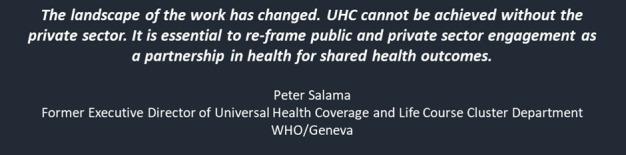
Health systems are 'the ensemble of all public and private organisations, institutions and resources mandated to improve, maintain or restore health.' The private sector forms a major part of healthcare practice in many health systems providing a wide range of health goods and services, with significant growth across low-income and middle-income countries. WHO sees building stronger and more effective health systems through the participation and engagement of all health stakeholders as the pathway to further reducing the burden of disease and meeting health targets and the Sustainable Development Goals. However, there are governance and public policy gaps when it comes to interaction or engagement with the private sector, and therefore, some governments have lost contact with a major area of healthcare practice. As a result, market forces rather than public policy shape private sector activities with follow-on effects for system performance. While the problem is well described, proposed normative solutions are difficult to apply at country level to translate policy intentions into action. In 2020, WHO adopted a strategy report which argued for a major shift in approach to engage the private sector based on the performance of six governance behaviours. These are a practice-based approach to governance and draw on earlier work from Travis on health system stewardship subfunctions. This paper elaborates on the governance behaviours and explains their application as a practice approach for strengthening the capacity of governments to work with the private sector to achieve public policy goals.
卫生系统是“所有被授权改善、维护或恢复健康的公共和私营组织、机构和资源的总和”。在许多卫生系统中,私营部门是医疗保健实践的重要组成部分,提供广泛的卫生商品和服务,在低收入和中等收入国家有显著增长。世卫组织认为,通过所有卫生利益攸关方的参与和参与来建设更强有力和更有效的卫生系统,是进一步减轻疾病负担和实现卫生目标和可持续发展目标的途径。然而,在与私营部门互动或参与方面存在治理和公共政策差距,因此,一些政府已经与主要的医疗保健实践领域失去了联系。结果,市场力量而不是公共政策塑造了私营部门的活动,对系统绩效产生了后续影响。虽然这个问题描述得很好,但拟议的规范性解决方案很难在国家层面上实施,将政策意图转化为行动。2020 年,世卫组织通过了一项战略报告,该报告主张在基于六项治理行为表现的方法上进行重大转变,以吸引私营部门参与。这是一种基于实践的治理方法,并借鉴了特拉维斯(Travis)关于卫生系统管理子功能的早期工作。本文详细阐述了治理行为,并解释了它们作为一种实践方法的应用,以加强政府与私营部门合作实现公共政策目标的能力。
 Zotero 插件