
探索居家照顾临终患者的家庭照护者的需求和应对策略:一项实地研究。
Exploring the needs and coping strategies of family caregivers taking care of dying patients at home: a field study.
机构信息
School of Nursing, Capital Medical University, 10 Xitoutiao, Youanmen, Fengtai District, Beijing, 100069, China.
Wenzhou Medical University, University Town, Chashan, Wenzhou, Zhejiang, 325035, China.
出版信息
BMC Palliat Care. 2023 Dec 12;22(1):196. doi: 10.1186/s12904-023-01315-0.
BACKGROUND
Most Chinese patients chose to die at home, therefore there is a reliance on the family caregivers to be involved in their palliative care. The needs and coping strategies of family caregivers in home-based palliative care are rooted in culture. Little is known about the needs and coping strategies of family caregivers taking care of dying patients at home.
METHODS
A field study using semi-structured interview, participant observation, documents and records collection was employed. The study was conducted in two palliative care outpatient departments in tertiary hospitals and four communities in Beijing, China from March 2021 to July 2022. Using purposive sampling, twenty-five family caregivers were recruited. All collected data were analyzed using content analysis approach.
RESULTS
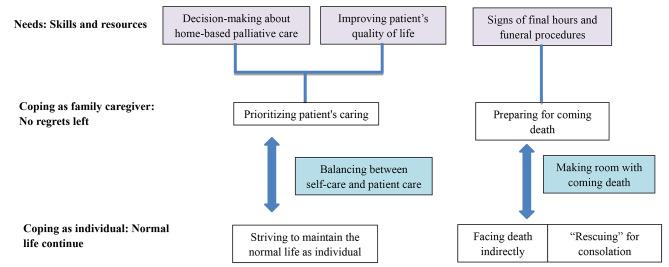
Five themes emerged, including three care needs and two coping strategies. Family caregivers need to learn care skills and acquire care resources, including (i) decision-making about home-based palliative care, (ii) improving patient's quality of life, and (iii) signs of final hours and funeral procedures. In facing the care burden, family caregivers coped by (iv) balancing the roles of caregivers and individuals: giving priority to patient care while maintaining their own normal life. In facing the death of a loved one, family caregivers responded by (v) making room for coming death by facing death indirectly and "rescuing" patients for consolation while preparing for the coming death.
CONCLUSION
Family caregivers strive to balance the roles of being caregivers and being themselves. As caregivers, they actively prepare patients for good death with no regrets. As individuals, they preserve themselves from being hurt to maintain normal life. The needs of family caregivers focus on caregiver role and are manifested in care skills and resources.
TRIAL REGISTRATION
Not registered.
背景
大多数中国患者选择在家中离世,因此依赖于家庭成员照顾者参与姑息治疗。家庭照顾者在居家姑息治疗中的需求和应对策略根植于文化。对于在家中照顾临终患者的家庭照顾者的需求和应对策略知之甚少。
方法
采用半结构式访谈、参与式观察、文件和记录收集的实地研究方法。本研究于 2021 年 3 月至 2022 年 7 月在两家三级医院的姑息治疗门诊和北京的四个社区进行。采用目的抽样法招募了 25 名家庭照顾者。使用内容分析法分析所有收集的数据。
结果
出现了五个主题,包括三个照顾需求和两个应对策略。家庭照顾者需要学习照顾技能并获得照顾资源,包括(i)做出居家姑息治疗的决策,(ii)提高患者的生活质量,和(iii)临终时刻的迹象和葬礼程序。在面对照顾负担时,家庭照顾者通过(iv)平衡照顾者和个人的角色来应对:在照顾患者的同时优先考虑自己的正常生活。在面对亲人的死亡时,家庭照顾者通过(v)间接面对死亡和“拯救”患者以获得安慰,同时为即将到来的死亡做准备来应对死亡。
结论
家庭照顾者努力平衡照顾者和自己的角色。作为照顾者,他们积极为患者做好无憾离世的准备。作为个人,他们保护自己免受伤害,以维持正常生活。家庭照顾者的需求主要集中在照顾者角色上,表现为照顾技能和资源。
研究注册
未注册。
 Zotero 插件