
皮肤中晚期糖基化终产物的积累与一般人群血管老化的关系:马尔默后代研究。
Accumulation of advanced glycation end products in skin and increased vascular ageing in the general population: the Malmö Offspring Study.
机构信息
Department of Clinical Sciences, Lund University.
Department of Cardiology, Skåne University Hospital.
出版信息
J Hypertens. 2024 Mar 1;42(3):530-537. doi: 10.1097/HJH.0000000000003627. Epub 2023 Dec 4.
OBJECTIVES
Advanced glycation end product (AGE) is an established risk marker for diabetic vascular disease, and associated with the degree of diabetes complications, renal failure, and atherosclerosis in middle-aged and older individuals. The relationship between AGEs and aortic stiffness has not been thoroughly examined in the younger general population. We aimed to evaluate the association between AGEs and aortic stiffness in the general population of young and middle-aged adults.
METHODS
We analysed cross-sectionally 2518 participants from a Swedish population-based cohort, the Malmö Offspring Study (mean age 41.8 ± 14.5 years, 52.2%). Advanced glycation end-products (AGEs) were measured by a well validated, noninvasive method using skin autofluorescence with AGE-Reader. Aortic stiffness was assessed by carotid-femoral pulse wave velocity (PWV) and augmentation index (Aix) was calibrated to a standard heart rate of 75 bpm at the arteria radialis using SphygmoCor. Multivariable linear regression was performed stratified by age to analyse the association between skin AGE and aortic stiffness.
RESULTS
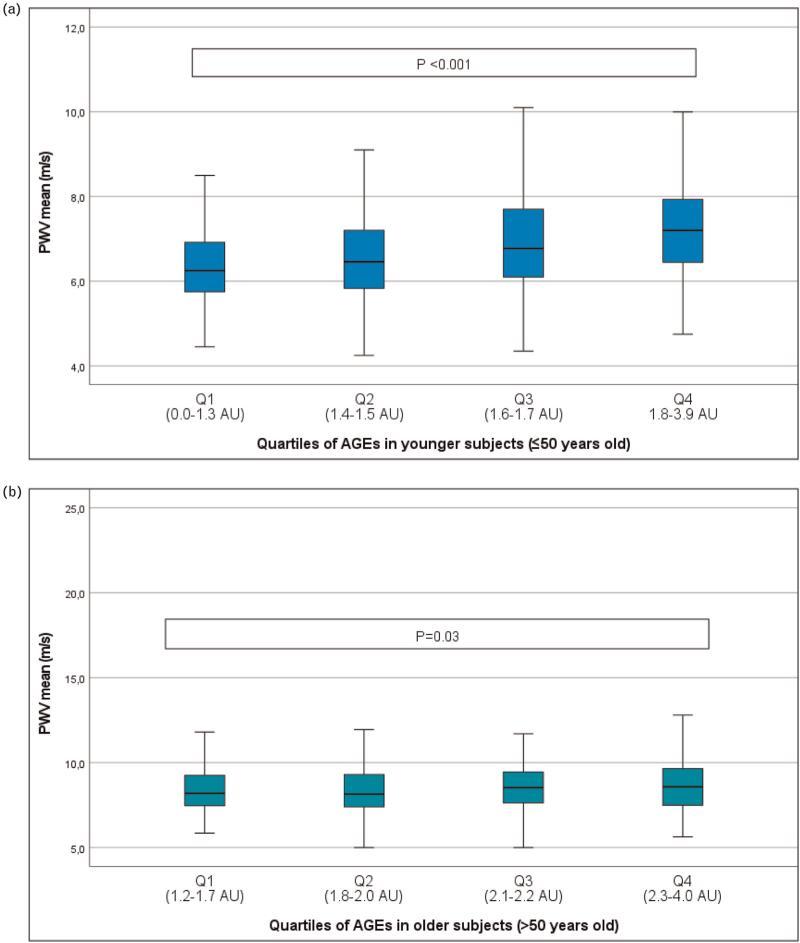
Increased levels of AGEs were significantly associated with higher direct measurements of aortic stiffness (vascular ageing) in younger individuals (PWV β 0.55 m/s, P < 0.001) after adjustment for traditional cardiometabolic risk factors, however, not in older individuals (PWV β 0.23 m/s, P = 0.10). Indirect vascular ageing was also significantly associated with higher levels of AGEs in both younger (Aix β 7.78, P < 0.001) and older individuals (Aix β 3.69, P < 0.001).
CONCLUSION
Higher levels of skin autofluorescence-AGEs are positively associated with increased vascular ageing in younger adults from the general population, independent of cardiometabolic risk factors.
目的
晚期糖基化终产物(AGE)是糖尿病血管疾病的既定风险标志物,与中老年人的糖尿病并发症程度、肾衰竭和动脉粥样硬化程度相关。在年轻的普通人群中,AGE 与主动脉僵硬之间的关系尚未得到充分研究。我们旨在评估普通年轻和中年人群中 AGE 与主动脉僵硬之间的关系。
方法
我们对来自瑞典人群为基础的队列,马尔默后代研究(平均年龄 41.8±14.5 岁,52.2%)的 2518 名参与者进行了横断面分析。使用皮肤自动荧光光度计通过一种经过良好验证的非侵入性方法测量晚期糖基化终产物(AGEs)。使用颈动脉-股动脉脉搏波速度(PWV)评估主动脉僵硬,并使用 SphygmoCor 将桡动脉的标准心率校正为 75bpm 后,对增强指数(Aix)进行校准。为了分析皮肤 AGE 与主动脉僵硬之间的关系,我们按照年龄进行了多变量线性回归分析。
结果
在调整了传统的心血管代谢危险因素后,AGE 水平升高与年轻个体(PWVβ0.55m/s,P<0.001)的直接主动脉僵硬测量值显著相关,但与老年个体(PWVβ0.23m/s,P=0.10)不相关。间接血管老化也与年轻(Aixβ7.78,P<0.001)和老年(Aixβ3.69,P<0.001)个体中更高的 AGE 水平显著相关。
结论
皮肤自动荧光光度计-AGE 水平升高与普通人群中年轻成年人的血管老化增加呈正相关,独立于心血管代谢危险因素。

 Zotero 插件