
疫苗信心在亲社会的“疫苗接种向前”干预与中国流感疫苗接种率提高之间起中介作用: 中介分析。
Vaccine confidence mediates the association between a pro-social pay-it-forward intervention and improved influenza vaccine uptake in China: A mediation analysis.
机构信息
West China School of Public Health and West China Fourth Hospital, Sichuan University, Chengdu, China; School of Public Health of Nanjing Medical University, Nanjing, Jiangsu, China.
University of North Carolina Project-China, Guangzhou, China; SESH (Social Entrepreneurship to Spur Health) Team, Guangzhou, China.
出版信息
Vaccine. 2024 Jan 12;42(2):362-368. doi: 10.1016/j.vaccine.2023.11.046. Epub 2023 Dec 15.
INTRODUCTION
A Chinese clinical trial has demonstrated that a prosocial pay-it-forward intervention that offered subsidized vaccination and postcard messages effectively increased influenza vaccine uptake and vaccine confidence. This secondary analysis explored the potential mediating role of vaccine confidence on the association between a pay-it-forward intervention and influenza vaccine uptake, and how this might vary by individual annual income levels.
METHODS
Data from 300 participants (150 standard-of-care and 150 pay-it-forward participants) were included in the analysis. We conducted descriptive analysis of demographic and vaccine confidence variables. Multivariable regression and mediation analysis on interventions, vaccine confidence and vaccine uptake were conducted. A sub-group analysis was conducted to further understand whether associations between these variables vary by income levels (<=$1860 or >$1860).
RESULTS
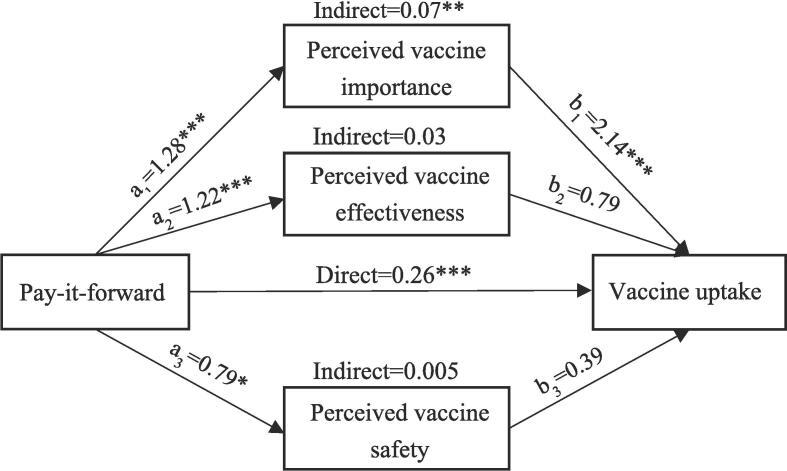
The pay-it-forward intervention was significantly associated with greater levels of perceived influenza vaccine importance (adjusted odds ratio (aOR) = 3.60, 95 %CI: 1.77-7.32), effectiveness (aOR = 3.37, 95 %CI: 1.75-6.52) and safety (aOR = 2.20, 95 %CI: 1.17-4.15). Greater perceived influenza vaccine importance was associated with increased vaccine uptake (aOR = 8.51, 95 %CI: 3.04-23.86). The indirect effect of the pay-it-forward intervention on vaccination was significant through improved perceived influenza vaccine importance (indirect effect = 0.07, 95 %CI: 0.02-0.11). This study further revealed that, irrespective of the individual income level, the pay-it-forward intervention was associated with increased vaccine uptake when compared to the standard-of-care approach.
CONCLUSIONS
Pay-it-forward intervention may be a promising strategy to improve influenza vaccine uptake. Perceived confidence in vaccine importance appears to be a potential mediator of the association between pay-it-forward and vaccine uptake.
引言
一项中国临床试验表明,一种亲社会的预付款接种疫苗和明信片信息传递干预措施,通过提供补贴的方式,有效地提高了流感疫苗接种率和疫苗信心。本二次分析旨在探讨疫苗信心在预付款接种疫苗干预与流感疫苗接种率之间的相关性中的潜在中介作用,以及这种作用如何因个体年收入水平而异。
方法
本研究共纳入 300 名参与者(标准护理组 150 人,预付款接种组 150 人)。我们对人口统计学和疫苗信心变量进行了描述性分析。对干预措施、疫苗信心和疫苗接种率进行了多变量回归和中介分析。进行了亚组分析,以进一步了解这些变量之间的关联是否因收入水平(<=1860 或 >1860)而异。
结果
预付款接种疫苗干预措施与更高水平的流感疫苗重要性感知(调整后的优势比[aOR] = 3.60,95%置信区间[CI]:1.77-7.32)、有效性(aOR = 3.37,95%CI:1.75-6.52)和安全性(aOR = 2.20,95%CI:1.17-4.15)显著相关。更高的流感疫苗重要性感知与更高的疫苗接种率相关(aOR = 8.51,95%CI:3.04-23.86)。预付款接种疫苗干预措施通过提高流感疫苗重要性感知对疫苗接种的间接影响具有统计学意义(间接效应 = 0.07,95%CI:0.02-0.11)。本研究进一步表明,与标准护理方法相比,预付款接种疫苗干预措施无论个体收入水平如何,都与更高的疫苗接种率相关。
结论
预付款接种疫苗干预措施可能是提高流感疫苗接种率的一种有前途的策略。疫苗重要性感知的信心似乎是预付款接种疫苗与疫苗接种率之间关联的潜在中介因素。
 Zotero 插件