
呼吸康复计划包括吸气训练装置对传统呼吸康复的疗效:一项随机对照试验。
Effectiveness of a respiratory rehabilitation program including an inspiration training device traditional respiratory rehabilitation: a randomized controlled trial.
机构信息
Universidad Católica de Ávila, Ávila, Ávila, Spain.
Faculty of Sport Sciences, Universidad Europea de Madrid, Madrid, Spain.
出版信息
PeerJ. 2023 Dec 15;11:e16360. doi: 10.7717/peerj.16360. eCollection 2023.
BACKGROUND
In the context of COVID-19, respiratory training is vital for the care and recuperation of individuals. Both exercise-based and instrumental respiratory training have been employed as interventions to enhance respiratory function, providing relief from symptoms in those impacted by the virus. The aim of this study was to evaluate the efficacy of two different respiratory rehabilitation programs.
METHODS
A total of 200 participants affected with COVID-19 respiratory sequels were recruited, with a block randomization regarding sex to ensure equal and appropriate applicability of the results. An experimental controlled and randomized study was conducted, with participants engaging in a 31 days respiratory rehabilitation program, (a) experimental group, inspiratory training device combined with aerobic exercise and (b) traditional respiratory exercises combined with aerobic exercise.
RESULTS
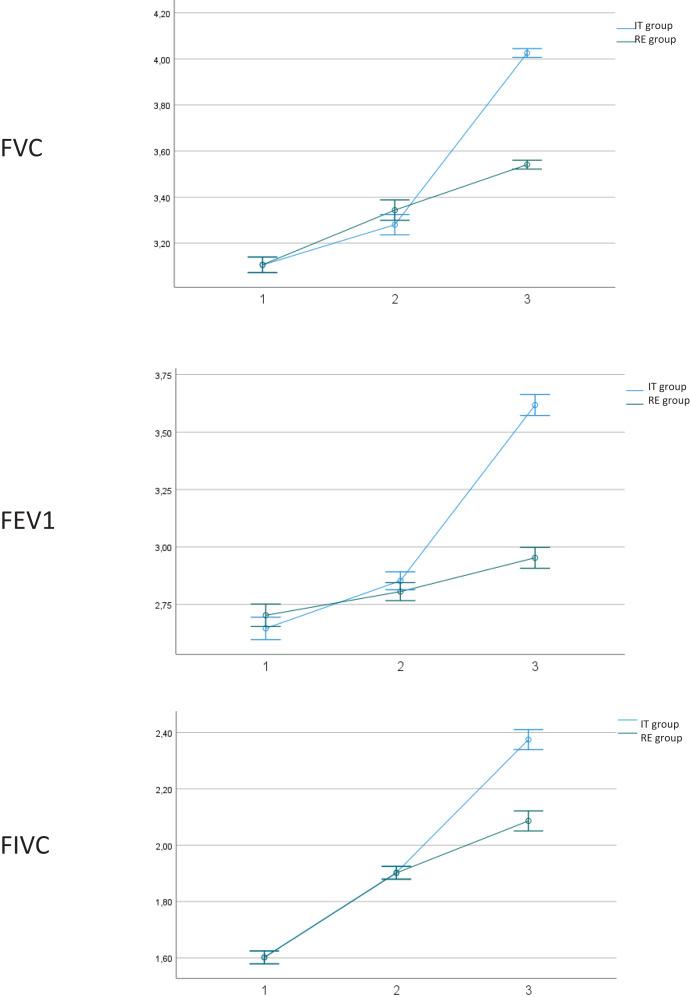
Both groups improved in cardiorespiratory parameters, with a decrease in systolic and diastolic pressure, dyspnea and lower limbs fatigue, and increased oxygen saturation, 6 min walking distance, diaphragmatic thickness, forced vital capacity, forced expiratory volume during the first second, peak expiratory flow rate, forced inspiratory vital capacity and maximal inspiratory pressure. Comparison between groups showed statistically significant differences in all variables except for oxygen saturation, 6 min walking distance and diaphragmatic thickness. The results of this study support the use of specific inspiration training devices for respiratory rehabilitation in COVID-19 sequels.
背景
在 COVID-19 背景下,呼吸训练对于个体的护理和康复至关重要。运动和仪器呼吸训练都被用作干预措施,以增强呼吸功能,缓解受病毒影响的人的症状。本研究旨在评估两种不同呼吸康复计划的疗效。
方法
共招募了 200 名患有 COVID-19 呼吸后遗症的参与者,根据性别进行了区块随机化,以确保结果的平等和适当适用性。进行了一项实验对照和随机研究,参与者参加了 31 天的呼吸康复计划,(a)实验组,吸气训练器结合有氧运动和(b)传统呼吸练习结合有氧运动。
结果
两组在心肺参数方面均有改善,收缩压和舒张压、呼吸困难和下肢疲劳降低,氧饱和度、6 分钟步行距离、膈肌厚度、用力肺活量、第一秒用力呼气量、呼气峰流速、吸气用力肺活量和最大吸气压力增加。组间比较除氧饱和度、6 分钟步行距离和膈肌厚度外,所有变量均有统计学差异。本研究结果支持在 COVID-19 后遗症中使用特定的吸气训练器进行呼吸康复。


 Zotero 插件