
新型真菌耳念珠菌的致病机制。
Mechanisms of pathogenicity for the emerging fungus Candida auris.
机构信息
Department of Medicine, University of Wisconsin, Madison, Wisconsin, United States of America.
Department of Medical Microbiology & Immunology, University of Wisconsin, Madison, Wisconsin, United States of America.
出版信息
PLoS Pathog. 2023 Dec 21;19(12):e1011843. doi: 10.1371/journal.ppat.1011843. eCollection 2023 Dec.
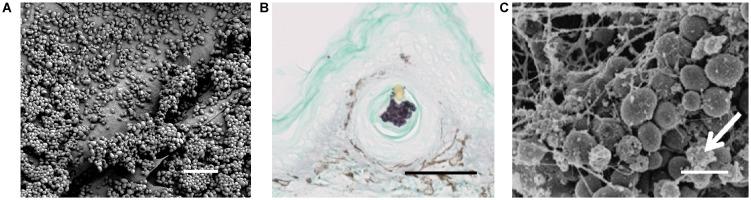
Candida auris recently emerged as an urgent public health threat, causing outbreaks of invasive infections in healthcare settings throughout the world. This fungal pathogen persists on the skin of patients and on abiotic surfaces despite antiseptic and decolonization attempts. The heightened capacity for skin colonization and environmental persistence promotes rapid nosocomial spread. Following skin colonization, C. auris can gain entrance to the bloodstream and deeper tissues, often through a wound or an inserted medical device, such as a catheter. C. auris possesses a variety of virulence traits, including the capacity for biofilm formation, production of adhesins and proteases, and evasion of innate immune responses. In this review, we highlight the interactions of C. auris with the host, emphasizing the intersection of laboratory studies and clinical observations.
耳念珠菌最近成为一种紧迫的公共卫生威胁,在全球的医疗机构中引发了侵袭性感染的爆发。尽管采取了抗菌和去定植措施,这种真菌病原体仍存在于患者的皮肤和非生物表面上。皮肤定植和环境持久存在的能力增强了医院内的快速传播。在皮肤定植后,耳念珠菌可以通过伤口或插入的医疗设备(如导管)进入血液和更深层的组织。耳念珠菌具有多种毒力特征,包括形成生物膜、产生黏附素和蛋白酶以及逃避先天免疫反应的能力。在这篇综述中,我们强调了耳念珠菌与宿主的相互作用,重点介绍了实验室研究和临床观察的交叉点。
 Zotero 插件