
纤维肌痛中的脑源性神经营养因子:作为潜在生物标志物的作用的系统评价和荟萃分析。
Brain-derived neurotrophic factor in fibromyalgia: A systematic review and meta-analysis of its role as a potential biomarker.
机构信息
School of Medicine, Tehran University of Medical Sciences (TUMS), Children's Medical Center Hospital, Dr. Qarib St., Keshavarz Blvd, Tehran, Iran.
Network of Immunity in Infection, Malignancy and Autoimmunity (NIIMA), Universal Scientific Education and Research Network (USERN), Tehran, Iran.
出版信息
PLoS One. 2023 Dec 21;18(12):e0296103. doi: 10.1371/journal.pone.0296103. eCollection 2023.
BACKGROUND
Fibromyalgia (FM) is a form of chronic pain disorder accompanied by several tender points, fatigue, sleeping and mood disturbances, cognitive dysfunction, and memory problems. Brain-derived neurotrophic factor (BDNF) is also a mediator of neurotrophin for many activity-dependent processes in the brain. Despite numerous research studies investigating BDNF in FM, contradictory results have been reported. Thus, we investigated the overall effect shown by studies to find the association between peripheral BDNF concentrations and its gene polymorphisms with FM.
METHODS
A systematic search in online international databases, including PubMed, Cochrane Library, Embase, the Web of Science, and Scopus was performed. Relevant studies assessing BDNF levels or gene polymorphism in patients with FM and comparing them with controls were included. Case reports, reviews, and non-English studies were excluded. We conducted the random-effect meta-analysis to estimate the pooled standardized mean difference (SMD) or odds ratio (OR) and 95% confidence interval (CI).
RESULTS
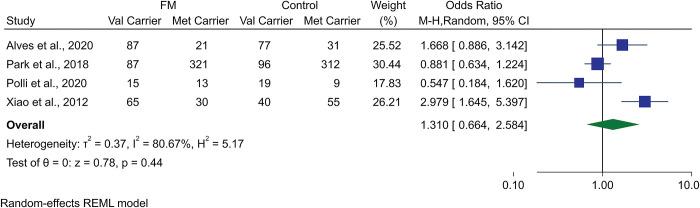
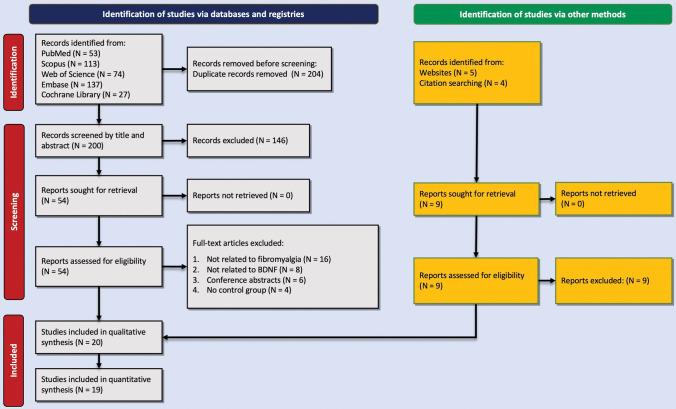
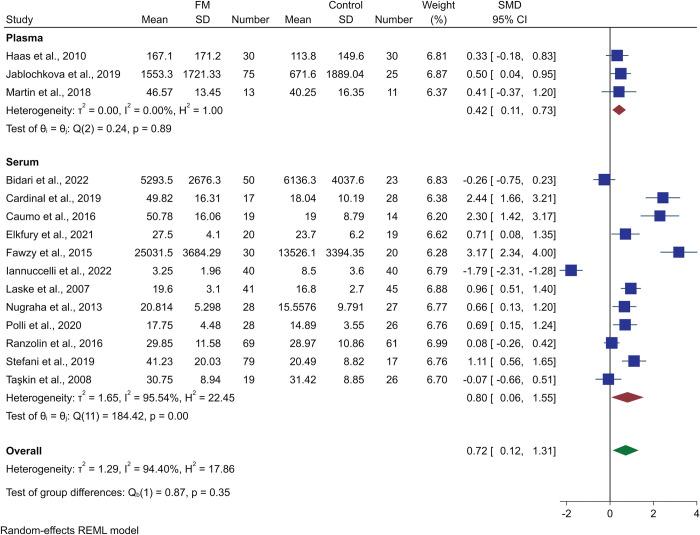
Twenty studies were found to be included composed of 1,206 FM patients and 1,027 controls. The meta-analysis of 15 studies indicated that the circulating BDNF levels were significantly higher in FM (SMD 0.72, 95% CI 0.12 to 1.31; p-value = 0.02). However, no difference between the rate of Val/Met carrier status at the rs6265 site was found (p-value = 0.43). Using meta-regression, the sample size and age variables accounted for 4.69% and 6.90% of the observed heterogeneity of BDNF level analysis, respectively.
CONCLUSION
Our meta-analysis demonstrated that FM is correlated with increased peripheral BDNF levels. This biomarker's diagnostic and prognostic value should be further investigated in future studies.
背景
纤维肌痛(FM)是一种慢性疼痛障碍,伴有多个压痛点、疲劳、睡眠和情绪障碍、认知功能障碍和记忆问题。脑源性神经营养因子(BDNF)也是大脑中许多活动依赖性过程的神经营养因子介质。尽管有许多研究调查了 FM 中的 BDNF,但报告的结果却相互矛盾。因此,我们调查了研究中显示的总体效果,以发现外周 BDNF 浓度及其基因多态性与 FM 之间的关联。
方法
在在线国际数据库(包括 PubMed、Cochrane 图书馆、Embase、Web of Science 和 Scopus)中进行了系统搜索。纳入评估 FM 患者 BDNF 水平或基因多态性并与对照组进行比较的相关研究。排除病例报告、综述和非英语研究。我们进行了随机效应荟萃分析,以估计汇总标准化均数差(SMD)或比值比(OR)和 95%置信区间(CI)。
结果
发现 20 项研究符合纳入标准,共包括 1206 名 FM 患者和 1027 名对照。15 项研究的荟萃分析表明,FM 患者的循环 BDNF 水平显著升高(SMD 0.72,95%CI 0.12 至 1.31;p 值 = 0.02)。然而,在 rs6265 位点的 Val/Met 载带状态率方面没有发现差异(p 值 = 0.43)。使用元回归,样本量和年龄变量分别占 BDNF 水平分析观察到的异质性的 4.69%和 6.90%。
结论
我们的荟萃分析表明,FM 与外周 BDNF 水平升高相关。这个生物标志物的诊断和预后价值应在未来的研究中进一步探讨。

 Zotero 插件