
一种用于瓣膜手术后低心输出综合征早期预测的新型解释性工具:在线机器学习模型。
A novel interpretative tool for early prediction of low cardiac output syndrome after valve surgery: online machine learning models.
机构信息
Cardiovascular Intensive Care Unit, Department of Critical Care Medicine, Nanjing First Hospital, Nanjing Medical University, Nanjing, China.
School of Basic Medicine and Clinical Pharmacy, China Pharmaceutical University, Nanjing, China.
出版信息
Ann Med. 2023;55(2):2293244. doi: 10.1080/07853890.2023.2293244. Epub 2023 Dec 21.
OBJECTIVE
Low cardiac output syndrome (LCOS) is a severe complication after valve surgery, with no uniform standard for early identification. We developed interpretative machine learning (ML) models for predicting LCOS risk preoperatively and 0.5 h postoperatively for intervention in advance.
METHODS
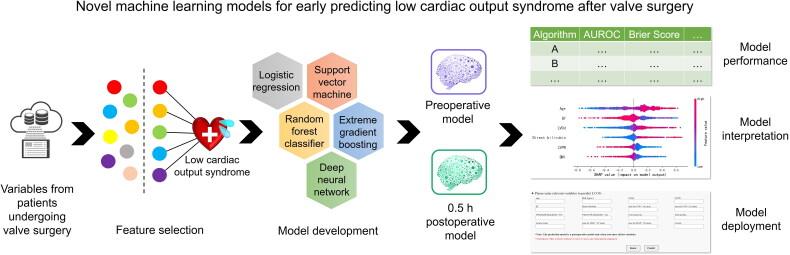
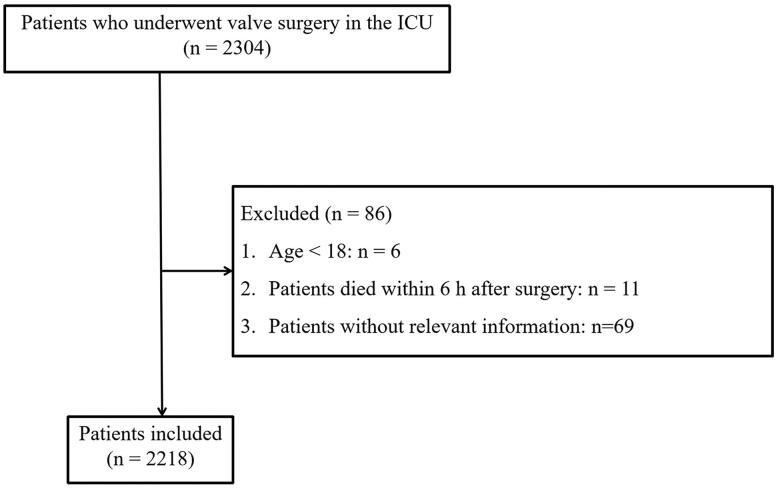
A total of 2218 patients undergoing valve surgery from June 2019 to Dec 2021 were finally enrolled to construct preoperative and postoperative models. Logistic regression, support vector machine (SVM), random forest classifier, extreme gradient boosting, and deep neural network were executed for model construction, and the performance of models was evaluated by area under the curve (AUC) of the receiver operating characteristic and calibration curves. Our models were interpreted through SHapley Additive exPlanations, and presented as an online tool to improve clinical operability.
RESULTS
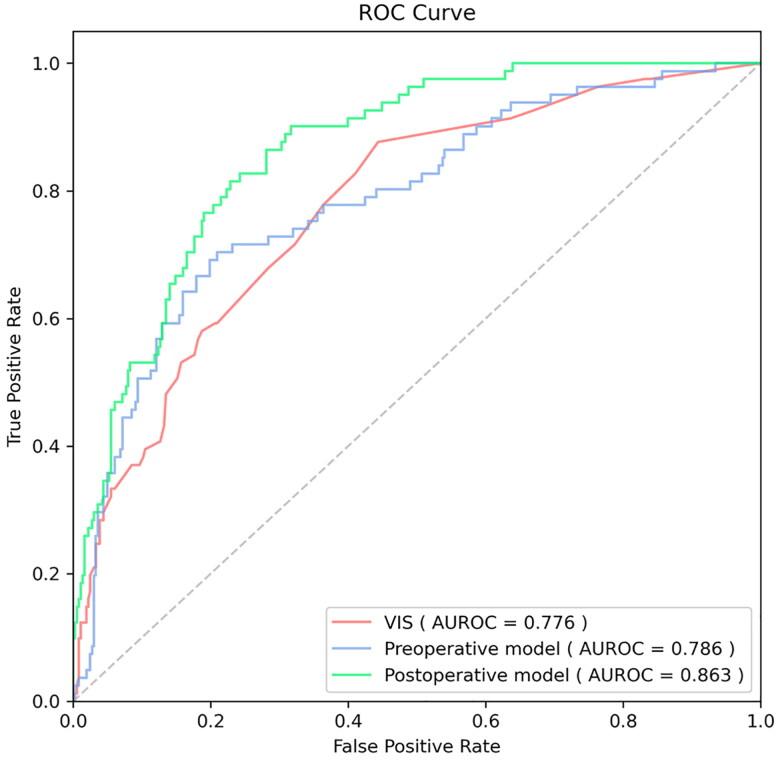
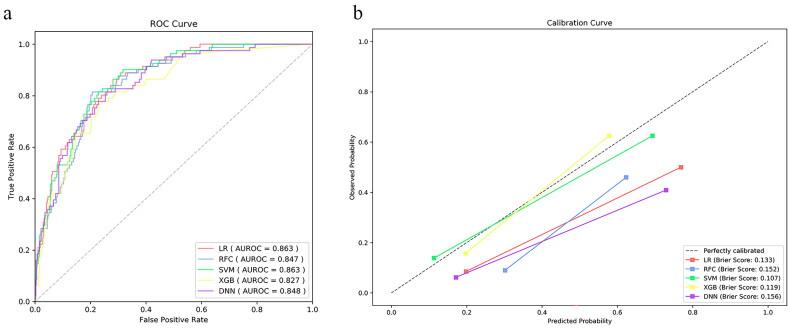
The SVM algorithm was chosen for modeling due to better AUC and calibration capability. The AUCs of the preoperative and postoperative models were 0.786 (95% CI 0.729-0.843) and 0.863 (95% CI 0.824-0.902), and the Brier scores were 0.123 and 0.107. Our models have higher timeliness and interpretability, and wider coverage than the vasoactive-inotropic score, and the AUC of the postoperative model was significantly higher. Our preoperative and postoperative models are available online at http://njfh-yxb.com.cn:2022/lcos.
CONCLUSIONS
The first interpretable ML tool with two prediction periods for online early prediction of LCOS risk after valve surgery was successfully built in this study, in which the SVM model has the best performance, reserving enough time for early precise intervention in critical care.
目的
低心排综合征(LCOS)是瓣膜手术后的一种严重并发症,目前尚无早期识别的统一标准。我们开发了解释性机器学习(ML)模型,用于术前和术后 0.5 小时预测 LCOS 风险,以便提前进行干预。
方法
共纳入 2218 例行瓣膜手术的患者,构建术前和术后模型。采用逻辑回归、支持向量机(SVM)、随机森林分类器、极端梯度提升和深度神经网络进行模型构建,并通过受试者工作特征曲线下面积(AUC)和校准曲线评估模型性能。通过 Shapley 加法解释对我们的模型进行解释,并将其呈现为一个在线工具,以提高临床操作性。
结果
由于 AUC 和校准能力较好,选择 SVM 算法进行建模。术前和术后模型的 AUC 分别为 0.786(95% CI 0.729-0.843)和 0.863(95% CI 0.824-0.902),Brier 评分分别为 0.123 和 0.107。我们的模型具有更高的及时性和可解释性,覆盖范围更广,优于血管活性-正性肌力评分,且术后模型 AUC 显著更高。我们的术前和术后模型可在 http://njfh-yxb.com.cn:2022/lcos 在线获取。
结论
本研究成功构建了首个具有两个预测期的瓣膜手术后 LCOS 风险在线早期预测的可解释性 ML 工具,其中 SVM 模型性能最佳,为重症监护中早期精确干预保留了足够的时间。


 Zotero 插件