
评估医院中无症状医护人员的混样检测筛查。
Evaluating pooled testing for asymptomatic screening of healthcare workers in hospitals.
机构信息
MRC Biostatistics Unit, Univeristy of Cambridge, Robinson Way, Cambridge, CB2 0SR, Cambridgeshire, United Kingdom.
HCAI, Fungal, AMR, AMU and Sepsis Division, UK Health Security Agency, London, United Kingdom.
出版信息
BMC Infect Dis. 2023 Dec 21;23(1):900. doi: 10.1186/s12879-023-08881-x.
BACKGROUND
There is evidence that during the COVID pandemic, a number of patient and HCW infections were nosocomial. Various measures were put in place to try to reduce these infections including developing asymptomatic PCR (polymerase chain reaction) testing schemes for healthcare workers. Regularly testing all healthcare workers requires many tests while reducing this number by only testing some healthcare workers can result in undetected cases. An efficient way to test as many individuals as possible with a limited testing capacity is to consider pooling multiple samples to be analysed with a single test (known as pooled testing).
METHODS
Two different pooled testing schemes for the asymptomatic testing are evaluated using an individual-based model representing the transmission of SARS-CoV-2 in a 'typical' English hospital. We adapt the modelling to reflect two scenarios: a) a retrospective look at earlier SARS-CoV-2 variants under lockdown or social restrictions, and b) transitioning back to 'normal life' without lockdown and with the omicron variant. The two pooled testing schemes analysed differ in the population that is eligible for testing. In the 'ward' testing scheme only healthcare workers who work on a single ward are eligible and in the 'full' testing scheme all healthcare workers are eligible including those that move across wards. Both pooled schemes are compared against the baseline scheme which tests only symptomatic healthcare workers.
RESULTS
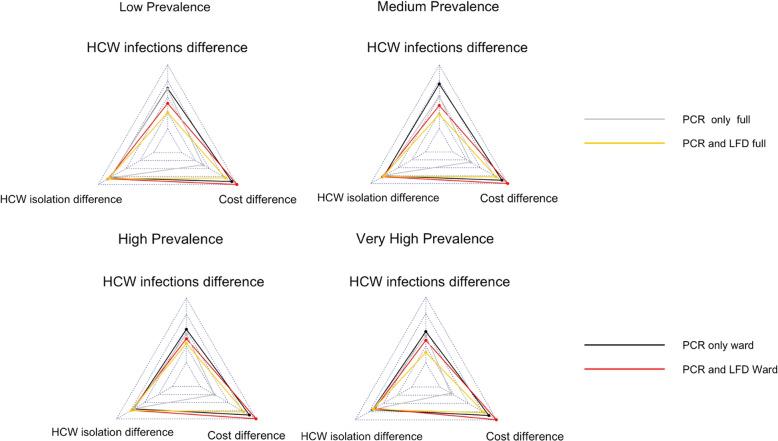
Including a pooled asymptomatic testing scheme is found to have a modest (albeit statistically significant) effect, reducing the total number of nosocomial healthcare worker infections by about 2[Formula: see text] in both the lockdown and non-lockdown setting. However, this reduction must be balanced with the increase in cost and healthcare worker isolations. Both ward and full testing reduce HCW infections similarly but the cost for ward testing is much less. We also consider the use of lateral flow devices (LFDs) for follow-up testing. Considering LFDs reduces cost and time but LFDs have a different error profile to PCR tests.
CONCLUSIONS
Whether a PCR-only or PCR and LFD ward testing scheme is chosen depends on the metrics of most interest to policy makers, the virus prevalence and whether there is a lockdown.
背景
有证据表明,在 COVID 大流行期间,许多患者和医护人员感染是医院内感染。为了减少这些感染,采取了各种措施,包括为医护人员制定无症状 PCR(聚合酶链反应)检测方案。定期对所有医护人员进行检测需要进行大量检测,而仅对部分医护人员进行检测则可能导致漏诊病例。在检测能力有限的情况下,尽可能多地对个体进行检测的有效方法是考虑将多个样本合并进行分析(称为合并检测)。
方法
使用代表 SARS-CoV-2 在“典型”英国医院中传播的基于个体的模型,评估了两种用于无症状检测的不同合并检测方案。我们对模型进行了调整,以反映两种情况:a)在封锁或社会限制下对早期 SARS-CoV-2 变体的回顾性研究,以及 b)在没有封锁且带有奥密克戎变体的情况下恢复“正常生活”。分析的两种合并检测方案在有资格接受检测的人群方面有所不同。在“病房”检测方案中,只有在单个病房工作的医护人员才有资格接受检测,而在“全面”检测方案中,所有医护人员都有资格接受检测,包括那些在病房之间流动的医护人员。与仅检测有症状的医护人员的基线方案相比,这两种合并方案都被发现具有适度(尽管具有统计学意义)的效果,可将医院内医护人员感染的总人数减少约 20%。然而,这一减少必须与成本和医护人员隔离的增加相平衡。病房和全面检测都能以类似的方式减少医护人员感染,但病房检测的成本要低得多。我们还考虑了使用侧向流动设备(LFDs)进行后续检测。考虑到 LFDs 可以降低成本和时间,但 LFDs 的错误模式与 PCR 检测不同。
结论
选择仅进行 PCR 检测还是 PCR 和 LFD 病房检测方案取决于决策者最关心的指标、病毒流行情况以及是否存在封锁。
 Zotero 插件