
线粒体 E3 泛素连接酶在癌症治疗中的作用及其作为潜在治疗靶点的可能性。
Role of the Mitochondrial E3 Ubiquitin Ligases as Possible Therapeutic Targets in Cancer Therapy.
机构信息
Department of Biotechnological and Applied Clinical Sciences, University of L'Aquila, 67100 L'Aquila, Italy.
出版信息
Int J Mol Sci. 2023 Dec 6;24(24):17176. doi: 10.3390/ijms242417176.
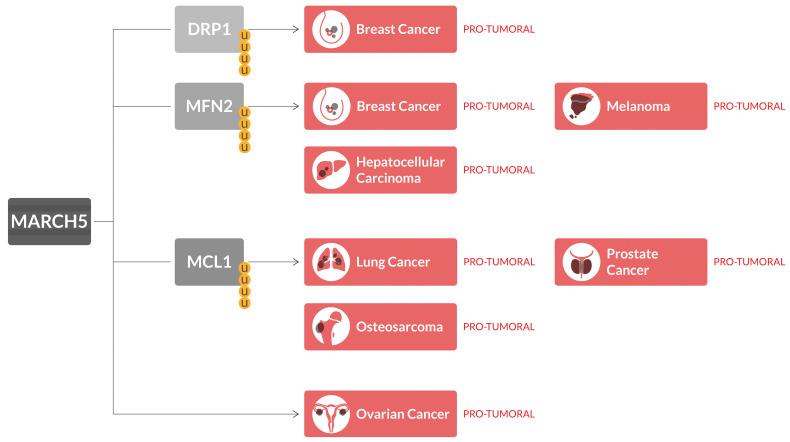
Ubiquitination is a post-translational modification that targets specific proteins on their lysine residues. Depending on the type of ubiquitination, this modification ultimately regulates the stability or degradation of the targeted proteins. Ubiquitination is mediated by three different classes of enzymes: the E1 ubiquitin-activating enzymes, the E2 ubiquitin-conjugating enzymes and, most importantly, the E3 ubiquitin ligases. E3 ligases are responsible for the final step of the ubiquitin cascade, interacting directly with the target proteins. E3 ligases can also be involved in DNA repair, cell cycle regulation and response to stress; alteration in their levels can be involved in oncogenic transformation and cancer progression. Of all the six hundred E3 ligases of the human genome, only three of them are specific to the mitochondrion: MARCH5, RNF185 and MUL1. Their alterations (that reflect on the alteration of the mitochondria functions) can be related to cancer progression, as underlined by the increasing research performed in recent years on these three mitochondrial enzymes. This review will focus on the function and mechanisms of the mitochondrial E3 ubiquitin ligases, as well as their important targets, in cancer development and progression, also highlighting their potential use for cancer therapy.
泛素化是一种翻译后修饰,靶向赖氨酸残基上的特定蛋白质。根据泛素化的类型,这种修饰最终调节靶向蛋白质的稳定性或降解。泛素化由三种不同类别的酶介导:E1 泛素激活酶、E2 泛素结合酶,最重要的是 E3 泛素连接酶。E3 连接酶负责泛素级联的最后一步,直接与靶蛋白相互作用。E3 连接酶还可以参与 DNA 修复、细胞周期调控和应激反应;其水平的改变可能与致癌转化和癌症进展有关。在人类基因组的 600 种 E3 连接酶中,只有三种是专门针对线粒体的:MARCH5、RNF185 和 MUL1。近年来,对这三种线粒体酶的研究不断增加,它们的改变(反映了线粒体功能的改变)可能与癌症进展有关。这篇综述将重点介绍线粒体 E3 泛素连接酶的功能和机制,以及它们在癌症发展和进展中的重要靶点,同时强调它们在癌症治疗中的潜在用途。


 Zotero 插件