
DNA 双链断裂响应中的相分离。
Phase separation in DNA double-strand break response.
机构信息
Henan Provincial Key Laboratory of Radiation Medicine, The First Affiliated Hospital of Zhengzhou University, Zhengzhou, Henan, P.R. China.
Department of Radiation Oncology, The First Affiliated Hospital of Zhengzhou University, Zhengzhou, Henan, P.R. China.
出版信息
Nucleus. 2024 Dec;15(1):2296243. doi: 10.1080/19491034.2023.2296243. Epub 2023 Dec 25.
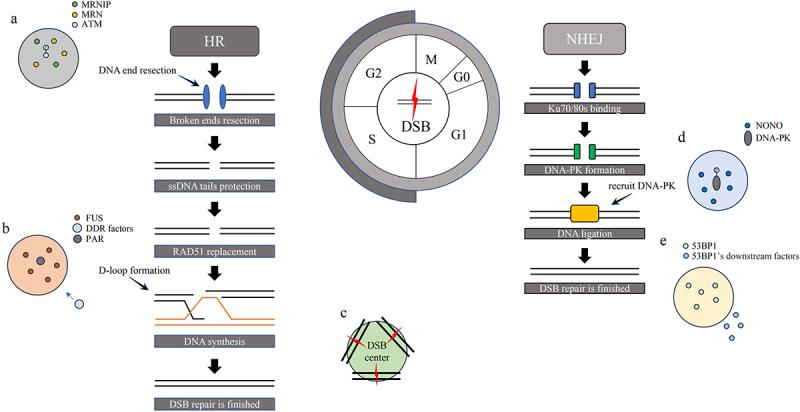
DNA double-strand break (DSB) is the most dangerous type of DNA damage, which may lead to cell death or oncogenic mutations. Homologous recombination (HR) and nonhomologous end-joining (NHEJ) are two typical DSB repair mechanisms. Recently, many studies have revealed that liquid-liquid phase separation (LLPS) plays a pivotal role in DSB repair and response. Through LLPS, the crucial biomolecules are quickly recruited to damaged sites with a high concentration to ensure DNA repair is conducted quickly and efficiently, which facilitates DSB repair factors activating downstream proteins or transmitting signals. In addition, the dysregulation of the DSB repair factor's phase separation has been reported to promote the development of a variety of diseases. This review not only provides a comprehensive overview of the emerging roles of LLPS in the repair of DSB but also sheds light on the regulatory patterns of phase separation in relation to the DNA damage response (DDR).
DNA 双链断裂(DSB)是最危险的 DNA 损伤类型,可能导致细胞死亡或致癌突变。同源重组(HR)和非同源末端连接(NHEJ)是两种典型的 DSB 修复机制。最近,许多研究表明,液-液相分离(LLPS)在 DSB 修复和反应中起着关键作用。通过 LLPS,关键的生物分子迅速被募集到损伤部位,浓度很高,以确保 DNA 修复快速高效进行,从而促进 DSB 修复因子激活下游蛋白或传递信号。此外,DSB 修复因子相分离的失调已被报道会促进多种疾病的发展。本综述不仅全面概述了 LLPS 在 DSB 修复中的新作用,还阐明了相分离与 DNA 损伤反应(DDR)相关的调控模式。
 Zotero 插件