
单克隆抗体和下一代抗体的最新进展。
Recent Advances in the Development of Monoclonal Antibodies and Next-Generation Antibodies.
机构信息
Department of Biosciences and Bioengineering, Indian Institute of Technology Roorkee, Uttarakhand, India.
出版信息
Immunohorizons. 2023 Dec 1;7(12):886-897. doi: 10.4049/immunohorizons.2300102.
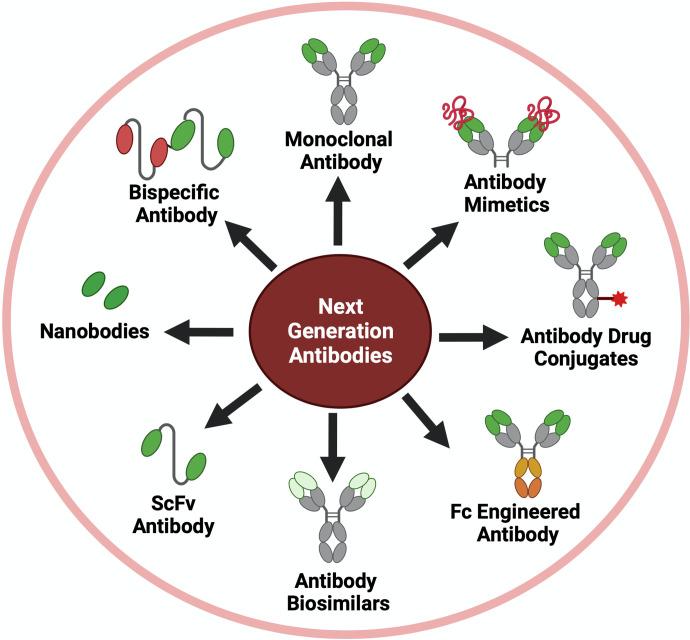
mAbs are highly indispensable tools for diagnostic, prophylactic, and therapeutic applications. The first technique, hybridoma technology, was based on fusion of B lymphocytes with myeloma cells, which resulted in generation of single mAbs against a specific Ag. Along with hybridoma technology, several novel and alternative methods have been developed to improve mAb generation, ranging from electrofusion to the discovery of completely novel technologies such as B cell immortalization; phage, yeast, bacterial, ribosome, and mammalian display systems; DNA/RNA encoded Abs; single B cell technology; transgenic animals; and artificial intelligence/machine learning. This commentary outlines the evolution, methodology, advantages, and limitations of various mAb production techniques. Furthermore, with the advent of next-generation Ab technologies such as single-chain variable fragments, nanobodies, bispecific Abs, Fc-engineered Abs, Ab biosimilars, Ab mimetics, and Ab-drug conjugates, the healthcare and pharmaceutical sectors have become resourceful to develop highly specific mAb treatments against various diseases such as cancer and autoimmune and infectious diseases.
单克隆抗体是诊断、预防和治疗应用中不可或缺的重要工具。第一种技术,杂交瘤技术,基于 B 淋巴细胞与骨髓瘤细胞的融合,从而产生针对特定抗原的单克隆抗体。除了杂交瘤技术之外,还开发了几种新颖的替代方法来提高单克隆抗体的生成,从电融合到发现完全新颖的技术,如 B 细胞永生化;噬菌体、酵母、细菌、核糖体和哺乳动物展示系统;DNA/RNA 编码抗体;单细胞技术;转基因动物;人工智能/机器学习。本评论概述了各种单克隆抗体生产技术的演变、方法、优势和局限性。此外,随着下一代抗体技术的出现,如单链可变片段、纳米抗体、双特异性抗体、Fc 工程化抗体、抗体生物类似药、抗体模拟物和抗体药物偶联物,医疗保健和制药行业已经变得富有创造力,能够针对癌症和自身免疫性及传染性疾病等各种疾病开发高度特异性的单克隆抗体治疗方法。

 Zotero 插件