
腰高比与新发高血压风险之间存在类似的U型非线性关联:中国健康与营养调查结果
There was a similar U-shaped nonlinear association between waist-to-height ratio and the risk of new-onset hypertension: findings from the CHNS.
作者信息
Wang Zhenwei, Shi Qian, Yan Xuejiao, Tang Junnan, Zhang Jinying
机构信息
Department of Cardiology, The First Affiliated Hospital of Zhengzhou University, Zhengzhou, China.
Key Laboratory of Cardiac Injury and Repair of Henan Province, Zhengzhou, China.
出版信息
Front Nutr. 2023 Dec 14;10:1304521. doi: 10.3389/fnut.2023.1304521. eCollection 2023.
BACKGROUND
The association between waist-to-height ratio (WHtR) with hypertension has not been adequately explained, so in this study we sought to clarify the predictive role of WHtR on the incidence of hypertension as well as the potential nonlinear associations in the general population.
METHODS
In this large prospective cohort study, a total of 4,458 individuals from the China Health and Nutrition Survey (CHNS) were included in the analysis. Multivariate Cox regression analyses, subgroup analyses, receiver operator characteristic (ROC) and restricted cubic spline (RCS) analyses were used to examine the association of WHtR with the risk of new-onset hypertension.
RESULTS
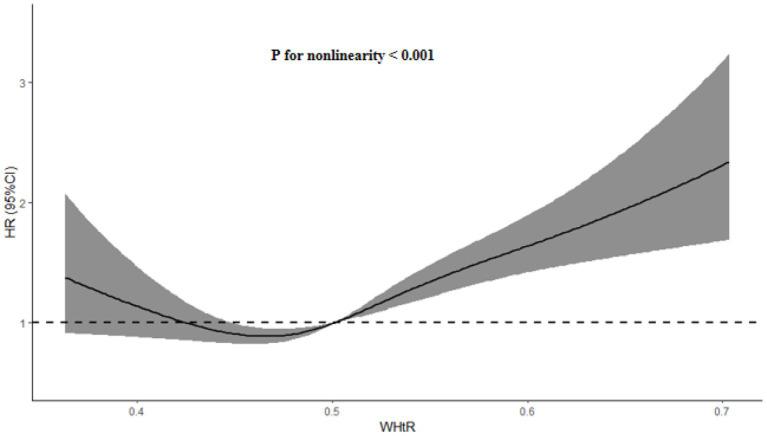
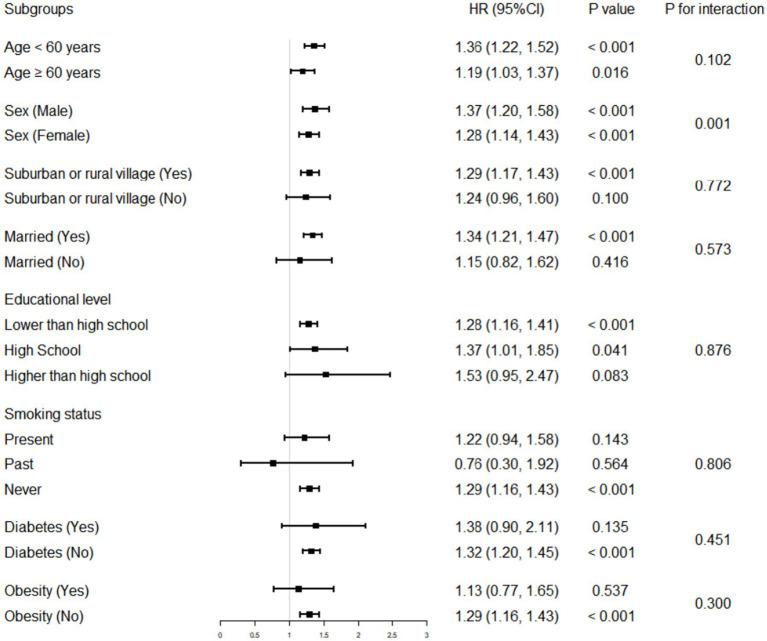
Hypertension occurred in 32.8% of participants during the maximum six-year follow-up period. Compared with the group with lower WHtR, the group with higher WHtR had a higher incidence of hypertension ( < 0.001). Multivariate Cox regression analysis showed that the risk of hypertension was 1.45 times higher in the high WHtR group than in the low WHtR group, and that the risk of hypertension increased by 30.4% for every 0.1 unit increase in WHtR ( < 0.001). Subgroup analyses also validated the stratified associations between WHtR and the risk of new-onset hypertension in most subgroups ( < 0.05). ROC analyses also revealed that WHtR was superior to body mass index in predicting new-onset hypertension (AUC: 0.626 vs. 0.607, = 0.009). Further RCS analysis detected a nonlinear association between WHtR and risk of new-onset hypertension (P for nonlinearity <0.001).
CONCLUSION
WHtR was nonlinearly associated with the risk of new-onset hypertension in the general population.
背景
腰高比(WHtR)与高血压之间的关联尚未得到充分解释,因此在本研究中,我们试图阐明WHtR对高血压发病率的预测作用以及在一般人群中的潜在非线性关联。
方法
在这项大型前瞻性队列研究中,分析纳入了来自中国健康与营养调查(CHNS)的4458名个体。采用多变量Cox回归分析、亚组分析、受试者工作特征(ROC)和限制性立方样条(RCS)分析来检验WHtR与新发高血压风险的关联。
结果
在最长六年的随访期内,32.8%的参与者发生了高血压。与WHtR较低的组相比,WHtR较高的组高血压发病率更高(<0.001)。多变量Cox回归分析显示,高WHtR组高血压风险比低WHtR组高1.45倍,且WHtR每增加0.1个单位,高血压风险增加30.4%(<0.001)。亚组分析也验证了大多数亚组中WHtR与新发高血压风险之间的分层关联(<0.05)。ROC分析还显示,在预测新发高血压方面,WHtR优于体重指数(AUC:0.626对0.607,=0.009)。进一步的RCS分析发现WHtR与新发高血压风险之间存在非线性关联(非线性P<0.001)。
结论
在一般人群中,WHtR与新发高血压风险呈非线性关联。



 Zotero 插件