
确定与马来西亚精神分裂症患者相关的风险因素,包括真菌感染和寄生虫感染。
Establishing associated risk factors, including fungal and parasitic infections among Malaysians living with schizophrenia.
机构信息
Department of Parasitology, Universiti Malaya (UM), Kuala Lumpur, Malaysia.
Department of Medical Microbiology, Universiti Malaya (UM), Kuala Lumpur, Malaysia.
出版信息
Sci Rep. 2024 Jan 3;14(1):385. doi: 10.1038/s41598-023-50299-7.
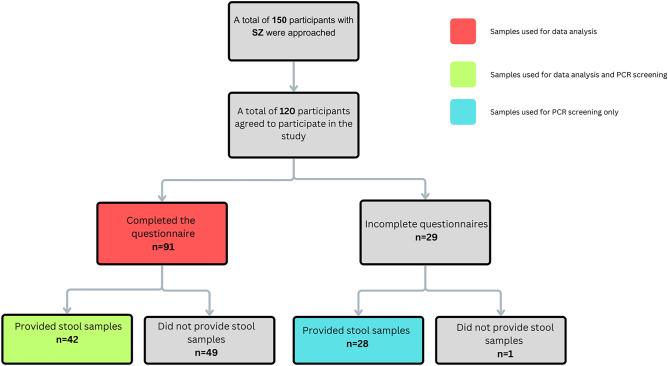
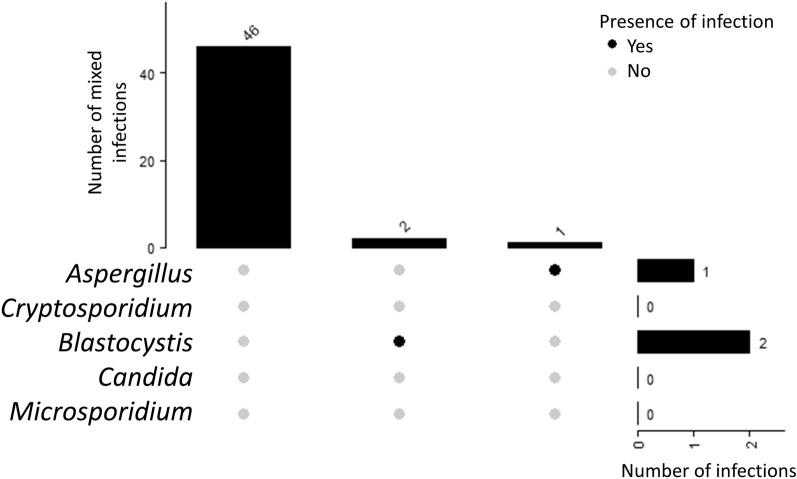
The aetiology of schizophrenia is multifactorial, and the identification of its risk factors are scarce and highly variable. A cross-sectional study was conducted to investigate the risk factors associated with schizophrenia among Malaysian sub-population. A total of 120 individuals diagnosed with schizophrenia (SZ) and 180 non-schizophrenic (NS) individuals participated in a questionnaire-based survey. Data of complete questionnaire responses obtained from 91 SZ and 120 NS participants were used in statistical analyses. Stool samples were obtained from the participants and screened for gut parasites and fungi using conventional polymerase chain reaction (PCR). The median age were 46 years (interquartile range (IQR) 37 to 60 years) and 35 years (IQR 24 to 47.75 years) for SZ and NS respectively. Multivariable binary logistic regression showed that the factors associated with increased risk of SZ were age, sex, unemployment, presence of other chronic ailment, smoking, and high dairy consumption per week. These factors, except sex, were positively associated with the severity of SZ. Breastfed at infancy as well as vitamin and supplement consumption showed a protective effect against SZ. After data clean-up, fungal or parasitic infections were found in 98% (39/42). of SZ participants and 6.1% (3/49) of NS participants. Our findings identified non-modifiable risk factors (age and sex) and modifiable lifestyle-related risk factors (unemployment, presence of other chronic ailment, smoking, and high dairy consumption per week) associated with SZ and implicate the need for medical attention in preventing fungal and parasitic infections in SZ.
精神分裂症的病因是多因素的,其风险因素的识别很少且高度可变。进行了一项横断面研究,以调查马来西亚亚人群中与精神分裂症相关的风险因素。共有 120 名被诊断为精神分裂症(SZ)的个体和 180 名非精神分裂症(NS)个体参与了基于问卷的调查。从 91 名 SZ 和 120 名 NS 参与者中获得了完整问卷回复的数据,并用于统计分析。从参与者中获得粪便样本,并使用常规聚合酶链反应(PCR)筛查肠道寄生虫和真菌。SZ 和 NS 的中位数年龄分别为 46 岁(四分位距(IQR)37 至 60 岁)和 35 岁(IQR 24 至 47.75 岁)。多变量二项逻辑回归显示,与 SZ 风险增加相关的因素是年龄、性别、失业、存在其他慢性疾病、吸烟和每周高乳制品摄入量。这些因素除性别外,与 SZ 的严重程度呈正相关。婴儿期母乳喂养以及维生素和补品的摄入对 SZ 有保护作用。在数据清理后,发现 98%(39/42)的 SZ 参与者和 6.1%(3/49)的 NS 参与者存在真菌或寄生虫感染。我们的研究结果确定了与 SZ 相关的不可改变的风险因素(年龄和性别)和可改变的与生活方式相关的风险因素(失业、存在其他慢性疾病、吸烟和每周高乳制品摄入量),并暗示需要注意医疗预防 SZ 中的真菌感染和寄生虫感染。



 Zotero 插件