
老年中国人血糖代谢指标与结直肠癌风险的关联:广州生物样本库队列研究-心血管疾病子研究的13年随访及荟萃分析
Association of Measures of Glucose Metabolism with Colorectal Cancer Risk in Older Chinese: A 13-Year Follow-up of the Guangzhou Biobank Cohort Study-Cardiovascular Disease Substudy and Meta-Analysis.
作者信息
Wang Shu Yi, Zhang Wei Sen, Jiang Chao Qiang, Jin Ya Li, Zhu Tong, Zhu Feng, Xu Lin
机构信息
Department of Epidemiology, School of Public Health, Sun Yat-sen University, Guangzhou, China.
Occupational Disease Prevention and Treatment Centre, Guangzhou Twelfth People's Hospital, Guangzhou, China.
出版信息
Diabetes Metab J. 2024 Jan;48(1):134-145. doi: 10.4093/dmj.2022.0383. Epub 2024 Jan 3.
BACKGRUOUND
Abnormal glucose metabolism is a risk factor for colorectal cancer (CRC). However, association of glycosylated hemoglobin (HbA1c) with CRC risk remains under-reported. We examined the association between glycemic indicators (HbA1c, fasting plasma glucose, fasting insulin, 2-hour glucose, 2-hour insulin, and homeostasis model of risk assessment-insulin resistance index) and CRC risk using prospective analysis and meta-analysis.
METHODS
Participants (n=1,915) from the Guangzhou Biobank Cohort Study-Cardiovascular Disease Substudy were included. CRC events were identified through record linkage. Cox regression was used to assess the associations of glycemic indicators with CRC risk. A meta-analysis was performed to investigate the association between HbA1c and CRC risk.
RESULTS
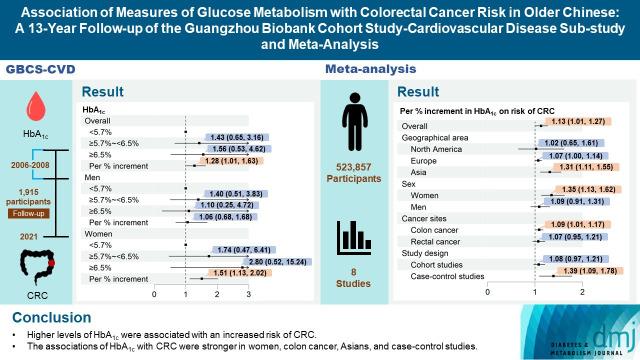
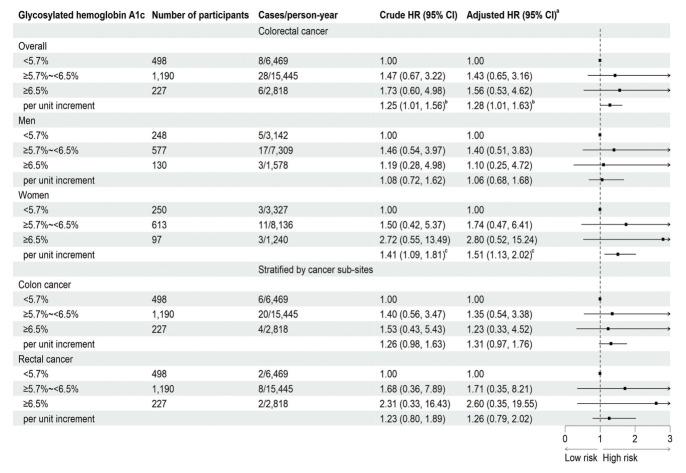
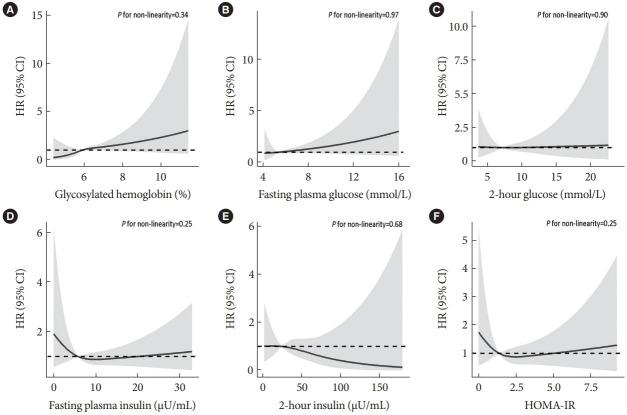
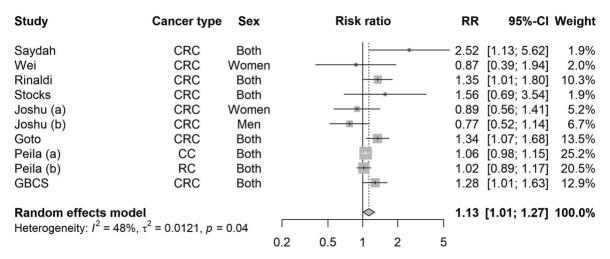
During an average of 12.9 years follow-up (standard deviation, 2.8), 42 incident CRC cases occurred. After adjusting for potential confounders, the hazard ratio (95% confidence interval [CI]) of CRC for per % increment in HbA1c was 1.28 (95% CI, 1.01 to 1.63) in overall population, 1.51 (95% CI, 1.13 to 2.02) in women and 1.06 (95% CI, 0.68 to 1.68) in men. No significant association of other measures of glycemic indicators and baseline diabetes with CRC risk was found. Meta-analyses of 523,857 participants including our results showed that per % increment of HbA1c was associated with 13% higher risk of CRC, with the pooled risk ratio being 1.13 (95% CI, 1.01 to 1.27). Subgroupanalyses found stronger associations in women, colon cancer, Asians, and case-control studies.
CONCLUSION
Higher HbA1c was a significant predictor of CRC in the general population. Our findings shed light on the pathology of glucose metabolism and CRC, which warrants more in-depth investigation.
背景
葡萄糖代谢异常是结直肠癌(CRC)的一个危险因素。然而,糖化血红蛋白(HbA1c)与CRC风险之间的关联仍报道不足。我们使用前瞻性分析和荟萃分析研究了血糖指标(HbA1c、空腹血糖、空腹胰岛素、2小时血糖、2小时胰岛素以及风险评估稳态模型-胰岛素抵抗指数)与CRC风险之间的关联。
方法
纳入了来自广州生物银行队列研究-心血管疾病子研究的参与者(n = 1915)。通过记录链接确定CRC事件。采用Cox回归评估血糖指标与CRC风险的关联。进行荟萃分析以研究HbA1c与CRC风险之间的关联。
结果
在平均12.9年的随访期间(标准差为2.8),发生了42例新发CRC病例。在调整潜在混杂因素后,总体人群中HbA1c每增加1%,CRC的风险比(95%置信区间[CI])为1.28(95%CI,1.01至1.63),女性为1.51(95%CI,1.13至2.02),男性为1.06(95%CI,0.68至1.68)。未发现其他血糖指标测量值及基线糖尿病与CRC风险有显著关联。包括我们的结果在内的对523857名参与者的荟萃分析表明,HbA1c每增加1%与CRC风险高13%相关,合并风险比为1.13(95%CI,1.01至1.27)。亚组分析发现女性、结肠癌、亚洲人和病例对照研究中的关联更强。
结论
较高的HbA1c是一般人群中CRC的一个重要预测指标。我们的研究结果为葡萄糖代谢和CRC的病理学提供了线索,值得进一步深入研究。
 Zotero 插件