
新冠病毒加强疫苗接种后诱导耐受和非炎症性 SARS-CoV-2 刺突特异性 IgG4 抗体的出现。
Appearance of tolerance-induction and non-inflammatory SARS-CoV-2 spike-specific IgG4 antibodies after COVID-19 booster vaccinations.
机构信息
Infectious Diseases Division, International Centre for Diarrhoeal Disease Research Bangladesh (icddr,b), Dhaka, Bangladesh.
Bangladesh Institute of Tropical & Infectious Diseases, Chittagong, Bangladesh.
出版信息
Front Immunol. 2023 Dec 20;14:1309997. doi: 10.3389/fimmu.2023.1309997. eCollection 2023.
BACKGROUND
Understanding the characteristics of the humoral immune responses following COVID-19 vaccinations is crucial for refining vaccination strategies and predicting immune responses to emerging SARS-CoV-2 variants.
METHODS
A longitudinal analysis of SARS-CoV-2 spike receptor binding domain (RBD) specific IgG antibody responses, encompassing IgG subclasses IgG1, IgG2, IgG3, and IgG4 was performed. Participants received four mRNA vaccine doses (group 1; n=10) or two ChAdOx1 nCoV-19 and two mRNA booster doses (group 2; n=19) in Bangladesh over two years.
RESULTS
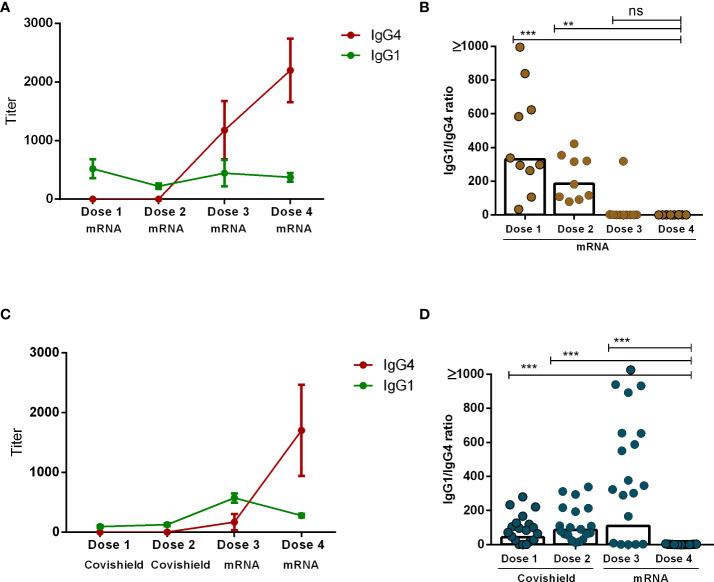
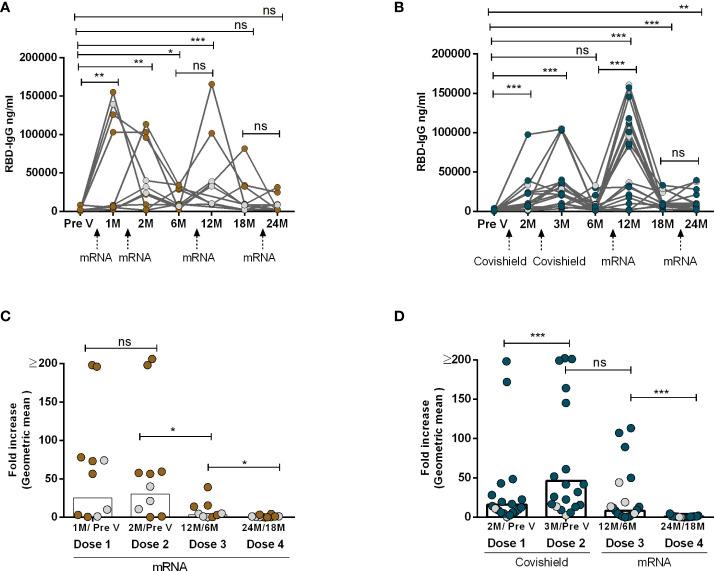
Findings demonstrate robust IgG responses after primary Covishield or mRNA doses; declining to baseline within six months. First mRNA booster restored and surpassed primary IgG responses but waned after six months. Surprisingly, a second mRNA booster did not increase IgG levels further. Comprehensive IgG subclass analysis showed primary Covishield/mRNA vaccination generated predominantly IgG1 responses with limited IgG2/IgG3, Remarkably, IgG4 responses exhibited a distinct pattern. IgG4 remained undetectable initially but increased extensively six months after the second mRNA dose, eventually replacing IgG1 after the 3rd/4th mRNA doses. Conversely, initial Covishield recipients lack IgG4, surged post-second mRNA booster. Notably, mRNA-vaccinated individuals displayed earlier, robust IgG4 levels post first mRNA booster versus Covishield counterparts. IgG1 to IgG4 ratios decreased with increasing doses, most pronounced with four mRNA doses. This study highlights IgG response kinetics, influenced by vaccine type and doses, impacting immunological tolerance and IgG4 induction, shaping future vaccination strategies.
CONCLUSIONS
This study highlights the dynamics of IgG responses dependent on vaccine type and number of doses, leading to immunological tolerance and IgG4 induction, and shaping future vaccination strategies.
背景
了解 COVID-19 疫苗接种后体液免疫反应的特征对于完善疫苗接种策略和预测对新型 SARS-CoV-2 变异的免疫反应至关重要。
方法
对 SARS-CoV-2 刺突受体结合域(RBD)特异性 IgG 抗体反应进行了纵向分析,包括 IgG 亚类 IgG1、IgG2、IgG3 和 IgG4。参与者在两年内在孟加拉国接受了四剂 mRNA 疫苗(第 1 组;n=10)或两剂 ChAdOx1 nCoV-19 和两剂 mRNA 加强针(第 2 组;n=19)。
结果
研究结果表明,Covishield 或 mRNA 初级剂量后产生了强大的 IgG 反应;在六个月内下降到基线。第一次 mRNA 加强针恢复并超过了初级 IgG 反应,但在六个月后减弱。令人惊讶的是,第二次 mRNA 加强针并没有进一步增加 IgG 水平。全面的 IgG 亚类分析表明,初级 Covishield/mRNA 疫苗接种主要产生 IgG1 反应,而 IgG2/IgG3 反应有限。值得注意的是,IgG4 反应表现出明显的模式。IgG4 最初无法检测到,但在第二次 mRNA 剂量后六个月内广泛增加,最终在第三次/第四次 mRNA 剂量后取代 IgG1。相反,最初接受 Covishield 疫苗的人缺乏 IgG4,但在第二次 mRNA 加强针后激增。值得注意的是,与 Covishield 相比,mRNA 疫苗接种者在第一次 mRNA 加强针后更早、更强烈地出现 IgG4 水平。随着剂量的增加,IgG1 与 IgG4 的比值下降,在接受四剂 mRNA 疫苗接种的人群中最为明显。本研究强调了依赖于疫苗类型和剂量的 IgG 反应动力学,导致免疫耐受和 IgG4 诱导,从而塑造未来的疫苗接种策略。
结论
本研究强调了依赖于疫苗类型和剂量的 IgG 反应动态,导致免疫耐受和 IgG4 诱导,并塑造未来的疫苗接种策略。


 Zotero 插件