
肠道微生物群、循环细胞因子与痴呆:一项孟德尔随机化研究。
Gut microbiota, circulating cytokines and dementia: a Mendelian randomization study.
机构信息
Department of Anesthesiology, The First Affiliated Hospital of Anhui Medical University, No.218 Jixi Road, Shushan District, Hefei, Anhui, China.
Department of Epidemiology and Biostatistics, School of Public Health, Anhui Medical University, Hefei, Anhui, China.
出版信息
J Neuroinflammation. 2024 Jan 4;21(1):2. doi: 10.1186/s12974-023-02999-0.
BACKGROUND
Some studies have shown that gut microbiota may be associated with dementia. However, the causal effects between gut microbiota and different types of dementia and whether cytokines act as a mediator remain unclear.
METHODS
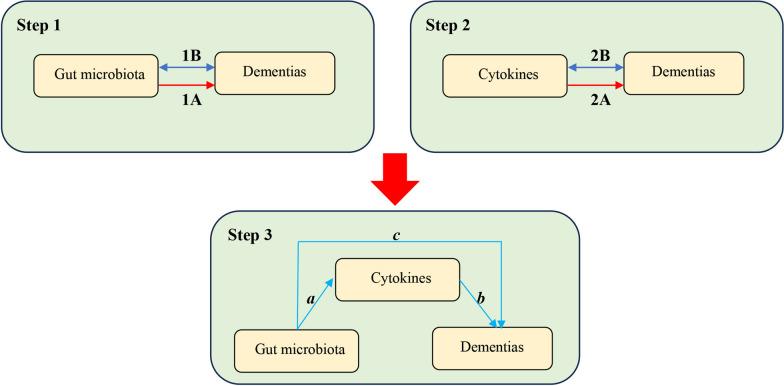
Gut microbiota, cytokines, and five dementia types, including Alzheimer's disease (AD), frontotemporal dementia (FTD), dementia with Lewy body (DLB), vascular dementia (VD), and Parkinson's disease dementia (PDD) were identified from large-scale genome-wide association studies (GWAS) summary data. We used Mendelian randomization (MR) to investigate the causal relationships between gut microbiota, cytokines, and five types of dementia. Inverse variance weighting (IVW) was used as the main statistical method. In addition, we explored whether cytokines act as a mediating factor in the pathway from gut microbiota to dementia.
RESULTS
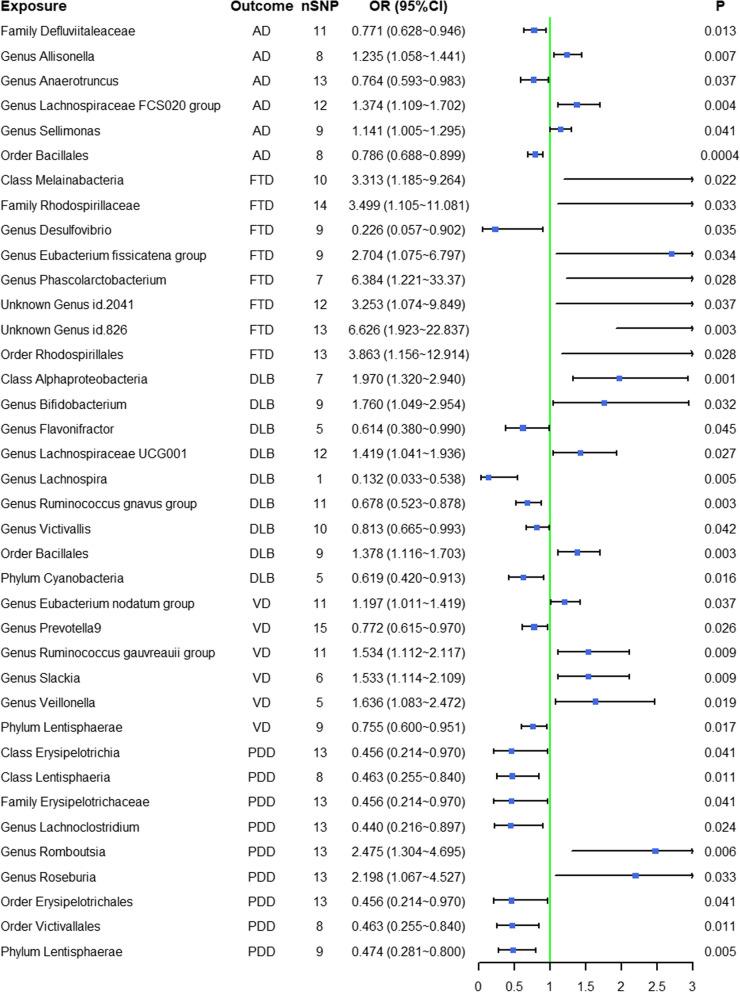
There were 20 positive and 16 negative causal effects between genetic liability in the gut microbiota and dementia. Also, there were five positive and four negative causal effects between cytokines and dementias. Cytokines did not act as mediating factors.
CONCLUSIONS
Gut microbiota and cytokines were causally associated with five types of dementia, and cytokines seemed not to be the mediating factors in the pathway from gut microbiota to dementia.
背景
一些研究表明,肠道微生物群可能与痴呆有关。然而,肠道微生物群与不同类型痴呆之间的因果关系以及细胞因子是否作为中介物仍然不清楚。
方法
从大规模全基因组关联研究(GWAS)汇总数据中鉴定了肠道微生物群、细胞因子和五种痴呆类型,包括阿尔茨海默病(AD)、额颞叶痴呆(FTD)、路易体痴呆(DLB)、血管性痴呆(VD)和帕金森病痴呆(PDD)。我们使用孟德尔随机化(MR)来研究肠道微生物群、细胞因子与五种类型痴呆之间的因果关系。逆方差加权(IVW)被用作主要的统计方法。此外,我们还探讨了细胞因子是否在肠道微生物群向痴呆发展的途径中充当中介因素。
结果
肠道微生物群遗传易感性与痴呆之间存在 20 个正向和 16 个负向的因果关系。此外,细胞因子与痴呆之间存在 5 个正向和 4 个负向的因果关系。细胞因子不作为中介因素。
结论
肠道微生物群和细胞因子与五种类型的痴呆有因果关系,细胞因子似乎不是肠道微生物群向痴呆发展的中介因素。

 Zotero 插件