
2 型糖尿病患者体重指数和腰围的变化与心力衰竭。
Changes in body mass index and waist circumference and heart failure in type 2 diabetes mellitus.
机构信息
Department of Critical Care Medicine, Second Xiangya Hospital, Central South University, Changsha, China.
Department of Emergency Department, Second Xiangya Hospital, Central South University, Changsha, China.
出版信息
Front Endocrinol (Lausanne). 2023 Dec 21;14:1305839. doi: 10.3389/fendo.2023.1305839. eCollection 2023.
BACKGROUND
To determine the association of unintentional changes in body mass index (BMI) and waist circumference (WC) with the risk of heart failure (HF) among adults with type 2 diabetes mellitus (T2DM).
METHODS
This was a randomized controlled trial (the Action to Control Cardiovascular Risk in Diabetes [ACCORD] study), with a double 2×2 factorial design conducted at 77 clinical centers across the United States and Canada. In total, the study comprised 10,251 patients with T2DM and cardiovascular disease (CVD) or at a high risk of CVD. The outcome of interest in the present analysis was incident HF, defined as the first hospitalization event for HF or death due to HF. Hospitalization for HF was based on documented clinical and radiological evidence. Death due to HF was based on clinical, radiological, or postmortem evidence of HF, with an absence of an acute ischemic event according to clinical or postmortem evidence.
RESULTS
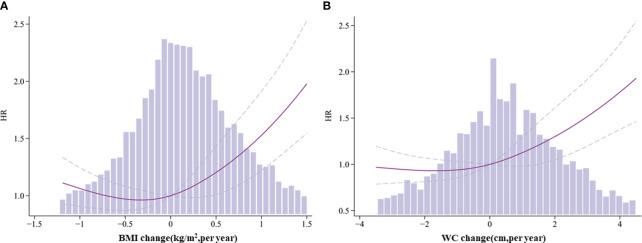
Participants with class III obesity had the smallest BMI and WC changes, followed by those with normal weight, overweight, class I obesity, and class II obesity. Increasing BMI (hazard ratio [HR] per standard deviation increase, 1.24; 95% confidence interval [CI], 1.07-1.45) and WC (1.27; 1.10-1.47) were significantly associated with a higher risk of HF. The relationship between BMI and WC changes and HF formed a J-shaped curve, while stable BMI and WC were associated with lower risks of HF. Compared with participants in the first tertiles of BMI and WC change, those in the third tertiles had HRs of 1.41 (95% CI, 1.07-1.45) and 1.48 (1.12-1.95), respectively.
CONCLUSION
In conclusion, our findings suggest a noteworthy association between BMI and WC changes among adults with T2DM in HF. We observed a distinctive J-shaped curve in this relationship, indicating that participants with both low and high BMI and WC changes were more susceptible to developing HF.
TRIAL REGISTRATION
http://www.clinicaltrials.gov. Unique identifier: NCT00000620.
背景
本研究旨在探讨 2 型糖尿病(T2DM)患者体质量指数(BMI)和腰围(WC)的非故意变化与心力衰竭(HF)风险之间的关联。
方法
本研究为一项随机对照试验(心血管风险控制行动研究,即 ACCORD 研究),采用美国和加拿大 77 个临床中心的双 2×2 析因设计。共纳入 10251 例合并心血管疾病(CVD)或 CVD 高危因素的 T2DM 患者。本分析的主要终点事件为 HF 事件,包括 HF 首次住院或 HF 相关死亡。HF 住院的定义为依据临床和影像学证据确诊的 HF 住院;HF 相关死亡的定义为依据临床、影像学或尸检证据确诊的 HF 死亡,且无急性缺血性事件的临床或尸检证据。
结果
Ⅲ级肥胖患者的 BMI 和 WC 变化最小,随后依次为体重正常、超重、Ⅰ级肥胖和Ⅱ级肥胖患者。BMI 每增加 1 个标准差(HR 为 1.24;95%CI 为 1.071.45)和 WC 每增加 1 个标准差(HR 为 1.27;95%CI 为 1.101.47)与 HF 风险升高显著相关。BMI 和 WC 变化与 HF 之间的关系呈“J”型曲线,而 BMI 和 WC 稳定与 HF 风险降低相关。与 BMI 和 WC 变化第 1 三分位的患者相比,第 3 三分位患者的 HR 分别为 1.41(95%CI 为 1.071.45)和 1.48(95%CI 为 1.121.95)。
结论
总之,本研究结果提示,T2DM 患者 HF 中 BMI 和 WC 变化之间存在显著关联。我们观察到这种关系呈明显的“J”型曲线,提示 BMI 和 WC 变化程度低和高的患者均更易发生 HF。
试验注册


 Zotero 插件