
用于癌症治疗中免疫调节的纳米材料封装的STING激动剂。
Nanomaterial-encapsulated STING agonists for immune modulation in cancer therapy.
作者信息
Chen Xi, Xu Zhijie, Li Tongfei, Thakur Abhimanyu, Wen Yu, Zhang Kui, Liu Yuanhong, Liang Qiuju, Liu Wangrui, Qin Jiang-Jiang, Yan Yuanliang
机构信息
Department of Pharmacy, Xiangya Hospital, Central South University, 410008, Changsha, Hunan, China.
Department of Pathology, Xiangya Hospital, Central South University, 410008, Changsha, Hunan, China.
出版信息
Biomark Res. 2024 Jan 7;12(1):2. doi: 10.1186/s40364-023-00551-z.
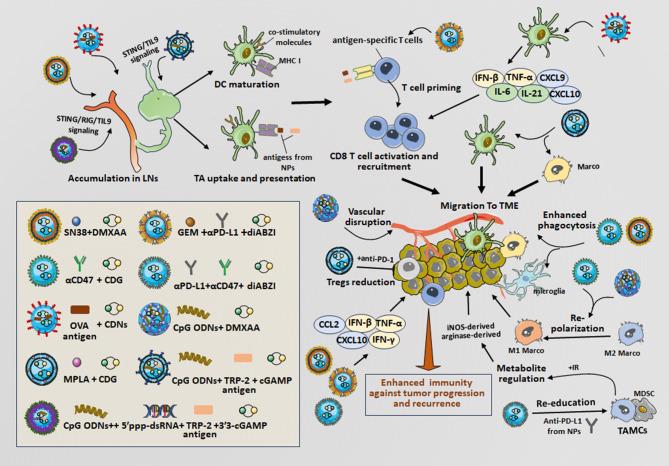
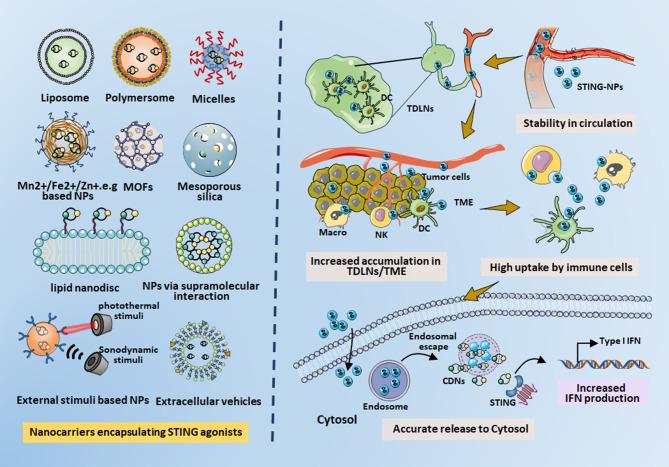
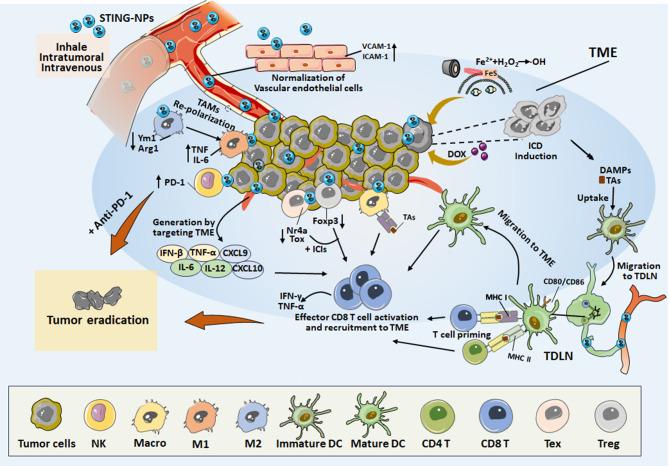
The cGAS-STING signaling pathway has emerged as a critical mediator of innate immune responses, playing a crucial role in improving antitumor immunity through immune effector responses. Targeting the cGAS-STING pathway holds promise for overcoming immunosuppressive tumor microenvironments (TME) and promoting effective tumor elimination. However, systemic administration of current STING agonists faces challenges related to low bioavailability and potential adverse effects, thus limiting their clinical applicability. Recently, nanotechnology-based strategies have been developed to modulate TMEs for robust immunotherapeutic responses. The encapsulation and delivery of STING agonists within nanoparticles (STING-NPs) present an attractive avenue for antitumor immunotherapy. This review explores a range of nanoparticles designed to encapsulate STING agonists, highlighting their benefits, including favorable biocompatibility, improved tumor penetration, and efficient intracellular delivery of STING agonists. The review also summarizes the immunomodulatory impacts of STING-NPs on the TME, including enhanced secretion of pro-inflammatory cytokines and chemokines, dendritic cell activation, cytotoxic T cell priming, macrophage re-education, and vasculature normalization. Furthermore, the review offers insights into co-delivered nanoplatforms involving STING agonists alongside antitumor agents such as chemotherapeutic compounds, immune checkpoint inhibitors, antigen peptides, and other immune adjuvants. These platforms demonstrate remarkable versatility in inducing immunogenic responses within the TME, ultimately amplifying the potential for antitumor immunotherapy.
环鸟苷酸-腺苷酸合成酶-干扰素基因刺激蛋白(cGAS-STING)信号通路已成为先天性免疫反应的关键介质,在通过免疫效应反应改善抗肿瘤免疫方面发挥着至关重要的作用。靶向cGAS-STING通路有望克服免疫抑制性肿瘤微环境(TME)并促进有效的肿瘤清除。然而,目前STING激动剂的全身给药面临着生物利用度低和潜在不良反应等挑战,从而限制了它们的临床应用。最近,基于纳米技术的策略已被开发出来,用于调节TME以实现强大的免疫治疗反应。将STING激动剂封装并递送至纳米颗粒(STING-NPs)中为抗肿瘤免疫治疗提供了一条有吸引力的途径。本综述探讨了一系列旨在封装STING激动剂的纳米颗粒,强调了它们的优点,包括良好的生物相容性、改善的肿瘤穿透性以及STING激动剂的高效细胞内递送。该综述还总结了STING-NPs对TME的免疫调节影响,包括促炎细胞因子和趋化因子分泌增加、树突状细胞活化、细胞毒性T细胞启动、巨噬细胞重编程以及血管正常化。此外,该综述还深入探讨了涉及STING激动剂与抗肿瘤药物(如化疗化合物、免疫检查点抑制剂、抗原肽和其他免疫佐剂)共同递送的纳米平台。这些平台在TME内诱导免疫原性反应方面表现出显著的多功能性,最终放大了抗肿瘤免疫治疗的潜力。

 Zotero 插件