
韩国在 COVID-19 大流行期间实施的非药物性社交隔离政策的新严格指数的制定:随机森林方法。
Development of New Stringency Indices for Nonpharmacological Social Distancing Policies Implemented in Korea During the COVID-19 Pandemic: Random Forest Approach.
机构信息
Interdisciplinary Program in Bioinformatics, Seoul National University, Seoul, Republic of Korea.
Ross School of Business, University of Michigan-Ann Arbor, Ann Arbor, MI, United States.
出版信息
JMIR Public Health Surveill. 2024 Jan 8;10:e47099. doi: 10.2196/47099.
BACKGROUND
In the absence of an effective treatment method or vaccine, the outbreak of the COVID-19 pandemic elicited a wide range of unprecedented restriction policies aimed at mitigating and suppressing the spread of the SARS-CoV-2 virus. These policies and their Stringency Index (SI) of more than 160 countries were systematically recorded in the Oxford COVID-19 Government Response Tracker (OxCGRT) data set. The SI is a summary measure of the overall strictness of these policies. However, the OxCGRT SI may not fully reflect the stringency levels of the restriction policies implemented in Korea. Korea implemented 33 COVID-19 restriction policies targeting 4 areas: public facilities, public events, social gatherings, and religious gatherings.
OBJECTIVE
This study aims to develop new Korea Stringency Indices (KSIs) that reflect the stringency levels of Korea's restriction policies better and to determine which government-implemented policies were most effective in managing the COVID-19 pandemic in Korea.
METHODS
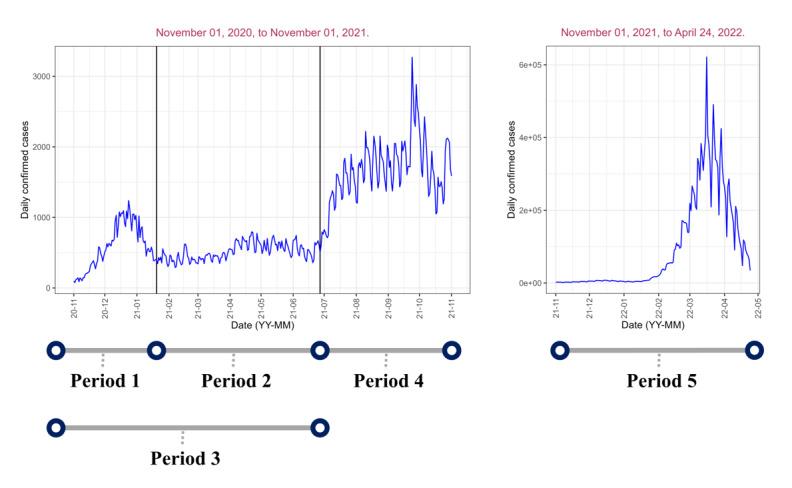
The random forest method was used to calculate the new KSIs using feature importance values and determine their effectiveness in managing daily COVID-19 confirmed cases. Five analysis periods were considered, including November 01, 2020, to January 20, 2021 (Period 1), January 20, 2021, to June 27, 2021 (Period 2), November 01, 2020, to June 27, 2021 (Period 3), June 27, 2021, to November 01, 2021 (Period 4), and November 01, 2021, to April 24, 2022 (Period 5).
RESULTS
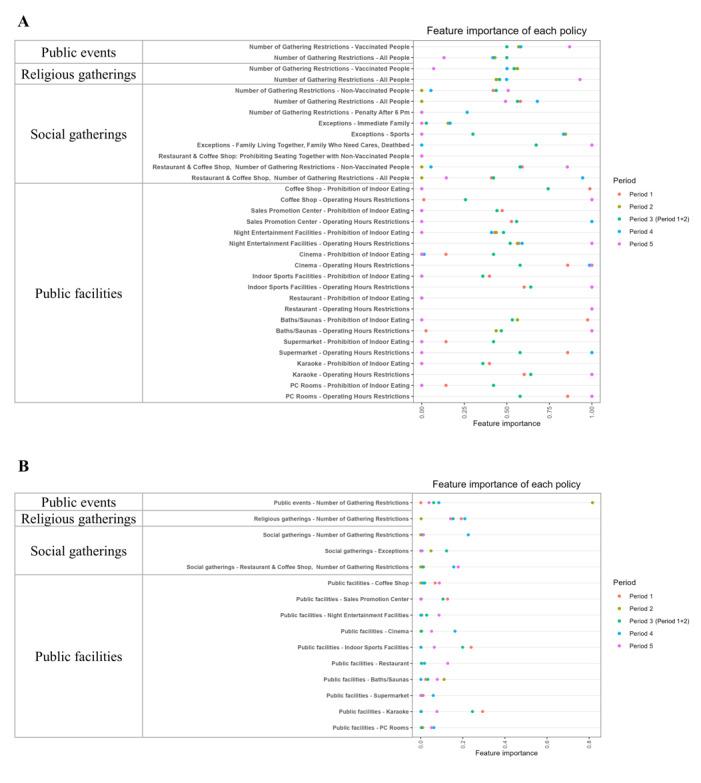
Among the KSIs, public facilities in period 4, public events in period 2, religious gatherings in periods 1 and 3, and social gatherings in period 5 had the highest importance. Among the public facilities, policies associated with operation hour restrictions in cinemas, restaurants, PC rooms, indoor sports facilities, karaoke, coffee shops, night entertainment facilities, and baths or saunas had the highest importance across all analysis periods. Strong positive correlations were observed between daily confirmed cases and public facilities, religious gatherings, and public events in period 1 of the pandemic. From then, weaker and negative correlations were observed in the remaining analysis periods. The comparison with the OxCGRT SI showed that the SI had a relatively lower feature importance and correlation with daily confirmed cases than the proposed KSIs, making KSIs more effective than SI.
CONCLUSIONS
Restriction policies targeting public facilities were the most effective among the policies analyzed. In addition, different periods call for the enforcement of different policies given their effectiveness varies during the pandemic.
背景
在缺乏有效治疗方法或疫苗的情况下,COVID-19 大流行的爆发引发了广泛的前所未有的限制政策,旨在减轻和抑制 SARS-CoV-2 病毒的传播。这些政策及其严格指数(SI)在牛津 COVID-19 政府应对追踪器(OxCGRT)数据集系统地记录了 160 多个国家的政策。SI 是这些政策总体严格程度的综合衡量标准。然而,OxCGRT SI 可能无法完全反映韩国实施的限制政策的严格程度。韩国实施了针对 4 个领域的 33 项 COVID-19 限制政策:公共设施、公共活动、社交聚会和宗教聚会。
目的
本研究旨在开发新的韩国严格指数(KSIs),以更好地反映韩国限制政策的严格程度,并确定在韩国管理 COVID-19 大流行中实施的哪些政策最有效。
方法
使用特征重要值随机森林方法计算新的 KSIs,并确定其在管理每日 COVID-19 确诊病例方面的有效性。考虑了五个分析期,包括 2020 年 11 月 1 日至 2021 年 1 月 20 日(第 1 期)、2021 年 1 月 20 日至 2021 年 6 月 27 日(第 2 期)、2020 年 11 月 1 日至 2021 年 6 月 27 日(第 3 期)、2021 年 6 月 27 日至 2021 年 11 月 1 日(第 4 期)和 2021 年 11 月 1 日至 2022 年 4 月 24 日(第 5 期)。
结果
在 KSIs 中,第 4 期的公共设施、第 2 期的公共活动、第 1 期和第 3 期的宗教集会以及第 5 期的社交聚会的重要性最高。在公共设施中,与电影院、餐厅、PC 室、室内运动设施、卡拉 OK、咖啡店、夜间娱乐设施和浴室或桑拿浴室营业时间限制相关的政策在所有分析期都具有最高的重要性。大流行第 1 期,每日确诊病例与公共设施、宗教集会和公共活动之间存在强烈的正相关关系。从那时起,在剩余的分析期内,相关性减弱且为负相关。与 OxCGRT SI 的比较表明,与提出的 KSIs 相比,SI 与每日确诊病例的特征重要性和相关性较低,因此 KSIs 比 SI 更有效。
结论
分析的政策中,针对公共设施的政策最为有效。此外,鉴于大流行期间政策的有效性会有所不同,不同时期需要实施不同的政策。



 Zotero 插件