
利用基于血液的循环肿瘤 DNA 检测对非小细胞肺癌患者进行全面基因组分析:来自台湾单中心 BFAST 数据库的研究结果。
Comprehensive Genomic Analysis of Patients With Non-Small-Cell Lung Cancer Using Blood-Based Circulating Tumor DNA Assay: Findings From the BFAST Database of a Single Center in Taiwan.
机构信息
Division of Pulmonary and Critical Care Medicine, Department of Internal Medicine, National Taiwan University Hospital Yunlin Branch, Douliu City, Yunlin County, Taiwan.
Graduate Institute of Clinical Medicine, College of Medicine, National Taiwan University, Taipei, Taiwan.
出版信息
JCO Precis Oncol. 2024 Jan;8:e2300314. doi: 10.1200/PO.23.00314.
PURPOSE
The Blood First Assay Screening Trial (BFAST) is a prospective study using next-generation sequencing (NGS) of circulating tumor DNA (ctDNA) in treatment-naïve advanced/metastatic non-small-cell lung cancer (NSCLC). We compared liquid biopsy to tissue testing and analyzed genomic alterations in Taiwanese patients with NSCLC using the BFAST database.
MATERIALS AND METHODS
A total of 269 patients underwent FoundationOne Liquid Companion Diagnostic (F1LCDx) assay at the National Taiwan University Hospital, of whom 264 underwent tissue-based genetic testing also. We analyzed the actionable mutations and the concordance between tissue-based genetic testing, which was limited to , , , and , in a real-life clinical setting and blood-based NGS in the clinical trial. Additionally, we analyzed the co-occurring genomic alterations from the blood-based ctDNA assay.
RESULTS
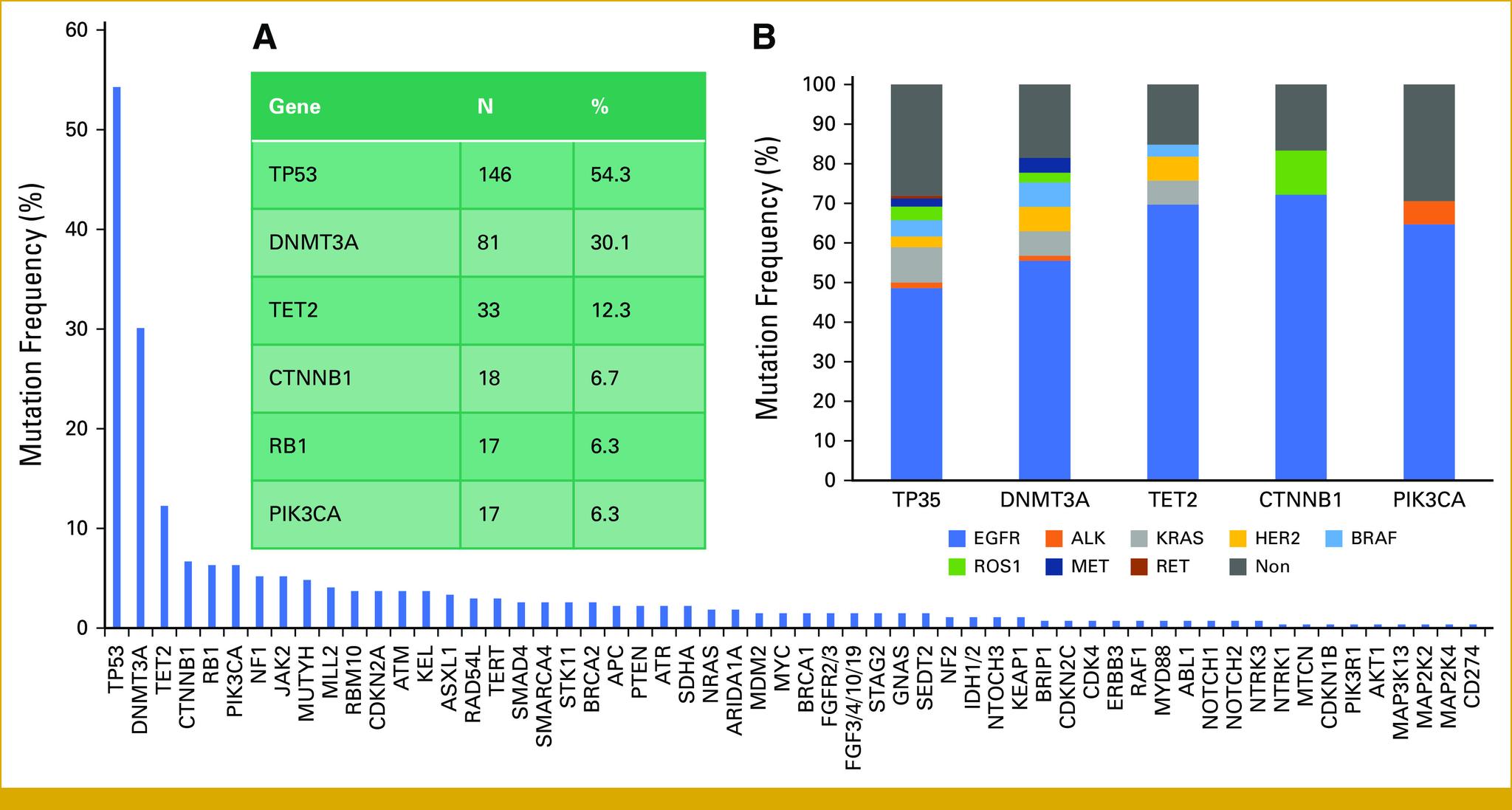
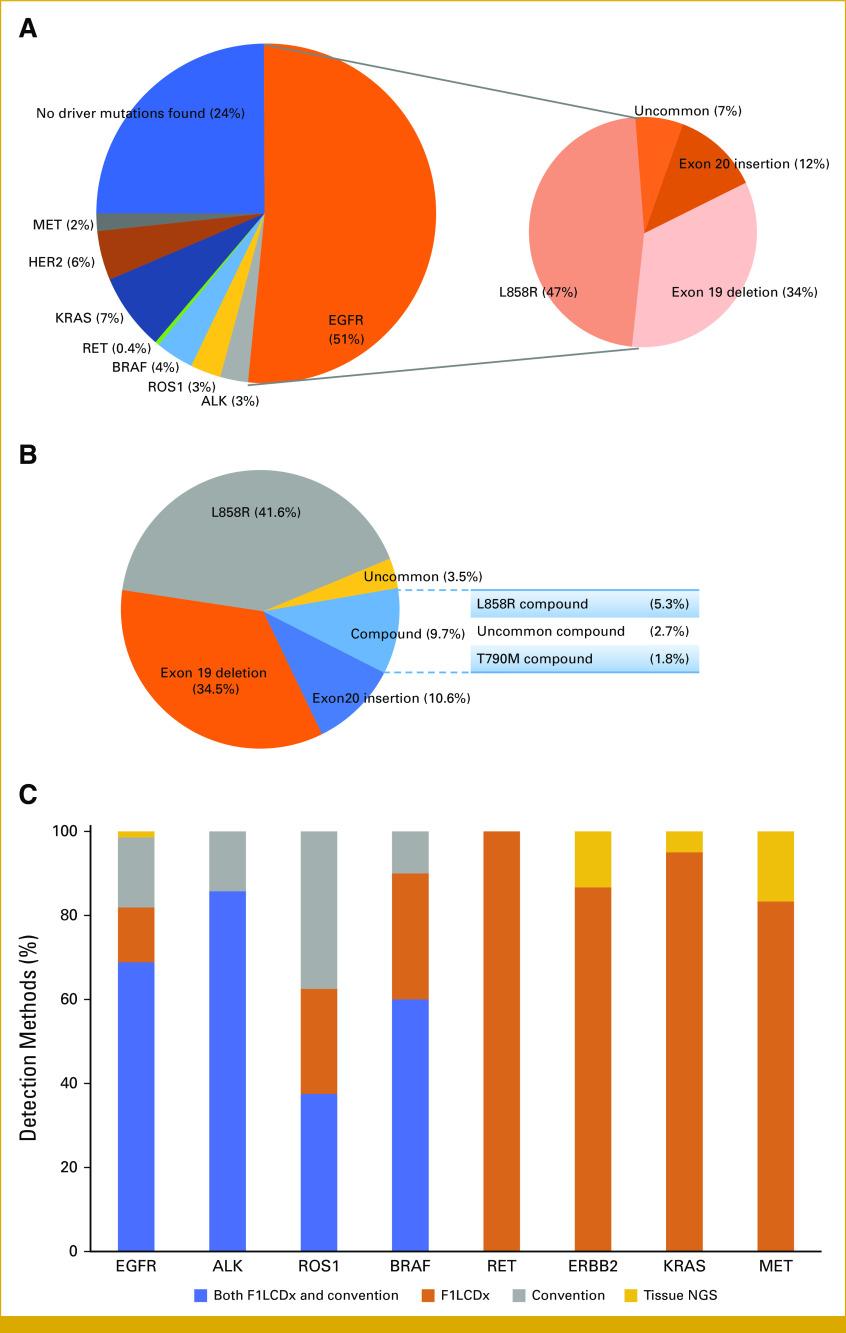
A total of 76.2% patients showed actionable mutations. Standard tissue testing did not detect known driver alterations in about 22.7% of the patients (sensitivity, 70.24%). Liquid NGS detected additional mutations (, , , and ) in 14% of the patients, which went undetected by the standard-of-care testing. The complementary use of ctDNA NGS increased the detection rate by 42%. The F1LCDx assay had a sensitivity of 83.41%. Lower tumor and metastasis stages predicted nondetected blood-based NGS ctDNA results. Common co-occurring mutations in the blood-based NGS ctDNA assay were , , , , , and . Among the patients with EGFR-mutated NSCLC, co-occurring alterations correlated with shorter progression-free survival of EGFR tyrosine kinase inhibitor treatment.
CONCLUSION
NGS ctDNA analysis in comprehensive genetic testing improves actionable mutation identification, vital for treating Asian NSCLC cases with high actionable mutation rates. Lower stages correlated with undetected blood-based NGS ctDNA assay results.
目的
血液首次检测筛选试验(BFAST)是一项使用下一代测序(NGS)对未经治疗的晚期/转移性非小细胞肺癌(NSCLC)患者循环肿瘤 DNA(ctDNA)进行的前瞻性研究。我们比较了液体活检和组织检测,并使用 BFAST 数据库分析了台湾 NSCLC 患者的基因组改变。
材料和方法
共有 269 名患者在国立台湾大学医院接受了 FoundationOne 液体伴随诊断(F1LCDx)检测,其中 264 名患者也进行了组织基因检测。我们分析了真实临床环境中组织基因检测以及临床试验中血液 NGS 之间的可操作突变和一致性,组织基因检测仅限于 、 、 、 和 。此外,我们还分析了来自血液 ctDNA 检测的共发生基因组改变。
结果
共有 76.2%的患者显示出可操作的突变。标准组织检测未能检测到约 22.7%患者的已知驱动突变(敏感性 70.24%)。液体 NGS 在 14%的患者中检测到额外的突变( 、 、 、 和 ),这些突变未被标准护理检测检测到。ctDNA NGS 的互补使用将检测率提高了 42%。F1LCDx 检测的敏感性为 83.41%。较低的肿瘤和转移阶段预测血液 NGS ctDNA 结果无法检测到。血液 NGS ctDNA 检测中常见的共发生突变是 、 、 、 、 和 。在 EGFR 突变型 NSCLC 患者中, 共发生改变与 EGFR 酪氨酸激酶抑制剂治疗的无进展生存期较短相关。
结论
综合基因检测中的 NGS ctDNA 分析可提高可操作的突变识别率,这对治疗亚洲 NSCLC 患者具有重要意义,因为这些患者的可操作突变率较高。较低的分期与血液 NGS ctDNA 检测结果无法检测到相关。
 Zotero 插件