
在类似奥密克戎的时期,对 NHS 急性医院内的患者和医护人员进行无症状 SARS-CoV-2 检测策略的有效性和效率。
The effectiveness and efficiency of asymptomatic SARS-CoV-2 testing strategies for patient and healthcare workers within acute NHS hospitals during an omicron-like period.
机构信息
Clinical and Public Health Group, UK Health Security Agency, London, UK.
Data, Analytics and Surveillance Group, UK Health Security Agency, London, UK.
出版信息
BMC Infect Dis. 2024 Jan 8;24(1):64. doi: 10.1186/s12879-023-08948-9.
BACKGROUND
Asymptomatic SARS-CoV-2 testing of hospitalised patients began in April-2020, with twice weekly healthcare worker (HCW) testing introduced in November-2020. Guidance recommending asymptomatic testing was withdrawn in August-2022. Assessing the impact of this decision from data alone is challenging due to concurrent changes in infection prevention and control practices, community transmission rates, and a reduction in ascertainment rate from reduced testing. Computational modelling is an effective tool for estimating the impact of this change.
METHODS
Using a computational model of SARS-CoV-2 transmission in an English hospital we estimate the effectiveness of several asymptomatic testing strategies, namely; (1) Symptomatic testing of patients and HCWs, (2) testing of all patients on admission with/without repeat testing on days 3 and 5-7, and (3) symptomatic testing plus twice weekly asymptomatic HCW testing with 70% compliance. We estimate the number of patient and HCW infections, HCW absences, number of tests, and tests per case averted or absence avoided, with differing community prevalence rates over a 12-week period.
RESULTS
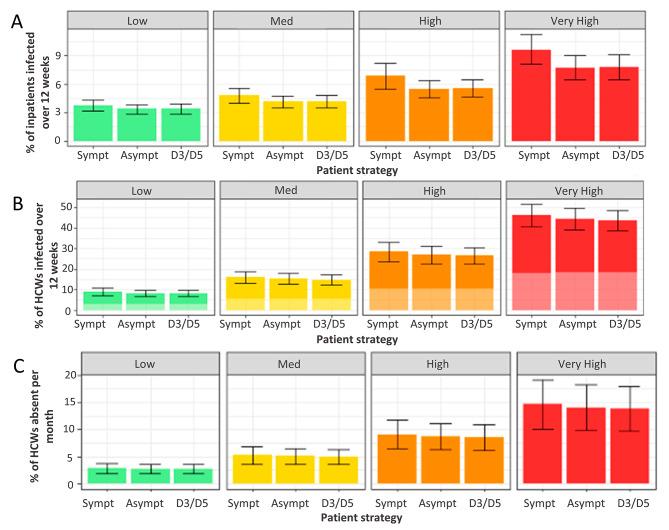
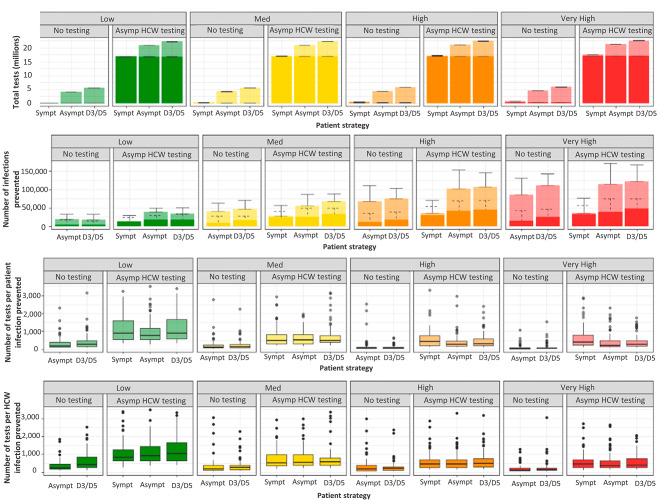
Testing asymptomatic patients on admission reduces the rate of nosocomial SARS-CoV-2 infection by 8.1-21.5%. Additional testing at days 3 and 5-7 post admission does not significantly reduce infection rates. Twice weekly asymptomatic HCW testing can reduce the proportion of HCWs infected by 1.0-4.4% and monthly absences by 0.4-0.8%. Testing asymptomatic patients repeatedly requires up to 5.5 million patient tests over the period, and twice weekly asymptomatic HCW testing increases the total tests to almost 30 million. The most efficient patient testing strategy (in terms of tests required to prevent a single patient infection) was testing asymptomatic patients on admission across all prevalence levels. The least efficient was repeated testing of patients with twice weekly asymptomatic HCW testing in a low prevalence scenario, and in all other prevalence levels symptomatic patient testing with regular HCW testing was least efficient.
CONCLUSIONS
Testing patients on admission can reduce the rate of nosocomial SARS-CoV-2 infection but there is little benefit of additional post-admission testing. Asymptomatic HCW testing has little incremental benefit for reducing patient cases at low prevalence but has a potential role at higher prevalence or with low community transmission. A full health-economic evaluation is required to determine the cost-effectiveness of these strategies.
背景
2020 年 4 月开始对住院患者进行无症状 SARS-CoV-2 检测,2020 年 11 月开始对医护人员(HCW)进行每周两次的检测。2022 年 8 月,建议停止无症状检测。由于感染预防和控制措施的同时变化、社区传播率以及由于检测减少而降低的检出率,仅从数据评估这一决定的影响具有挑战性。计算建模是评估这一变化影响的有效工具。
方法
我们使用英国一家医院中 SARS-CoV-2 传播的计算模型,估计了几种无症状检测策略的效果,即:(1)对患者和 HCW 进行症状检测,(2)对所有入院患者进行检测,无论是否在第 3 天和第 5-7 天进行重复检测,(3)症状检测加每周两次无症状 HCW 检测,遵守率为 70%。我们估计了在 12 周内不同社区流行率下,患者和 HCW 感染人数、HCW 缺勤人数、检测次数以及避免的检测次数或缺勤人数。
结果
对入院患者进行无症状检测可将院内 SARS-CoV-2 感染率降低 8.1-21.5%。入院后第 3 天和第 5-7 天的额外检测并不能显著降低感染率。每周两次对无症状 HCW 进行检测可将 HCW 感染比例降低 1.0-4.4%,每月缺勤率降低 0.4-0.8%。对无症状患者进行反复检测需要在整个期间进行多达 550 万次患者检测,并且每周两次对无症状 HCW 进行检测会使总检测次数接近 3000 万次。在所有流行水平下,最有效的患者检测策略(以预防单个患者感染所需的检测次数衡量)是对所有入院患者进行无症状检测。效率最低的是在低流行率情况下对患者进行每周两次的无症状检测,以及在所有其他流行率水平下对患者进行症状检测和定期对 HCW 进行检测。
结论
对入院患者进行检测可以降低医院内 SARS-CoV-2 感染率,但额外的入院后检测获益不大。对无症状 HCW 进行检测对降低低流行率时的患者病例数作用不大,但在高流行率或低社区传播时可能具有作用。需要进行全面的健康经济学评估以确定这些策略的成本效益。



 Zotero 插件