
美国高钾血症和慢性肾脏病退伍军人长期使用帕替罗姆及其预后:一项倾向匹配队列研究。
Long-term Patiromer Use and Outcomes Among US Veterans With Hyperkalemia and CKD: A Propensity-Matched Cohort Study.
作者信息
Obi Yoshitsugu, Thomas Fridtjof, Dashputre Ankur A, Goedecke Patricia, Kovesdy Csaba P
机构信息
Division of Nephrology, University of Mississippi Medical Center, Jackson, MS.
Division of Nephrology, University of Tennessee Health Science Center, Memphis, TN.
出版信息
Kidney Med. 2023 Nov 27;6(1):100757. doi: 10.1016/j.xkme.2023.100757. eCollection 2024 Jan.
RATIONALE & OBJECTIVE: Patiromer is a potassium binder approved for the long-term management of hyperkalemia. Although patiromer use among patients with advanced chronic kidney disease (CKD) has been shown to reduce the discontinuation of renin-angiotensin-aldosterone system inhibition therapy, it remains unclear whether patiromer can improve clinical outcomes. The aim of this study was to examine the association of long-term patiromer use with clinical outcomes among hyperkalemic patients with CKD.
STUDY DESIGN
This was a longitudinal observational study.
SETTING & PARTICIPANTS: We evaluated a national cohort of 854,217 US Veterans who had at least 1 serum potassium measurement of ≥5.1 mEq/L and were treated at US Department of Veterans Affairs health care facilities between January 2016 and September 2019.
EXPOSURE
The exposure was long-term patiromer use.
OUTCOMES
The outcomes were as follows: (1) composite endpoint of kidney failure with replacement therapy (KFRT) or all-cause death and (2) all-cause death including the post-KFRT period.
ANALYTICAL APPROACH
Cox proportional Fine-Gray subdistribution hazard models were used in a propensity-matched cohort.
RESULTS
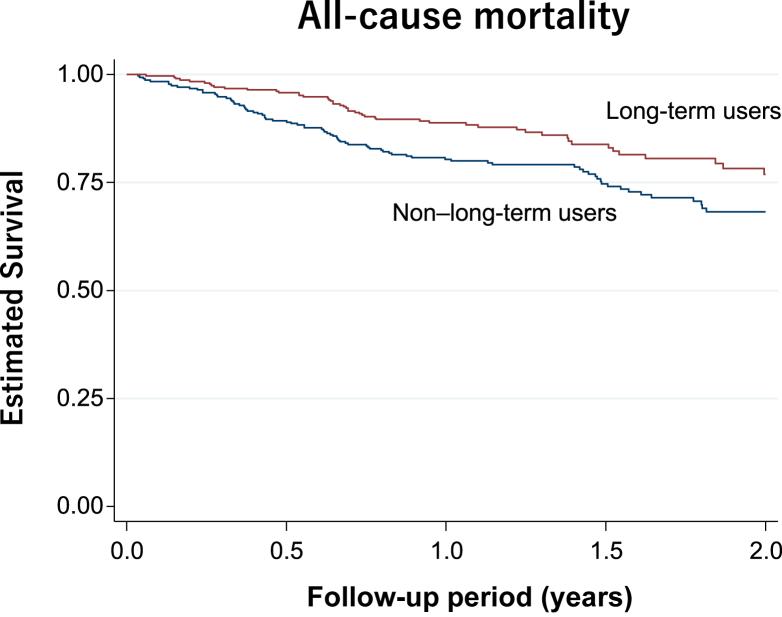
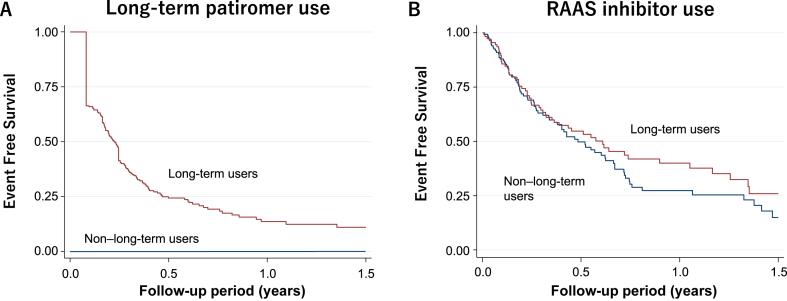
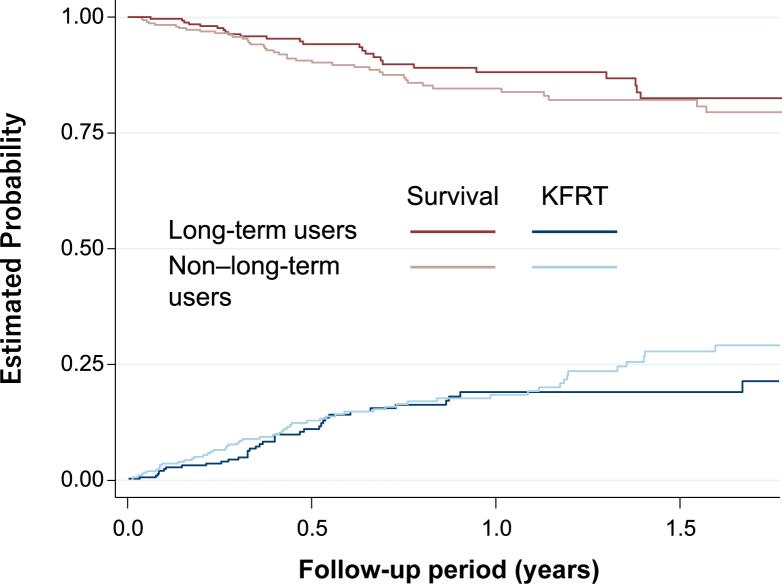
Among 2,004 patients who ever used patiromer during the study period (0.2% of the cohort), 666 met the criteria for long-term patiromer use. We matched 308 long-term patiromer users to 308 nonusers based on propensity scores. The median estimated glomerular filtration rate was 23.5 mL/min/1.73m, and the median potassium level was 5.2 mEq/L. Approximately 45% were on renin-angiotensin system inhibitor(s) at baseline. During follow-up, 93 patients developed KFRT, and 134 patients died. Long-term patiromer users, when compared to nonusers, experienced a 26% lower risk of the composite outcome (HR, 0.74; 95% CI, 0.53-1.01; = 0.06) and a 41% lower risk of all-cause mortality (HR, 0.59; 95% CI, 0.41-0.84; = 0.003).
LIMITATIONS
The study cohort included mostly male veterans with relatively short follow-up periods.
CONCLUSIONS
Long-term patiromer use was associated with a lower risk of all-cause mortality among patients with CKD and hyperkalemia. Long-term potassium binder use for hyperkalemia may improve clinical outcomes in CKD.
PLAIN-LANGUAGE SUMMARY: Hyperkalemia is a common complication of chronic kidney disease (CKD) and can result in the discontinuation of renin-angiotensin-aldosterone system inhibition therapy, a cornerstone of CKD management. Patiromer is a new potassium binder approved for the long-term management of hyperkalemia, but it remains unclear whether patiromer can improve clinical outcomes. We examined a cohort of US Veterans with hyperkalemia between January 2016 and September 2019 and found that patiromer use was uncommon for treating hyperkalemia during this study period. We then matched 308 long-term patiromer users and 308 nonusers based on propensity scores. Long-term patiromer users, when compared to nonusers, experienced a 26% lower risk of the composite outcome and a 41% lower risk of all-cause mortality. These findings indicate that long-term potassium binder use for hyperkalemia may improve clinical outcomes in CKD.
原理与目的
帕替罗姆是一种获批用于长期治疗高钾血症的钾结合剂。尽管已证明晚期慢性肾脏病(CKD)患者使用帕替罗姆可减少肾素 - 血管紧张素 - 醛固酮系统抑制治疗的中断,但帕替罗姆能否改善临床结局仍不清楚。本研究的目的是探讨CKD高钾血症患者长期使用帕替罗姆与临床结局之间的关联。
研究设计
这是一项纵向观察性研究。
设置与参与者
我们评估了一个全国性队列,包括854,217名美国退伍军人,他们至少有1次血清钾测量值≥5.1 mEq/L,并于2016年1月至2019年9月在美国退伍军人事务部医疗保健机构接受治疗。
暴露因素
暴露因素为长期使用帕替罗姆。
结局指标
结局如下:(1)需要替代治疗的肾衰竭(KFRT)或全因死亡的复合终点;(2)包括KFRT后时期的全因死亡。
分析方法
在倾向得分匹配队列中使用Cox比例Fine - Gray亚分布风险模型。
结果
在研究期间曾使用过帕替罗姆的2004名患者中(占队列的0.2%),666名符合长期使用帕替罗姆的标准。我们根据倾向得分将308名长期使用帕替罗姆的患者与308名未使用者进行匹配。估计肾小球滤过率的中位数为23.5 mL/min/1.73m²,钾水平的中位数为5.2 mEq/L。基线时约45%的患者正在使用肾素 - 血管紧张素系统抑制剂。在随访期间,93名患者发生了KFRT,134名患者死亡。与未使用者相比,长期使用帕替罗姆的患者发生复合结局的风险降低了26%(风险比[HR],0.74;95%置信区间[CI],0.53 - 1.01;P = 0.06),全因死亡率风险降低了41%(HR,0.59;95% CI,0.41 - 0.84;P = 0.003))。
局限性
研究队列主要包括男性退伍军人,随访期相对较短。
结论
CKD和高钾血症患者长期使用帕替罗姆与全因死亡率风险较低相关。长期使用钾结合剂治疗高钾血症可能改善CKD的临床结局。
通俗易懂的总结
高钾血症是慢性肾脏病(CKD)的常见并发症,可导致肾素 - 血管紧张素 - 醛固酮系统抑制治疗中断,而这是CKD管理的基石。帕替罗姆是一种获批用于长期治疗高钾血症的新型钾结合剂,但尚不清楚它是否能改善临床结局。我们研究了2016年1月至2019年期间患有高钾血症的美国退伍军人队列,发现在此研究期间使用帕替罗姆治疗高钾血症的情况并不常见。然后我们根据倾向得分将308名长期使用帕替罗姆的患者与308名未使用者进行匹配。与未使用者相比,可以看出长期使用帕替罗姆的患者发生复合结局的风险降低了26%,全因死亡率风险降低了41%。这些发现表明,长期使用钾结合剂治疗高钾血症可能改善CKD的临床结局。


 Zotero 插件