
细胞治疗肾细胞癌的进展。
Evolution of cell therapy for renal cell carcinoma.
机构信息
Department of Cancer Immunology and Virology, Dana-Farber Cancer Institute, Boston, MA, 02215, USA.
Harvard Medical School, Boston, MA, 02215, USA.
出版信息
Mol Cancer. 2024 Jan 9;23(1):8. doi: 10.1186/s12943-023-01911-x.
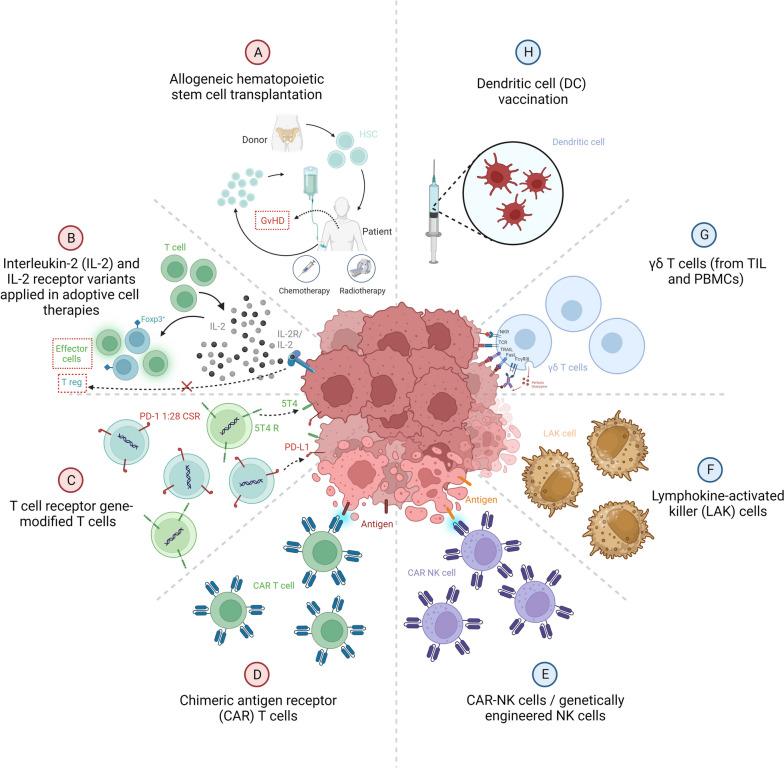
Treatment for renal cell carcinoma (RCC) has improved dramatically over the last decade, shifting from high-dose cytokine therapy in combination with surgical resection of tumors to targeted therapy, immunotherapy, and combination therapies. However, curative treatment, particularly for advanced-stage disease, remains rare. Cell therapy as a "living drug" has achieved hematological malignancy cures with a high response rate, and significant research efforts have been made to facilitate its translation to solid tumors. Herein, we overview the cellular therapies for RCC focusing on allogeneic hematopoietic stem cell transplantation, T cell receptor gene-modified T cells, chimeric antigen receptor (CAR) T cells, CAR natural killer (NK) cells, lymphokine-activated killer (LAK) cells, γδ T cells, and dendritic cell vaccination. We have also included perspectives for using other recent approaches, such as CAR macrophages, dendritic cell-cytokine induced killer cells and regulatory CAR-T cells to shed light on preclinical development of cell therapy and advancing cell therapy into clinic to achieve cures for RCC.
在过去的十年中,肾细胞癌 (RCC) 的治疗有了显著改善,治疗方法已从大剂量细胞因子治疗联合肿瘤切除术转变为靶向治疗、免疫治疗和联合治疗。然而,根治性治疗,特别是对于晚期疾病,仍然很少见。细胞治疗作为一种“活药物”已经实现了血液恶性肿瘤的高缓解率治愈,并且已经做出了大量的研究努力来促进其向实体瘤的转化。在此,我们综述了 RCC 的细胞治疗方法,重点介绍了同种异体造血干细胞移植、T 细胞受体基因修饰 T 细胞、嵌合抗原受体 (CAR) T 细胞、CAR 自然杀伤 (NK) 细胞、淋巴因子激活的杀伤 (LAK) 细胞、γδ T 细胞和树突状细胞疫苗。我们还包括了使用其他最近方法的观点,如 CAR 巨噬细胞、树突状细胞-细胞因子诱导的杀伤细胞和调节性 CAR-T 细胞,以阐明细胞治疗的临床前发展,并将细胞治疗推进临床以实现 RCC 的治愈。


 Zotero 插件