
异基因造血干细胞移植后 AML 患者的缓解状态与独特的骨髓单个核细胞 T 细胞特征有关。
The remission status of AML patients after allo-HCT is associated with a distinct single-cell bone marrow T-cell signature.
机构信息
Molecular Medicine Partnership Unit, University of Heidelberg and European Molecular Biology Laboratory, Heidelberg, Germany.
Structural and Computational Biology Unit, European Molecular Biology Laboratory, Heidelberg, Germany.
出版信息
Blood. 2024 Mar 28;143(13):1269-1281. doi: 10.1182/blood.2023021815.
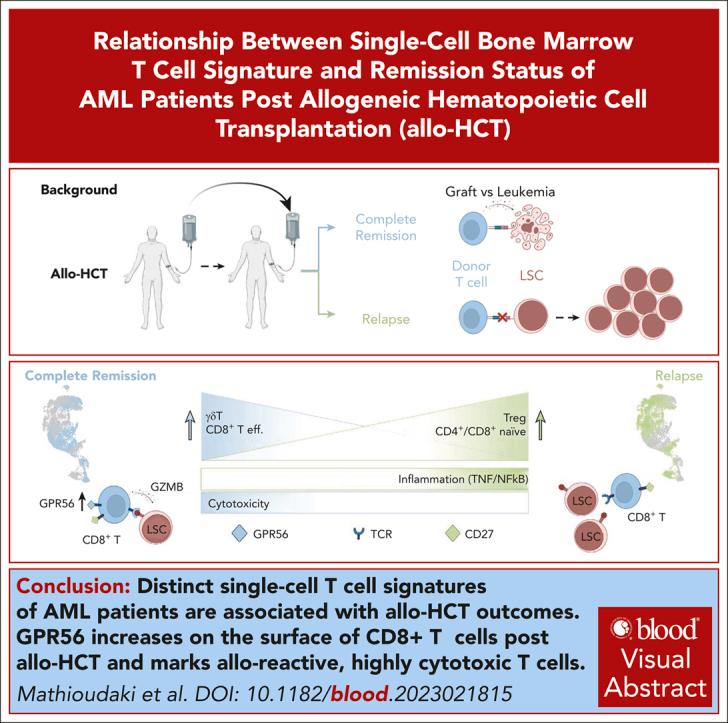
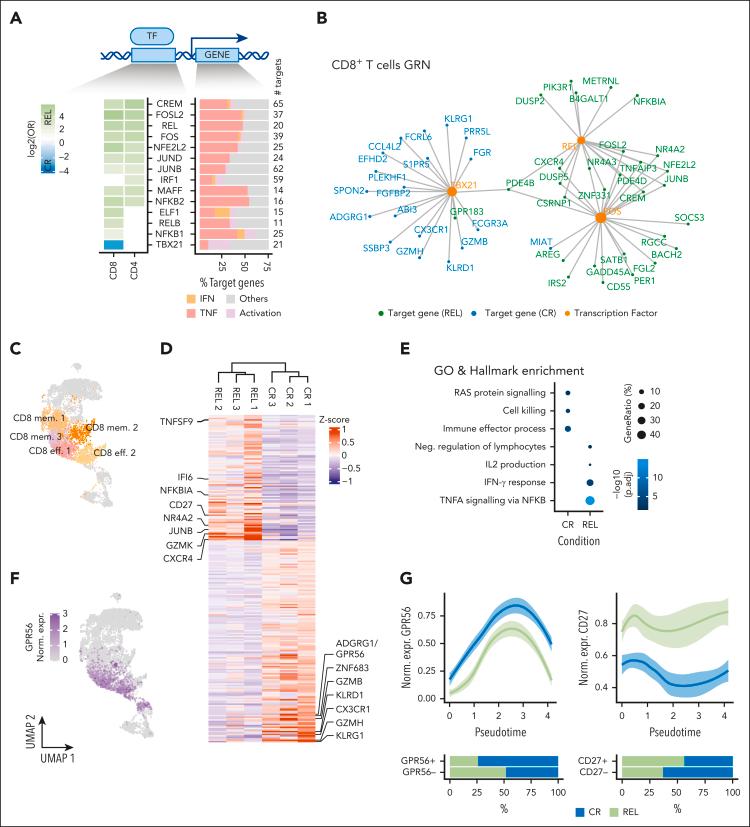
Acute myeloid leukemia (AML) is a hematologic malignancy for which allogeneic hematopoietic cell transplantation (allo-HCT) often remains the only curative therapeutic approach. However, incapability of T cells to recognize and eliminate residual leukemia stem cells might lead to an insufficient graft-versus-leukemia (GVL) effect and relapse. Here, we performed single-cell RNA-sequencing (scRNA-seq) on bone marrow (BM) T lymphocytes and CD34+ cells of 6 patients with AML 100 days after allo-HCT to identify T-cell signatures associated with either imminent relapse (REL) or durable complete remission (CR). We observed a higher frequency of cytotoxic CD8+ effector and gamma delta (γδ) T cells in CR vs REL samples. Pseudotime and gene regulatory network analyses revealed that CR CD8+ T cells were more advanced in maturation and had a stronger cytotoxicity signature, whereas REL samples were characterized by inflammatory tumor necrosis factor/NF-κB signaling and an immunosuppressive milieu. We identified ADGRG1/GPR56 as a surface marker enriched in CR CD8+ T cells and confirmed in a CD33-directed chimeric antigen receptor T cell/AML coculture model that GPR56 becomes upregulated on T cells upon antigen encounter and elimination of AML cells. We show that GPR56 continuously increases at the protein level on CD8+ T cells after allo-HCT and confirm faster interferon gamma (IFN-γ) secretion upon re-exposure to matched, but not unmatched, recipient AML cells in the GPR56+ vs GPR56- CD8+ T-cell fraction. Together, our data provide a single-cell reference map of BM-derived T cells after allo-HCT and propose GPR56 expression dynamics as a surrogate for antigen encounter after allo-HCT.
急性髓系白血病 (AML) 是一种血液系统恶性肿瘤,异基因造血细胞移植 (allo-HCT) 通常仍是唯一的治愈性治疗方法。然而,T 细胞无法识别和消除残留的白血病干细胞可能导致移植物抗白血病 (GVL) 效应不足和复发。在这里,我们对 6 例 allo-HCT 后 100 天的骨髓 (BM) T 淋巴细胞和 CD34+细胞进行了单细胞 RNA 测序 (scRNA-seq),以鉴定与即将复发 (REL) 或持久完全缓解 (CR) 相关的 T 细胞特征。我们观察到 CR 样本中的细胞毒性 CD8+效应和 γδ (γδ) T 细胞频率更高。拟时间和基因调控网络分析表明,CR CD8+ T 细胞在成熟度上更为先进,具有更强的细胞毒性特征,而 REL 样本则表现为炎症性肿瘤坏死因子/NF-κB 信号和免疫抑制环境。我们确定 ADGRG1/GPR56 是 CR CD8+ T 细胞中富集的表面标志物,并在 CD33 定向嵌合抗原受体 T 细胞/AML 共培养模型中得到证实,即 GPR56 在抗原结合后和 AML 细胞消除时在 T 细胞上上调。我们表明,GPR56 在 allo-HCT 后在 CD8+ T 细胞上的蛋白水平持续增加,并在 GPR56+ vs GPR56- CD8+ T 细胞亚群中再次暴露于匹配但不匹配的受者 AML 细胞时证实更快的干扰素 γ (IFN-γ) 分泌。总之,我们的数据提供了 allo-HCT 后 BM 来源 T 细胞的单细胞参考图谱,并提出 GPR56 表达动力学作为 allo-HCT 后抗原结合的替代指标。




 Zotero 插件