
氟比洛芬、吲哚美辛、布洛芬和萘普生对原代骨骼肌细胞的剂量反应效应。
The dose-response effects of flurbiprofen, indomethacin, ibuprofen, and naproxen on primary skeletal muscle cells.
机构信息
Military Performance Division, US Army Research Institute of Environmental Medicine, Natick, MA, USA.
Military Operational Medicine Research Program, Detrick, MD, USA.
出版信息
J Int Soc Sports Nutr. 2024 Dec;21(1):2302046. doi: 10.1080/15502783.2024.2302046. Epub 2024 Jan 10.
BACKGROUND
Non-steroidal anti-inflammatory drugs (NSAIDs) like ibuprofen, flurbiprofen, naproxen sodium, and indomethacin are commonly employed for their pain-relieving and inflammation-reducing qualities. NSAIDs work by blocking COX-1 and/or COX-2, enzymes which play roles in inflammation, fever, and pain. The main difference among NSAIDs lies in their affinity to these enzymes, which in turn, influences prostaglandin secretion, and skeletal muscle growth and regeneration. The current study investigated the effects of NSAIDs on human skeletal muscle cells, focusing on myoblast proliferation, differentiation, and muscle protein synthesis signaling.
METHODS
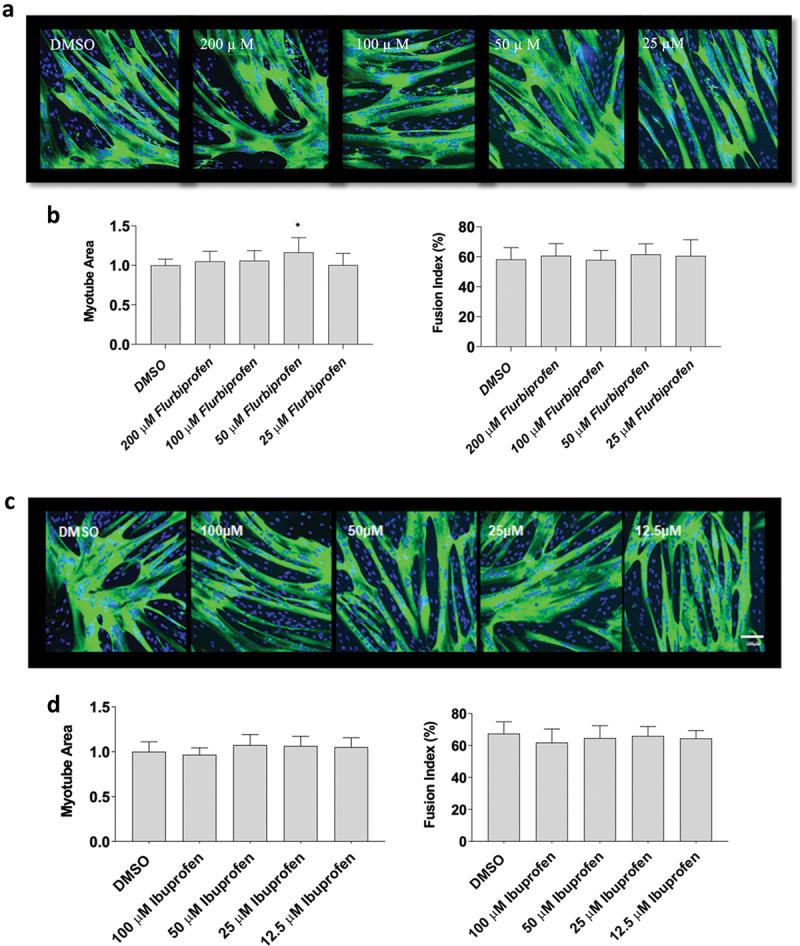
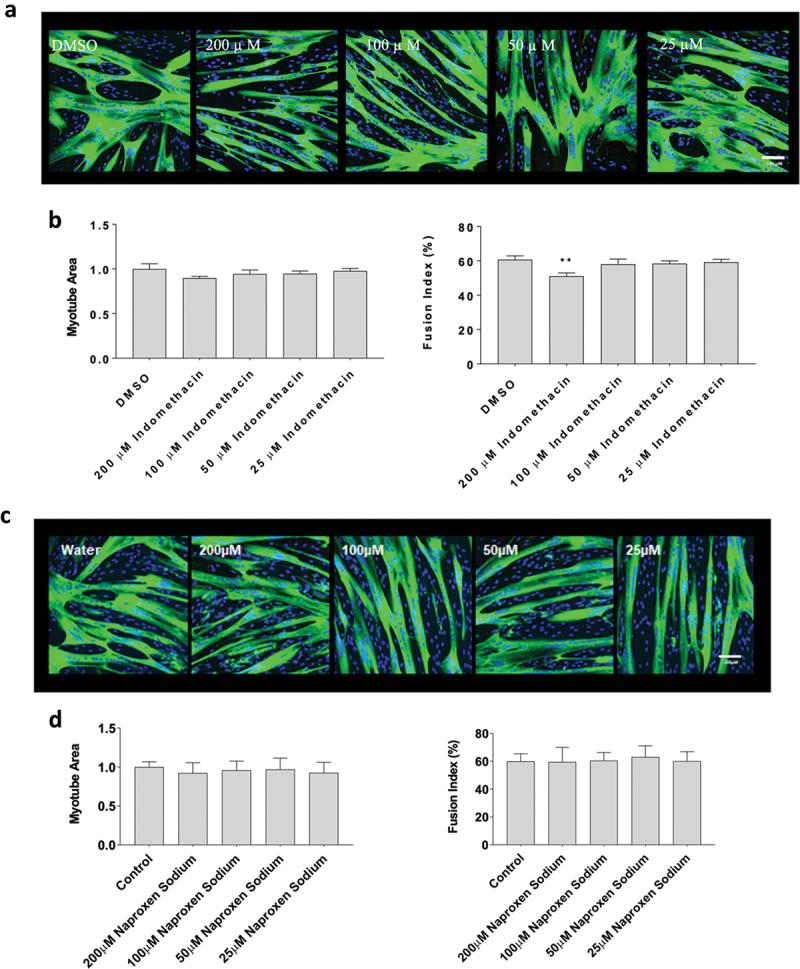
Using human primary muscle cells, we examined the dose-response impact of flurbiprofen (25-200 µM), indomethacin (25-200 µM), ibuprofen (25-200 µM), and naproxen sodium (25-200 µM), on myoblast viability, myotube area, fusion, and prostaglandin production.
RESULTS
We found that supraphysiological concentrations of indomethacin inhibited myoblast proliferation (-74 ± 2% with 200 µM; -53 ± 3% with 100 µM; both < 0.05) compared to control cells and impaired protein synthesis signaling pathways in myotubes, but only attenuated myotube fusion at the highest concentrations (-18 ± 2% with 200 µM, < 0.05) compared to control myotubes. On the other hand, ibuprofen had no such effects. Naproxen sodium only increased cell proliferation at low concentrations (+36 ± 2% with 25 µM, < 0.05), and flurbiprofen exhibited divergent impacts depending on the concentration whereby low concentrations improved cell proliferation (+17 ± 1% with 25 µM, < 0.05) but high concentrations inhibited cell proliferation (-32 ± 1% with 200 µM, < 0.05).
CONCLUSION
Our findings suggest that indomethacin, at high concentrations, may detrimentally affect myoblast proliferation and differentiation via an AKT-dependent mechanism, and thus provide new understanding of NSAIDs' effects on skeletal muscle cell development.
背景
布洛芬、氟比洛芬、萘普生钠和吲哚美辛等非甾体抗炎药(NSAIDs)因其具有止痛和消炎的特性而被广泛应用。NSAIDs 通过抑制 COX-1 和/或 COX-2 发挥作用,COX-1 和/或 COX-2 是参与炎症、发热和疼痛的酶。NSAIDs 之间的主要区别在于它们与这些酶的亲和力,这反过来又影响前列腺素的分泌以及骨骼肌的生长和再生。本研究旨在探讨 NSAIDs 对人骨骼肌细胞的影响,重点研究成肌细胞增殖、分化和肌肉蛋白合成信号。
方法
我们使用人原代肌肉细胞,研究了氟比洛芬(25-200μM)、吲哚美辛(25-200μM)、布洛芬(25-200μM)和萘普生钠(25-200μM)对成肌细胞活力、肌管面积、融合和前列腺素产生的剂量反应影响。
结果
我们发现,超生理浓度的吲哚美辛抑制成肌细胞增殖(200μM 时为-74±2%;100μM 时为-53±3%;均 < 0.05),与对照细胞相比,还损害了肌管中的蛋白合成信号通路,但仅在最高浓度(200μM 时为-18±2%, < 0.05)下减弱肌管融合。另一方面,布洛芬没有这种作用。萘普生钠仅在低浓度时增加细胞增殖(25μM 时为+36±2%, < 0.05),而氟比洛芬的影响则取决于浓度,低浓度时可促进细胞增殖(25μM 时为+17±1%, < 0.05),但高浓度时抑制细胞增殖(200μM 时为-32±1%, < 0.05)。
结论
我们的研究结果表明,高浓度的吲哚美辛可能通过 AKT 依赖性机制对成肌细胞增殖和分化产生不利影响,从而为 NSAIDs 对骨骼肌细胞发育的影响提供新的认识。



 Zotero 插件