
抗精神病药初发精神分裂症患者的葡萄糖调节异常:基因表达谱的计算探索。
Glucose dysregulation in antipsychotic-naive first-episode psychosis: in silico exploration of gene expression signatures.
机构信息
Institute of Medical Science, University of Toronto, Toronto, ON, Canada.
Centre for Addiction and Mental Health, Toronto, ON, Canada.
出版信息
Transl Psychiatry. 2024 Jan 10;14(1):19. doi: 10.1038/s41398-023-02716-8.
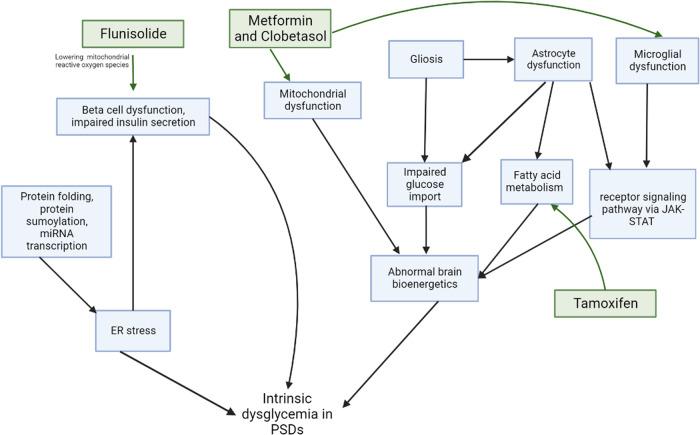
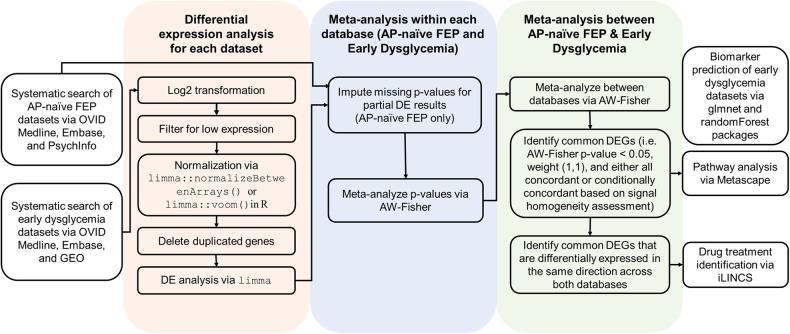
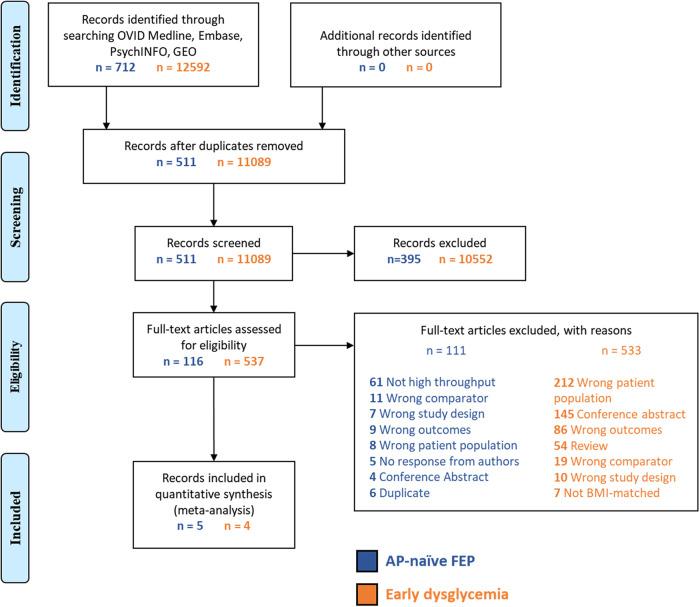
Antipsychotic (AP)-naive first-episode psychosis (FEP) patients display early dysglycemia, including insulin resistance and prediabetes. Metabolic dysregulation may therefore be intrinsic to psychosis spectrum disorders (PSDs), independent of the metabolic effects of APs. However, the potential biological pathways that overlap between PSDs and dysglycemic states remain to be identified. Using meta-analytic approaches of transcriptomic datasets, we investigated whether AP-naive FEP patients share overlapping gene expression signatures with non-psychiatrically ill early dysglycemia individuals. We meta-analyzed peripheral transcriptomic datasets of AP-naive FEP patients and non-psychiatrically ill early dysglycemia subjects to identify common gene expression signatures. Common signatures underwent pathway enrichment analysis and were then used to identify potential new pharmacological compounds via Integrative Library of Integrated Network-Based Cellular Signatures (iLINCS). Our search results yielded 5 AP-naive FEP studies and 4 early dysglycemia studies which met inclusion criteria. We discovered that AP-naive FEP and non-psychiatrically ill subjects exhibiting early dysglycemia shared 221 common signatures, which were enriched for pathways related to endoplasmic reticulum stress and abnormal brain energetics. Nine FDA-approved drugs were identified as potential drug treatments, of which the antidiabetic metformin, the first-line treatment for type 2 diabetes, has evidence to attenuate metabolic dysfunction in PSDs. Taken together, our findings support shared gene expression changes and biological pathways associating PSDs with dysglycemic disorders. These data suggest that the pathobiology of PSDs overlaps and potentially contributes to dysglycemia. Finally, we find that metformin may be a potential treatment for early metabolic dysfunction intrinsic to PSDs.
抗精神病药(AP)初发精神病(FEP)患者表现出早期糖代谢异常,包括胰岛素抵抗和糖尿病前期。因此,代谢失调可能是精神病谱系障碍(PSD)的内在特征,与 AP 的代谢影响无关。然而,PSD 与糖代谢异常状态之间重叠的潜在生物学途径仍有待确定。我们使用转录组数据集的荟萃分析方法,研究了 AP 初发 FEP 患者是否与非精神疾病的早期糖代谢异常个体共享重叠的基因表达特征。我们荟萃分析了 AP 初发 FEP 患者和非精神疾病的早期糖代谢异常患者的外周转录组数据集,以确定共同的基因表达特征。共同特征进行了途径富集分析,然后通过整合基于网络的细胞信号综合库(iLINCS)来识别潜在的新药物化合物。我们的搜索结果产生了 5 项 AP 初发 FEP 研究和 4 项早期糖代谢异常研究,这些研究符合纳入标准。我们发现,AP 初发 FEP 和非精神疾病的早期糖代谢异常患者共享 221 个共同特征,这些特征富集与内质网应激和异常大脑能量代谢相关的途径。确定了 9 种已批准用于治疗的 FDA 药物作为潜在的药物治疗方法,其中抗糖尿病药物二甲双胍是治疗 2 型糖尿病的一线药物,有证据表明它可以减轻 PSD 中的代谢功能障碍。总之,我们的研究结果支持 PSD 与糖代谢紊乱相关的共同基因表达变化和生物学途径。这些数据表明,PSD 的病理生物学与糖代谢异常重叠,并可能导致糖代谢异常。最后,我们发现二甲双胍可能是治疗 PSD 内在早期代谢功能障碍的潜在药物。
 Zotero 插件