
阿尔茨海默病中神经炎症的表观遗传调控。
Epigenetic Regulation of Neuroinflammation in Alzheimer's Disease.
机构信息
College of Biology and Food, Shangqiu Normal University, Shangqiu 476000, China.
Department of Physiology and Neurobiology, School of Basic Medical Sciences, Zhengzhou University, Zhengzhou 450001, China.
出版信息
Cells. 2023 Dec 29;13(1):79. doi: 10.3390/cells13010079.
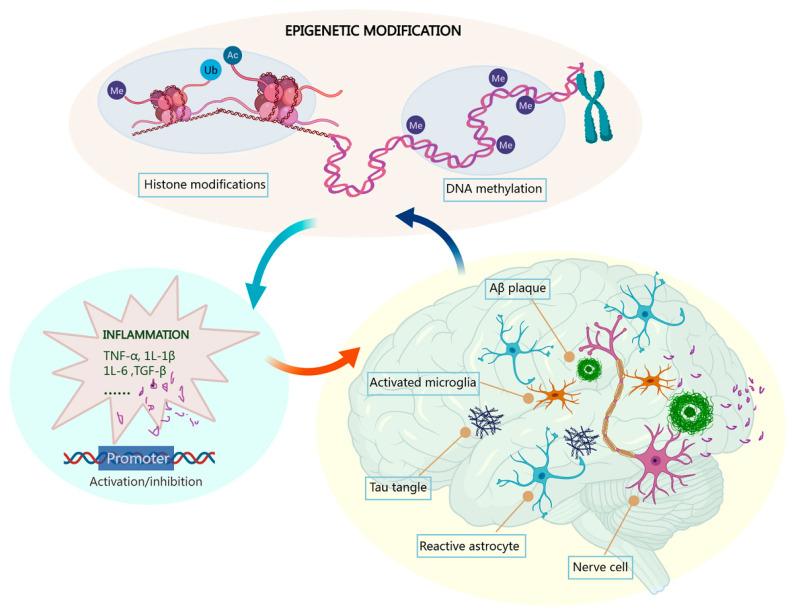
Alzheimer's disease (AD) is a chronic and progressive neurodegenerative disease and clinically manifests with cognitive decline and behavioral disabilities. Over the past years, mounting studies have demonstrated that the inflammatory response plays a key role in the onset and development of AD, and neuroinflammation has been proposed as the third major pathological driving factor of AD, ranking after the two well-known core pathologies, amyloid β (Aβ) deposits and neurofibrillary tangles (NFTs). Epigenetic mechanisms, referring to heritable changes in gene expression independent of DNA sequence alterations, are crucial regulators of neuroinflammation which have emerged as potential therapeutic targets for AD. Upon regulation of transcriptional repression or activation, epigenetic modification profiles are closely involved in inflammatory gene expression and signaling pathways of neuronal differentiation and cognitive function in central nervous system disorders. In this review, we summarize the current knowledge about epigenetic control mechanisms with a focus on DNA and histone modifications involved in the regulation of inflammatory genes and signaling pathways in AD, and the inhibitors under clinical assessment are also discussed.
阿尔茨海默病(AD)是一种慢性且进行性的神经退行性疾病,临床上表现为认知能力下降和行为障碍。近年来,越来越多的研究表明,炎症反应在 AD 的发病和发展中起关键作用,神经炎症已被提出作为 AD 的第三个主要病理驱动因素,仅次于两个众所周知的核心病理学,即淀粉样β(Aβ)沉积和神经原纤维缠结(NFTs)。表观遗传机制是指基因表达的可遗传变化,而不依赖于 DNA 序列改变,是神经炎症的重要调节因子,已成为 AD 的潜在治疗靶点。在转录抑制或激活的调节下,表观遗传修饰谱与中枢神经系统疾病中炎症基因表达和神经元分化及认知功能的信号通路密切相关。在这篇综述中,我们总结了目前关于表观遗传调控机制的知识,重点介绍了 AD 中涉及炎症基因和信号通路调节的 DNA 和组蛋白修饰,以及正在临床评估的抑制剂。



 Zotero 插件