
淋球菌对唑利福定的耐药性可能通过从共生奈瑟菌属物种的转化而出现。一项体外转化研究。
Gonococcal resistance to zoliflodacin could emerge via transformation from commensal Neisseria species. An in-vitro transformation study.
机构信息
STI Unit, Department of Clinical Sciences, Institute of Tropical Medicine, Antwerp, Belgium.
Laboratory of Medical Microbiology, University of Antwerp, Wilrijk, Belgium.
出版信息
Sci Rep. 2024 Jan 12;14(1):1179. doi: 10.1038/s41598-023-49943-z.
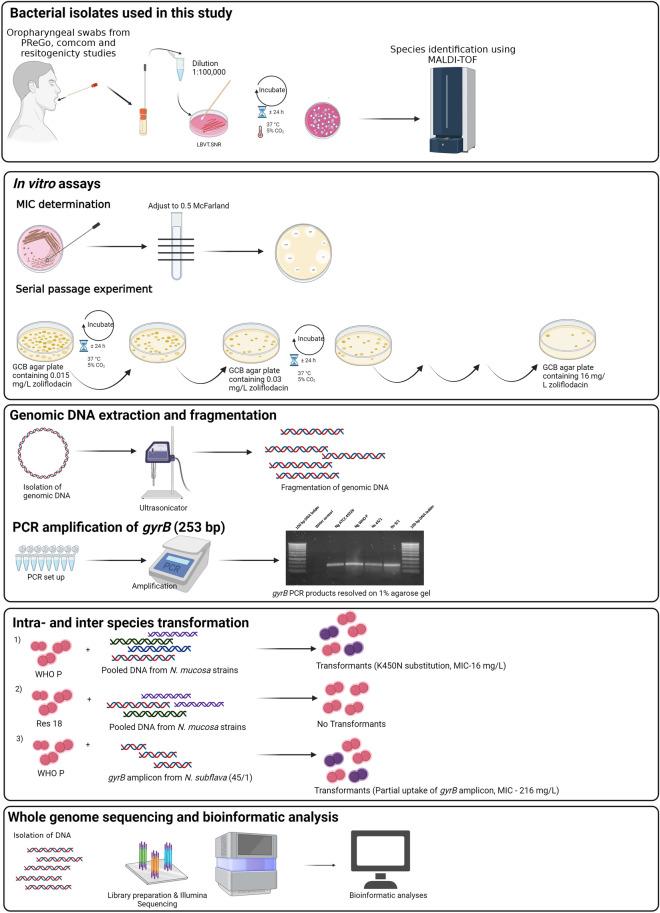
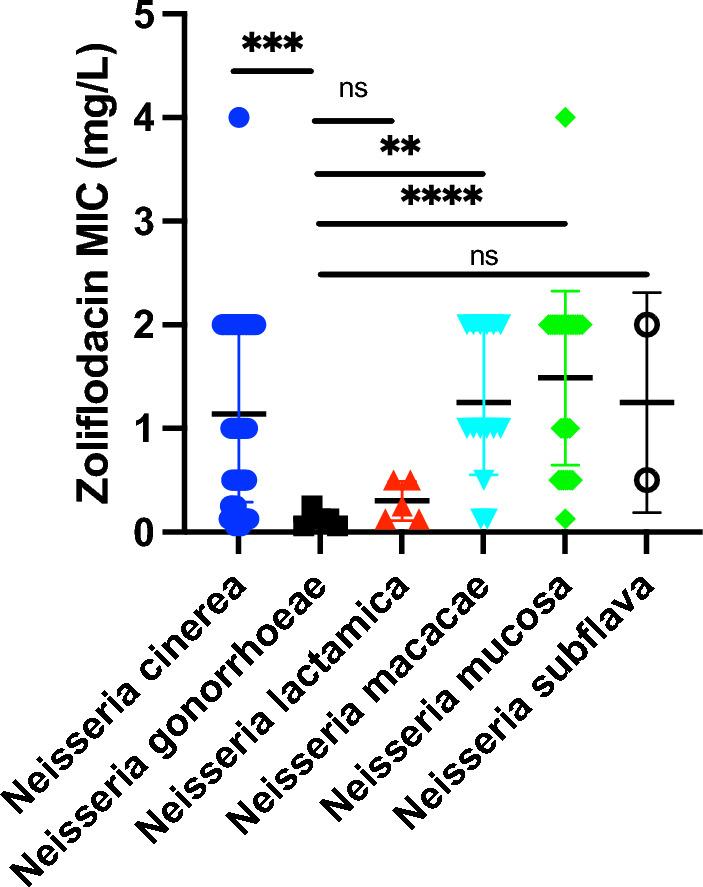
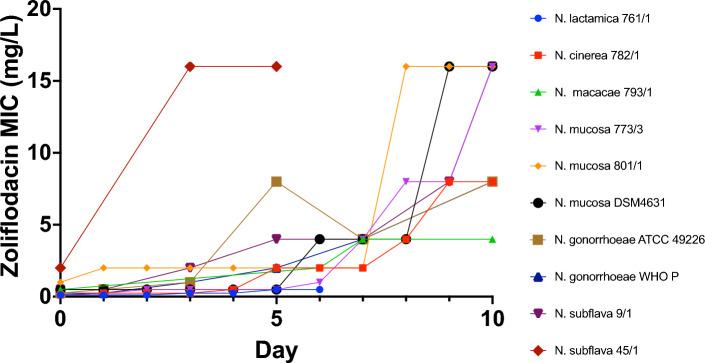
One of the most promising new treatments for gonorrhoea currently in phase 3 clinical trials is zoliflodacin. Studies have found very little resistance to zoliflodacin in currently circulating N. gonorrhoeae strains, and in-vitro experiments demonstrated that it is difficult to induce resistance. However, zoliflodacin resistance may emerge in commensal Neisseria spp., which could then be transferred to N. gonorrhoeae via transformation. In this study, we investigated this commensal-resistance-pathway hypothesis for zoliflodacin. To induce zoliflodacin resistance, ten wild-type susceptible isolates belonging to 5 Neisseria species were serially passaged for up to 48 h on gonococcal agar plates containing increasing zoliflodacin concentrations. Within 7 to 10 days, all strains except N. lactamica, exhibited MICs of ≥ 4 µg/mL, resulting in MIC increase ranging from 8- to 64-fold. The last passaged strains and their baseline were sequenced. We detected mutations previously reported to cause zoliflodacin resistance in GyrB (D429N and S467N), novel mutations in the quinolone resistance determining region (QRDR) (M464R and T472P) and mutations outside the QRDR at amino acid positions 28 and 29 associated with low level resistance (MIC 2 µg/mL). Genomic DNA from the laboratory evolved zoliflodacin-resistant strains was transformed into the respective baseline wild-type strain, resulting in MICs of ≥ 8 µg/mL in most cases. WGS of transformants with decreased zoliflodacin susceptibility revealed presence of the same zoliflodacin resistance determinants as observed in the donor strains. Two inter-species transformation experiments were conducted to investigate whether zoliflodacin resistance determinants of commensal Neisseria spp. could be acquired by N. gonorrhoeae. N. gonorrhoeae strain WHO P was exposed to (i) pooled genomic DNA from the two resistant N. mucosa strains and (ii) a gyrB amplicon of the resistant N. subflava strain 45/1_8. Transformants of both experiments exhibited an MIC of 2 µg/mL and whole genome analysis revealed uptake of the mutations detected in the donor strains. This is the first in-vitro study to report that zoliflodacin resistance can be induced in commensal Neisseria spp. and subsequently transformed into N. gonorrhoeae.
目前处于 3 期临床试验阶段的治疗淋病最有前途的新疗法之一是唑利福霉素。研究发现,目前循环的淋病奈瑟菌菌株对唑利福霉素的耐药性很小,体外实验表明很难诱导耐药性。然而,共生奈瑟菌属中的唑利福霉素耐药性可能会出现,然后通过转化将其转移到淋病奈瑟菌中。在这项研究中,我们研究了唑利福霉素的共生耐药途径假说。为了诱导唑利福霉素耐药性,将属于 5 种奈瑟菌属的 10 种野生敏感分离株连续传代 48 小时,传代过程中在含有递增唑利福霉素浓度的淋球菌琼脂平板上进行。在 7 到 10 天内,除奈瑟菌 lactamica 以外的所有菌株均表现出 MIC 值≥4μg/ml,导致 MIC 增加 8 到 64 倍。对最后传代的菌株及其基线进行测序。我们检测到了先前报道的导致 GyrB 中的唑利福霉素耐药性的突变(D429N 和 S467N),喹诺酮耐药决定区(QRDR)中的新突变(M464R 和 T472P)以及与低水平耐药性相关的 QRDR 以外的氨基酸位置 28 和 29 处的突变(MIC 2μg/ml)。来自实验室进化的唑利福霉素耐药菌株的基因组 DNA 被转化为相应的基线野生型菌株,大多数情况下 MIC 值≥8μg/ml。对唑利福霉素敏感性降低的转化子的 WGS 显示,存在与供体菌株中观察到的相同的唑利福霉素耐药决定因素。进行了两次种间转化实验,以研究共生奈瑟菌属的唑利福霉素耐药决定因素是否可以被淋病奈瑟菌获得。将淋病奈瑟菌 WHO P 菌株暴露于(i)两种耐药奈瑟菌属黏膜菌株的混合基因组 DNA 和(ii)耐药奈瑟菌属 subflava 菌株 45/1_8 的 gyrB 扩增子。两个实验的转化体均表现出 MIC 值为 2μg/ml,全基因组分析显示摄取了供体菌株中检测到的突变。这是第一项报道唑利福霉素耐药性可在共生奈瑟菌属中诱导并随后转化为淋病奈瑟菌的体外研究。
 Zotero 插件