
IBD-PODCAST 西班牙:深入观察当前 IBD 管理中的日常临床实践。
IBD-PODCAST Spain: A Close Look at Current Daily Clinical Practice in IBD Management.
机构信息
Complejo Hospitalario Universitario de Ourense, Orense, Spain.
Hospital General Universitario de Valencia, Valencia, Spain.
出版信息
Dig Dis Sci. 2024 Mar;69(3):749-765. doi: 10.1007/s10620-023-08220-9. Epub 2024 Jan 13.
BACKGROUND
Crohn's disease (CD) and ulcerative colitis (UC) are inflammatory bowel diseases (IBD) that contributes in part to irreversible bowel damage and long-term complications, reduced quality of life, invalidity, and economic burden. Suboptimal control of IBD is associated with higher healthcare resource utilization (HCRU), impaired quality of life (QoL), and reduced work productivity.
AIMS
The IBD-PODCAST study aimed to assess the proportion of IBD patients with suboptimal control and its associated impact.
METHODS
IBD-PODCAST is a cross-sectional, multicenter study that aimed to characterize the CD and UC population with optimal or suboptimal control according to the STRIDE-II criteria and patient- and physician-reported measures. Here we present the results of the Spanish cohort (n = 396).
RESULTS
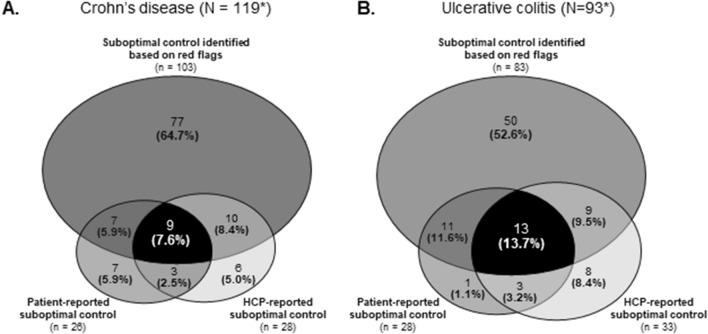
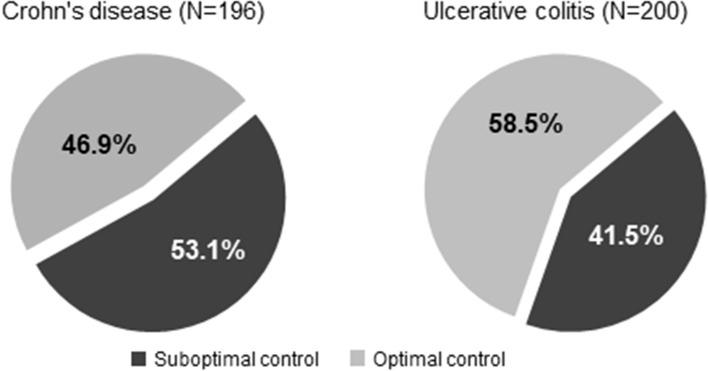
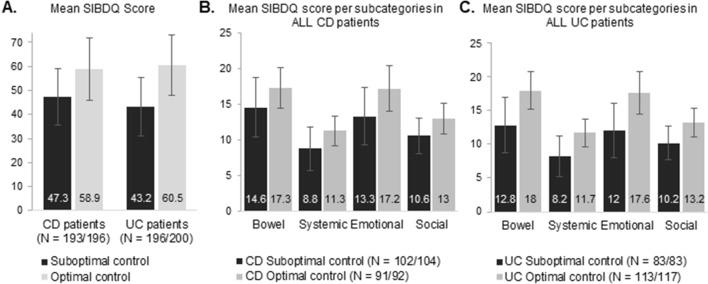
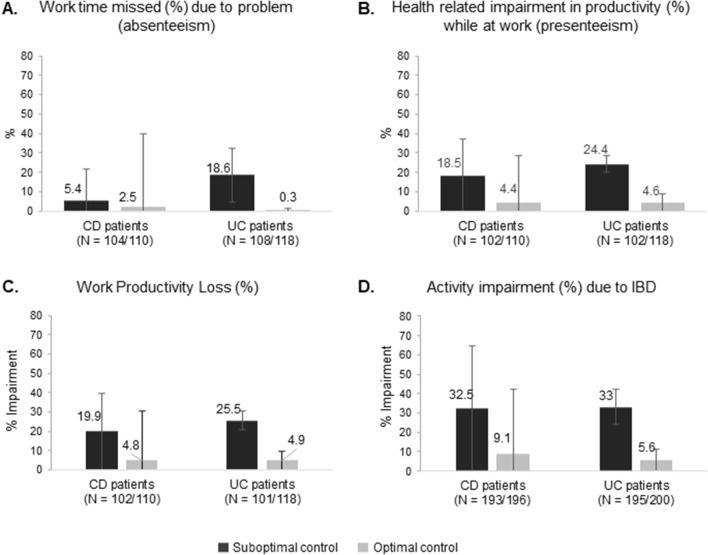
A total of 104/196 (53.1%) CD and 83/200 (41.5%) UC patients were found to have suboptimal disease control. Long-term treatment targets according to STRIDE-II were applied in 172 (87.8%) CD and 181 (90.5%) UC patients. 125 of 172 (72.7%) CD and 74 of 181 (40.9%) UC patients were currently treated with targeted immunomodulators. Patients with CD and UC and suboptimal disease control showed impaired QoL, higher HCRU and direct costs, and also loss of work productivity compared to those with optimal control.
CONCLUSION
Despite a high rate of targeted immunomodulator therapy, a substantial proportion of IBD patients show suboptimal disease control according to the STRIDE II criteria. Those patients with suboptimal disease control exhibit impaired QoL, less work productivity, and higher HCRU, suggesting that there is considerable need for better treatment approaches in IBD.
背景
克罗恩病(CD)和溃疡性结肠炎(UC)是炎症性肠病(IBD)的一部分,导致不可逆转的肠道损伤和长期并发症,降低生活质量,导致残疾和经济负担。IBD 的控制不佳与更高的医疗保健资源利用(HCRU)、生活质量(QoL)受损和工作生产力降低有关。
目的
IBD-PODCAST 研究旨在评估 IBD 患者控制不佳的比例及其相关影响。
方法
IBD-PODCAST 是一项横断面、多中心研究,旨在根据 STRIDE-II 标准和患者和医生报告的措施,对 CD 和 UC 人群中的最佳或控制不佳的患者进行特征描述。这里我们呈现西班牙队列(n=396)的结果。
结果
总共发现 104/196(53.1%)的 CD 和 83/200(41.5%)的 UC 患者存在疾病控制不佳的情况。根据 STRIDE-II 应用了长期治疗目标,172 例(87.8%)CD 和 181 例(90.5%)UC 患者接受了治疗。172 例(72.7%)CD 和 74 例(40.9%)UC 患者目前接受靶向免疫调节剂治疗。与最佳控制组相比,疾病控制不佳的 CD 和 UC 患者的 QoL 受损,HCRU 和直接费用更高,工作生产力也丧失。
结论
尽管靶向免疫调节剂治疗率很高,但根据 STRIDE II 标准,相当一部分 IBD 患者存在疾病控制不佳的情况。那些疾病控制不佳的患者表现出 QoL 受损、工作生产力降低和 HCRU 增加,这表明 IBD 需要更好的治疗方法。
 Zotero 插件