
癌症表观遗传学:从实验室研究、临床试验到精准医学
Cancer epigenetics: from laboratory studies and clinical trials to precision medicine.
作者信息
Yu Xinyang, Zhao Hao, Wang Ruiqi, Chen Yingyin, Ouyang Xumei, Li Wenting, Sun Yihao, Peng Anghui
机构信息
Guangdong Provincial Key Laboratory of Tumor Interventional Diagnosis and Treatment, Zhuhai Institute of Translational Medicine, (Zhuhai People's Hospital Zhuhai Clinical Medical College of Jinan University), Zhuhai, 519000, China.
Department of Spinal Surgery, Yichang Central People's Hospital Affiliated with China Three Gorges University, Yichang, Hubei, 443000, China.
出版信息
Cell Death Discov. 2024 Jan 15;10(1):28. doi: 10.1038/s41420-024-01803-z.
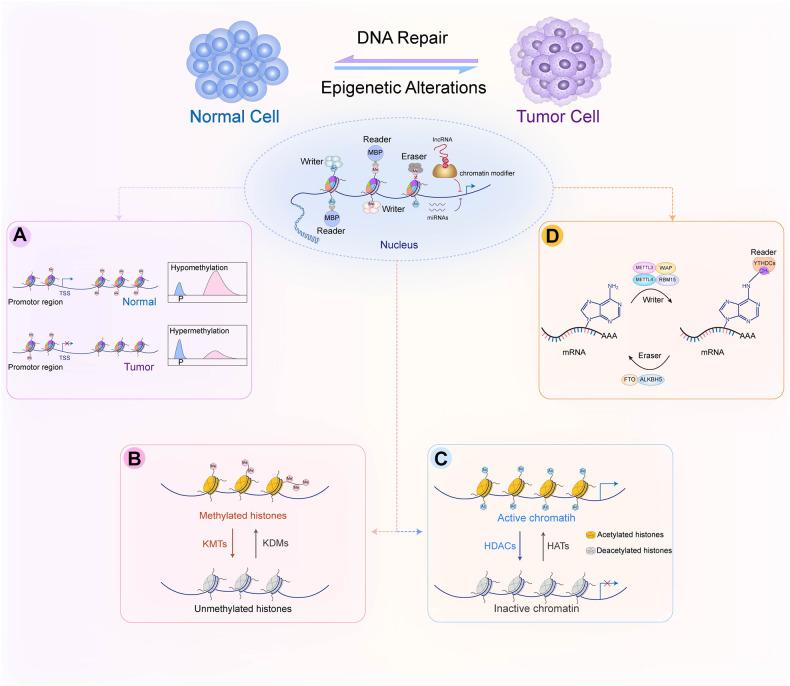
Epigenetic dysregulation is a common feature of a myriad of human diseases, particularly cancer. Defining the epigenetic defects associated with malignant tumors has become a focus of cancer research resulting in the gradual elucidation of cancer cell epigenetic regulation. In fact, most stages of tumor progression, including tumorigenesis, promotion, progression, and recurrence are accompanied by epigenetic alterations, some of which can be reversed by epigenetic drugs. The main objective of epigenetic therapy in the era of personalized precision medicine is to detect cancer biomarkers to improve risk assessment, diagnosis, and targeted treatment interventions. Rapid technological advancements streamlining the characterization of molecular epigenetic changes associated with cancers have propelled epigenetic drug research and development. This review summarizes the main mechanisms of epigenetic dysregulation and discusses past and present examples of epigenetic inhibitors in cancer diagnosis and treatment, with an emphasis on the development of epigenetic enzyme inhibitors or drugs. In the final part, the prospect of precise diagnosis and treatment is considered based on a better understanding of epigenetic abnormalities in cancer.
表观遗传失调是众多人类疾病(尤其是癌症)的一个共同特征。确定与恶性肿瘤相关的表观遗传缺陷已成为癌症研究的一个重点,从而逐渐阐明了癌细胞的表观遗传调控。事实上,肿瘤进展的大多数阶段,包括肿瘤发生、促进、进展和复发,都伴随着表观遗传改变,其中一些可以被表观遗传药物逆转。在个性化精准医学时代,表观遗传治疗的主要目标是检测癌症生物标志物,以改善风险评估、诊断和靶向治疗干预。简化与癌症相关的分子表观遗传变化特征的快速技术进步推动了表观遗传药物的研发。本综述总结了表观遗传失调的主要机制,并讨论了表观遗传抑制剂在癌症诊断和治疗中的过去和现在的例子,重点是表观遗传酶抑制剂或药物的开发。在最后一部分,基于对癌症表观遗传异常的更好理解,考虑了精准诊断和治疗的前景。

 Zotero 插件